
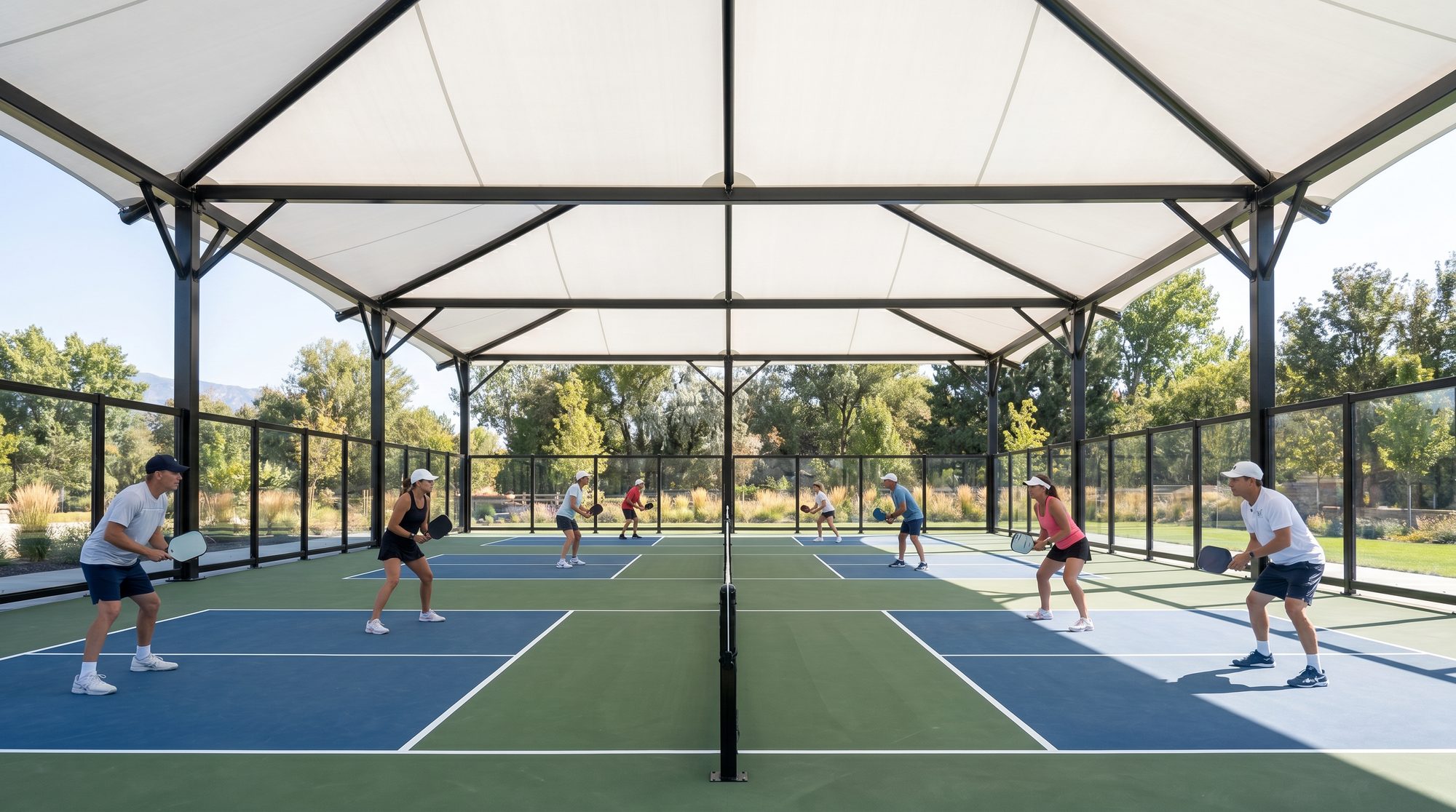
College pickleball courts are moving from an intramural side project to a planned line item on campus recreation and athletics master plans. Recreation departments are converting underused tennis courts, adding dedicated multi-court complexes near residence halls, and pairing pickleball with existing racquet programs. Athletics departments at a growing number of NCAA institutions are looking at club-varsity pathways as the sport becomes a viable roster.
If you are on a college campus recreation, capital planning, athletics, or facilities team and pickleball is now on your project list, this page walks through what a campus pickleball facility looks like, how it fits alongside existing racquet infrastructure, the site and noise considerations that get flagged in campus reviews, and what the cost and funding picture looks like at the higher-education scale.
This page is scoped to higher education only. K-12 school facilities are not part of PICKLETILE’s scope, so nothing on this page addresses primary or secondary school builds.
Why colleges are building pickleball courts now
Three drivers are pushing pickleball onto campus master plans in 2025 to 2026.
Student demand. Campus recreation surveys since 2023 have shown pickleball moving into the top three most-requested activities at most institutions, alongside strength training and group fitness. On many campuses it has replaced tennis in the top-five ranking. NIRSA (the national association for campus recreation) has published multiple sessions on capacity planning for pickleball at annual meetings.
Tennis court utilization. Older tennis courts at colleges are often underused, especially on campuses without a varsity or club tennis program pulling reserved time. Converting one or two of these to a multi-court pickleball layout (four to six pickleball courts fit on a standard tennis court footprint) turns a low-utilization asset into a high-utilization one, often for the cost of resurfacing plus striping and net posts.
Club and varsity growth. DUPR and USA Pickleball’s college initiatives, plus the emergence of the Collegiate Pickleball Championship, have created a competitive pathway. Institutions that want to field a competitive club or emerging varsity team need dedicated hitting time on regulation courts, which drives demand for at least one indoor facility on larger campuses.
Where campus pickleball courts get built
The four common site categories on a college campus are:
Existing outdoor tennis court conversion. The most common starting point. A standard tennis court (60 ft x 120 ft) fits four regulation pickleball courts with reasonable run-out, or six with tight spacing. Conversion is the cheapest and fastest option if the base and surface are in reasonable condition. See configuring tennis court to pickleball court conversions for the technical detail on conversion geometry.
Dedicated outdoor multi-court complex. New-build multi-court facilities are showing up on campuses with space near residence halls or the campus recreation center. A four to eight court complex with fencing, lighting, and shade structures gives the recreation program a signature facility and pulls players out of shared tennis time. See pickleball facility planning for how to size and lay out a multi-court complex.
Indoor courts in existing rec buildings. Multi-purpose gyms can be converted to pickleball time by taping temporary lines or installing permanent inlaid lines. Dedicated indoor pickleball courts inside campus recreation centers, with proper ceiling height (18 to 22 feet clear) and acoustic treatment, are the highest-utilization asset for cold-climate campuses. See indoor pickleball facility.
Under existing shade or covered structures. Some campuses are installing covered outdoor courts as a compromise between fully indoor and fully outdoor. This adds daytime shade, extends play into light rain, and reduces summer surface temperatures.
The K-12 line and why it matters
Some campus planning conversations will inevitably touch community access, city partnerships, or shared use with local school districts. To be clear on scope: PICKLETILE and this page address higher-education facilities only. K-12 school district facilities are outside PICKLETILE’s ICP because those projects have different design constraints, procurement channels, and safety requirements (age-specific fall zones, fencing spec, restricted access controls) that we do not build for.
If a college project has a community K-12 shared-use component, we can plan the college-owned facility to a standard that accommodates community use, but K-12 school district projects should be scoped to specialty builders in that lane.
Noise: the specific challenge on a campus
Pickleball noise is the number-one issue that stops or delays campus projects. A ball hitting a paddle produces a sharp impulse in the 700 to 1,100 Hz band that carries well outdoors and is measurable at 100 feet or more depending on wind and surroundings. On a college campus, three noise sensitivities usually come up:
Residence halls within 300 to 500 feet of the courts.
Academic buildings with windows facing the site (especially quiet study spaces and labs).
Neighboring residential properties, if the campus abuts a residential district.
Campus reviews often ask for a noise study before approving the site. That study typically compares the measured or modeled dBA at the nearest sensitive receiver against the applicable municipal noise ordinance and any campus-specific quiet-hours rules. See how loud is pickleball for the underlying acoustics, pickleball noise complaints for how complaints usually escalate, and pickleball noise regulations for a rundown of the ordinance landscape.
Mitigation options that work well on a campus site:
Site the courts more than 300 feet from residence hall windows if possible.
Orient the long axis of the courts to put player positions between the noise source and the sensitive receiver (a modest but real benefit).
Add a solid acoustic barrier or acoustic enclosure pickleball courts system on the side facing residences or classrooms. A well-designed acoustic barrier can drop dBA at the receiver by 10 to 15 dB.
For high-profile locations, spec PICKLEGLASS structural glass enclosures. Glass panels give real acoustic attenuation without blocking sightlines and are often the design choice for a signature campus facility.
Court surface: what campus rec programs specify
Campus recreation programs typically default to one of three surface systems:
Post-tensioned concrete with cushioned acrylic. The higher-tier standard. Post-tensioned slab minimizes cracking, cushioned acrylic gives players a comfortable and consistent bounce, and the surface lasts eight to twelve years before recoat. Used on new-build multi-court complexes at larger programs.
Standard reinforced concrete with acrylic color coat. Middle tier. Reliable, cheaper to build, slightly firmer under foot. Common on smaller campus builds and on conversions.
Modular tile. Interlocking modular tile over an existing concrete slab or over a properly prepared base. Faster install, lower-maintenance surface, forgives minor slab imperfections. Common on conversions where the base is sound but the top surface has aged.
See pickleball court surface options for the full comparison and pickleball court base for the substructure that these surfaces sit on.
Lighting and hours-of-play
Most campus courts run into the evening. Lighting extends the day and doubles utilization compared to daytime-only play. Standard specs:
30 to 50 foot-candles average illuminance on the playing area.
LED fixtures with a color temperature around 5000 K.
Pole heights of 20 to 22 feet for standard outdoor pickleball (not 30-plus feet like tennis, which drives glare and wasted lumens).
Uniformity ratio target of 2:1 maximum to average.
Full detail is in pickleball court lighting. Include lighting in the initial project scope, not as a phase-two add: pole foundations are much cheaper to include in the initial slab pour than to retrofit.
Fencing, wind, and campus context
Campus fencing decisions balance security, wind protection, and visual context. Chain-link fencing is the utility default and is fine for many campus sites. Higher-visibility campus locations (near the rec center entrance, along a main pedestrian route) often justify:
Vinyl-coated chain-link (typically black or dark green) for a cleaner visual read.
Windscreen panels along the prevailing wind side.
Architectural fencing or glass panels on the frontage facing the primary campus walkway.
See pickleball court fencing for the fence spec detail. For campus locations where the courts double as a signature amenity, PICKLEGLASS structural glass enclosures do the fencing job while also giving the site an architectural quality that a chain-link enclosure will not.
Cost, funding, and procurement
Cost. Rough planning ranges for a college multi-court build:
Tennis court conversion (four courts on one tennis court): about $30,000 to $85,000 total depending on surface condition, striping method, net posts, and whether new fencing is added.
New-build four-court outdoor complex with lighting and standard fencing: about $180,000 to $360,000.
New-build six-court outdoor complex with acoustic enclosure and premium surface: about $450,000 to $850,000.
Indoor four-court conversion inside an existing gym (permanent lines, portable nets, no structural work): $8,000 to $25,000.
See pickleball court cost for the underlying cost drivers. Institution size and site prep condition move these ranges significantly.
Funding. Higher-education pickleball projects usually draw from one of five funding sources:
Campus recreation fee reserves or student activity fee capital allocations.
Athletics capital budgets (if the project supports a club or emerging varsity program).
Alumni or donor gifts (naming opportunities work well on a signature multi-court complex).
Deferred maintenance funds redirected from an aging tennis court that is being converted.
Local, state, or federal recreational facility grants (see pickleball court grants for the grant landscape).
Procurement. Public universities typically go through a formal RFP or IFB process; private institutions have more procurement flexibility. In both cases we recommend specifying to the substrate level (base, drainage, surface system, fencing spec, lighting spec, acoustic treatment) rather than to a brand or a system name, so that competing bids can be evaluated on comparable terms.
Planning timeline
A realistic timeline for a new college pickleball facility, from decision to first play:
2 to 4 months: needs assessment, site selection, campus review sign-off (facilities, campus rec, noise/environmental review).
3 to 6 months: schematic design through construction documents, procurement (RFP), award.
3 to 5 months: site work, base, surface, fencing, lighting, enclosure. Weather-dependent for outdoor concrete work.
Conversions of existing tennis courts can move faster: as short as 6 to 10 weeks from decision if surface and base are in good condition.
What tends to go wrong on college projects
Three common failure patterns on campus pickleball builds:
Noise was not addressed in schematic design. Acoustic mitigation is expensive to retrofit and easy to plan in. Residence-hall proximity should drive the site decision, not the other way around.
Lighting was cut from the initial scope. Retrofitting light poles after the slab is poured costs three to five times more than including them from the start.
Fencing was value-engineered late in design. Cutting from vinyl-coated to bare galvanized chain-link is a small saving that shows up in every campus tour for the next fifteen years.
A campus category note
Campus pickleball courts are recreation infrastructure. They are used dawn to dusk, sometimes seven days a week, by a student population that expects the facility to work every time they show up. Building them as a checked-box amenity delivers a checked-box amenity. Building them as engineered infrastructure with the base, surface, lighting, fencing, and acoustic mitigation all planned together delivers a signature campus asset with a fifteen-year service life.
For the umbrella facility planning framework across all facility-segment types, see pickleball facility planning. For funding and grant paths, see pickleball court grants. For the business-case framing (utilization, revenue potential, and return on capital) that campus rec directors sometimes need to make the case for the project, see are pickleball courts profitable.
If you are scoping this work for your facility, an instant estimate will put real numbers behind the options discussed here, so scope, phasing, and budget can be weighed together.
Frequently asked questions
Are colleges building pickleball courts?
Yes, and at growing volume since 2023. Student demand, low-utilization tennis courts, and the emergence of club and emerging-varsity pickleball are the three main drivers.
How many pickleball courts fit on a college tennis court?
Four regulation pickleball courts fit on a standard tennis court footprint (60 ft x 120 ft) with reasonable run-out. Six pickleball courts fit with tighter spacing.
Do college pickleball courts need to meet regulation dimensions?
Yes for club, intramural competition, or emerging varsity play. Each court measures 20 ft by 44 ft with a total playing area (including run-out) of at least 34 ft by 64 ft.
Where do colleges typically build pickleball courts?
Common locations include converted outdoor tennis courts, dedicated outdoor multi-court complexes near residence halls or the campus recreation center, and indoor courts inside existing rec facilities.
What does noise mitigation cost on a campus pickleball facility?
Acoustic barrier walls or glass enclosure systems typically add $15,000 to $60,000 per court depending on the barrier height, material, and coverage. This is usually significantly cheaper than moving the courts after the project is built.
Do colleges get grants for pickleball courts?
Sometimes. Federal, state, and regional recreational facility grants occasionally apply, especially for community-access facilities. See pickleball court grants for the current grant landscape.
How long does a college pickleball court project take?
Tennis court conversions: 6 to 10 weeks if the base is sound. New-build multi-court complexes: 8 to 15 months from decision to first play, including campus review, design, procurement, and construction.
Are K-12 pickleball courts covered here?
No. This page addresses higher-education facilities only. K-12 school district projects have different design constraints and procurement channels and are outside PICKLETILE’s scope.
