
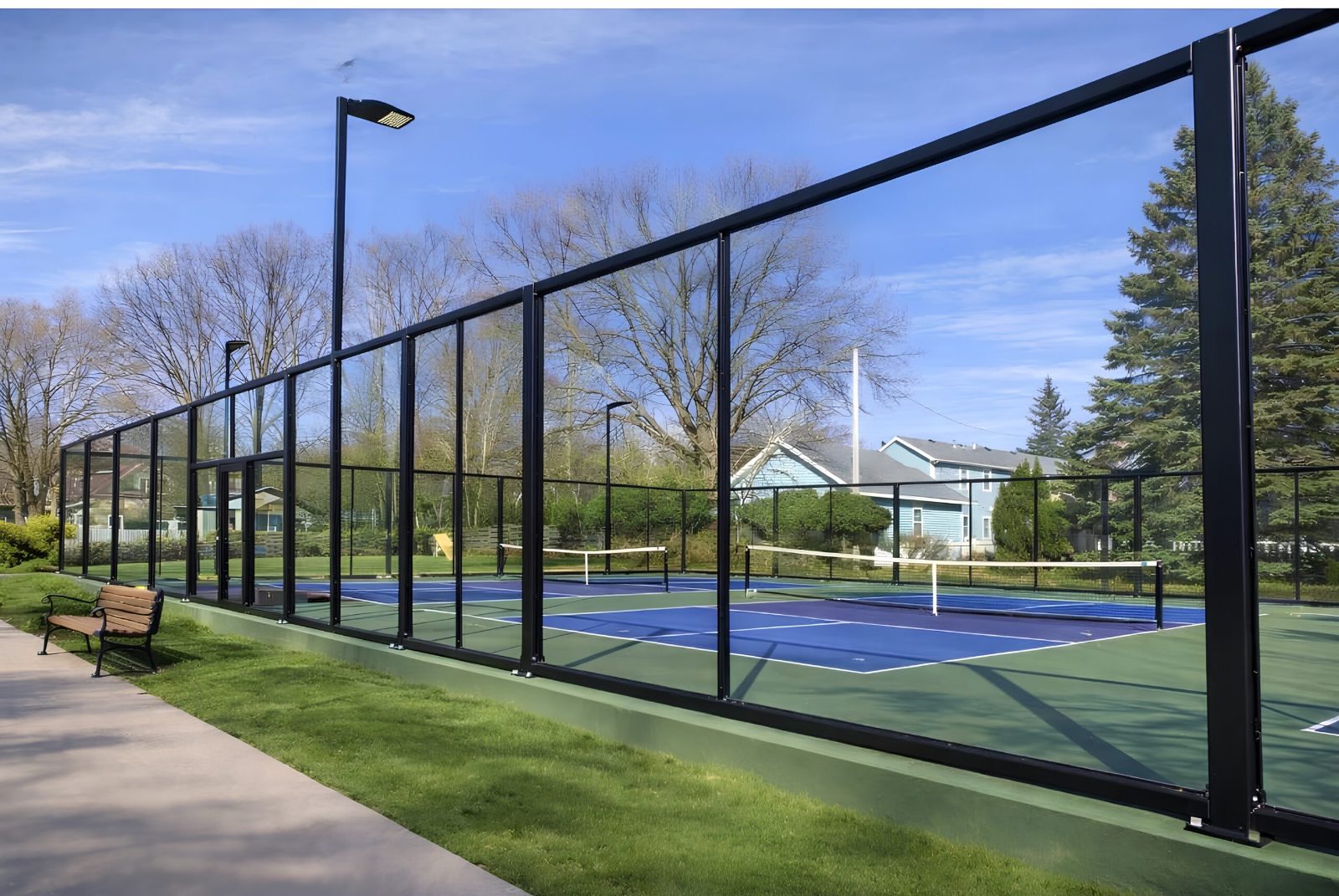
Across residential communities, the fastest-growing racquet sport has run into the same obstacle again and again: the neighbors. Pickleball noise complaints now delay, restrict, and in some cases shut down courts that were welcomed when they were proposed. The pattern is consistent enough that it has become the single largest barrier to new facility development, and it usually catches owners by surprise because the courts were built without anyone asking how they would sound from the house across the street.
This guide explains why pickleball generates complaints that tennis and most other court sports do not: what the sound actually is, how loud it is, how far it travels, and why the problem is acoustic rather than behavioral. Understanding the mechanism is the first step, because communities that treat noise as a design question (before complaints arrive) end up with very different outcomes than those that treat it as a dispute to manage afterward.
Why pickleball is so loud
The complaint is rarely about volume alone. It is about the kind of sound. Every shot produces a sharp, high-pitched “pop” as a hard paddle strikes a hard plastic ball. Measured from a typical residential distance, that pop often lands in the range of 70 decibels, and considerably higher close to the court.
Two characteristics make it carry and grate in a way steady noise does not:
- It is impulsive. The sound is a sudden percussive crack, not a continuous hum. Human hearing (and most noise ordinances) treat sharp, repetitive impulses as far more intrusive than steady sound at the same average level.
- It is relentless. A single doubles game produces a pop roughly every second, and a multi-court complex layers dozens of them on top of each other for hours. The brain locks onto the pattern and cannot tune it out.
The frequency of the pop also sits squarely in the range the human ear is most sensitive to, which is why it cuts through other ambient noise and reaches ears indoors that would never notice traffic or wind.
How pickleball noise compares to tennis
Communities often assume a pickleball court will sound like the tennis court it replaced. It does not. A tennis ball striking a strung racquet produces a lower, softer, more muffled “thock,” and points have long gaps between hits. Pickleball’s paddle-and-ball impact is louder, higher-pitched, and far more frequent. Converting one tennis court to several pickleball courts (a common and otherwise sensible move) can multiply both the loudness and the repetition several times over on the same footprint, which is exactly when previously quiet neighbors begin to object.
How far the sound travels, and why setbacks alone rarely solve it
Sound falls off with distance, but the impulsive pop carries farther than people expect. Complaints are common when courts sit within roughly 100 to 200 feet of homes, and on quiet sites they can reach considerably farther. Distance helps, but raw setback is a blunt instrument: most sites do not have hundreds of feet to spare, and even where they do, distance alone does nothing for the homes that are close.
This is why the durable solutions are acoustic, not just spatial. The sound has to be absorbed or blocked between the court and the listener, which depends on the mass, height, placement, and material of whatever sits in the path. A standard chain-link fence does effectively nothing for sound; it was designed for containment, not acoustics. Engineered acoustic barriers and enclosure systems are designed to attenuate the specific frequencies pickleball produces, and their performance is measured (for example, by sound transmission ratings) rather than assumed.
What happens when noise is not planned for
The cost of treating acoustics as an afterthought is tangible and well documented across communities:
- Restricted hours that cut a facility’s usable time, often eliminating the early-morning and evening play that members value most.
- Legal disputes between facilities, HOAs, and neighbors that are expensive, slow, and damaging to community relationships.
- Moratoriums and denied permits as municipalities react to complaints by pausing or blocking new court development entirely.
- Closures of courts that were built and paid for but could not coexist with the homes around them.
Every one of these outcomes is more expensive than the acoustic planning that would have prevented it, and most of them cannot be fully undone once construction is complete.
Noise is an infrastructure problem, not a complaint to manage
The instinct, once complaints start, is to manage them: post quiet hours, ask players to use softer equipment, respond to each grievance as it comes. Those measures help at the margins, but they treat the symptom. The underlying issue is that the facility was built without engineering for the one thing most likely to determine whether it survives in its neighborhood.
A facility planned as infrastructure addresses sound during design, when an acoustic assessment of the site, the surrounding homes, and the enclosure system still costs a fraction of what a retrofit (or a lawsuit) costs later. That is the difference between a court that generates complaints and one that was engineered so the complaints never start. PICKLETILE developed PICKLEGLASS, an acoustic-rated structural glass enclosure system, specifically to address pickleball’s acoustic signature while integrating cleanly into residential and architectural settings, and the broader set of design strategies for managing sound is covered in our guide to pickleball noise reduction.
The communities seeing the best outcomes are not the ones with the strictest quiet hours. They are the ones that asked how the courts would sound before they were built.
Frequently asked questions
Why are pickleball courts so noisy?
Each shot produces a sharp, high-pitched pop as a hard paddle hits a hard plastic ball, often around 70 decibels at a residential distance and louder up close. The sound is impulsive (a sudden crack rather than steady noise) and relentless, repeating roughly once a second per game, and it sits in the frequency range human hearing is most sensitive to. That combination makes it far more intrusive than its average volume alone would suggest.
How loud is pickleball compared to tennis?
Pickleball is louder, higher-pitched, and much more frequent. A tennis ball on a strung racquet makes a lower, softer thock with long gaps between hits, while pickleball’s paddle-and-ball impact produces a sharp pop about once a second. Converting one tennis court into several pickleball courts can multiply both the loudness and the repetition on the same footprint.
How far away can you hear a pickleball court?
The impulsive pop carries farther than people expect. Complaints are common when courts are within roughly 100 to 200 feet of homes, and on quiet sites the sound can reach considerably farther. Because distance alone rarely solves the problem, durable solutions absorb or block the sound between the court and the listener.
What can be done about pickleball noise complaints?
The most effective approach is acoustic planning during design: assessing the site and surrounding homes and using engineered acoustic barriers or enclosure systems that attenuate pickleball’s specific frequencies. Standard chain-link fencing does almost nothing for sound. Measures like restricted hours and quieter equipment help at the margins but treat the symptom rather than the cause.
