
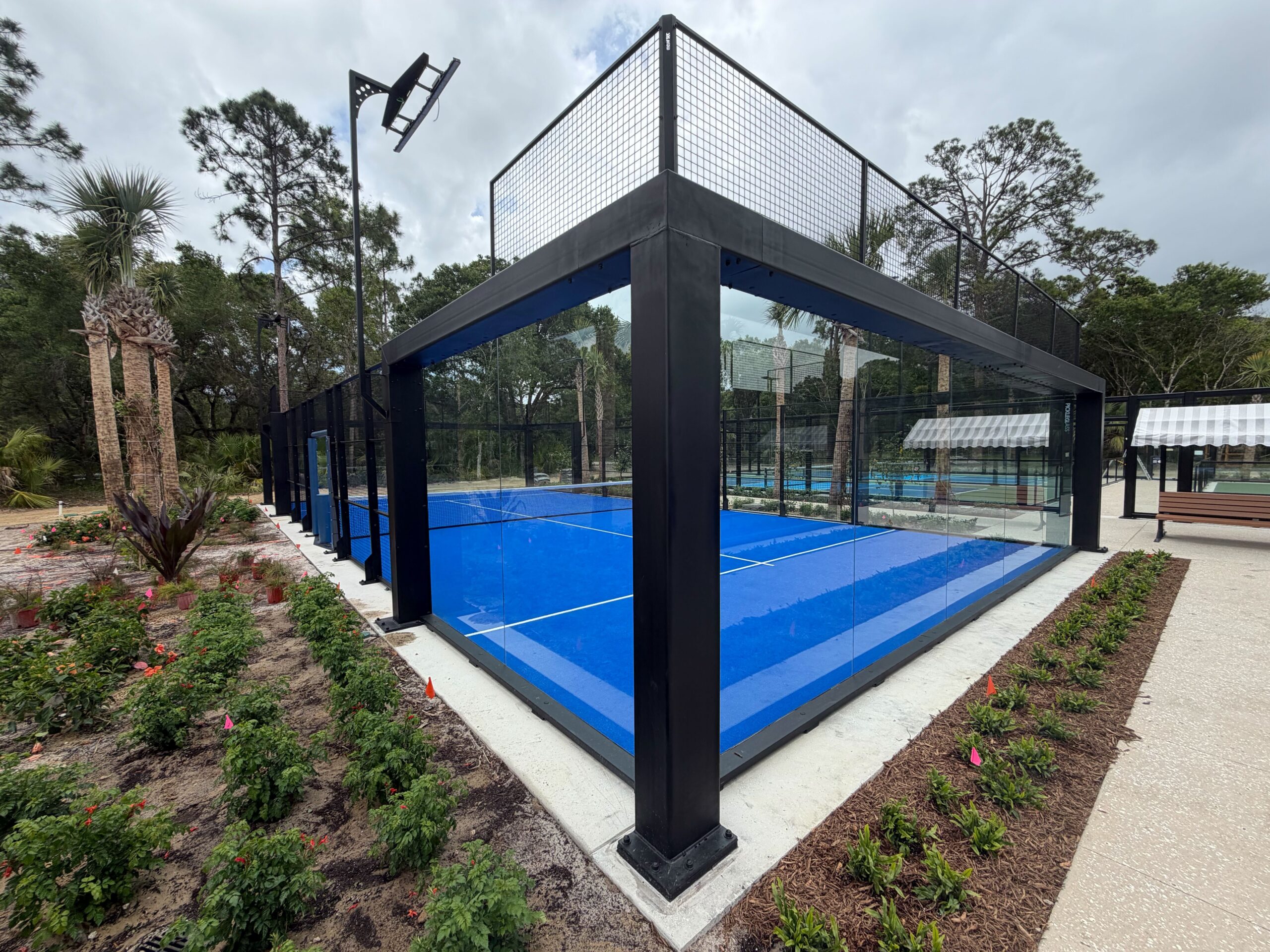
Padel court walls are structural: they are not a fence around the court, they are part of the court. A regulation padel court measures 20 meters by 10 meters and is enclosed on all four sides by a combination of tempered glass panels and metal mesh. Balls bounce off the walls in active play, so the enclosure has to hold its geometry under repeated ball impact, wind loads, and player collisions.
If you are planning a padel facility, whether one court at a club or a six-court complex at a resort, the walls are the single biggest design decision after the court base. This page walks through what regulation calls for, what the glass and steel spec looks like in practice, how the walls are anchored, and what separates a padel enclosure engineered for a commercial multi-court facility from a lower-tier kit imported from an unproven overseas supplier.
What padel court walls have to do
Padel rules are simple to state and precise to build to. The court is enclosed. Balls can rebound off the back walls, corner walls, and (partially) the side walls, and remain in play. Every wall dimension, every glass thickness, and every steel-frame connection has to hold up to that rebound behavior for years without deflection, cracking, or hardware fatigue.
The World Padel Tour, the International Padel Federation (FIP), and most municipal recreation departments treat FIP dimensions as the reference. That means:
20 meters long by 10 meters wide (about 65.6 ft by 32.8 ft) inside the enclosure.
Back walls 3 meters tall (glass), with an additional 1 meter of metal mesh above (total 4 meters at the ends).
Side walls stepped: 3 meters of glass and mesh at the ends, dropping to 2 meters of mesh along the middle of each side.
Player access openings in the side walls, typically 0.72 to 1.02 meters wide, centered on each side.
These are minimums for competitive play. Recreational courts sometimes go slightly outside these numbers, but any commercial facility that wants to host club tournaments, league play, or a resident pro should build to FIP specs.
Glass: what thickness, what temper, what edge
Padel walls use tempered safety glass. The thickness is nearly always 10 millimeters (about 3/8 inch) for regulation walls. Some builders spec 12 mm for outdoor or high-traffic sites, and a very small number of low-cost kits go down to 8 mm, which we do not recommend for any commercial facility.
Tempered glass matters for two reasons. First, the surface compression makes the panel four to five times stronger in impact than annealed glass of the same thickness. Second, if it does fail, tempered glass fractures into small blunt pebbles rather than long sharp shards. Both properties are non-negotiable on a court where players and spectators sit inches from the panels.
Edges are polished (flat-polished or arris) and the corners are typically radiused to reduce stress concentrations at the mounting points. Panels are pre-drilled at the factory for point-fixings; field drilling of tempered glass is impossible without re-annealing, so the frame and the drilling pattern have to be coordinated before fabrication starts.
Structural steel frame
The glass sits inside a steel frame, either hot-dip galvanized or powder-coated after galvanization. The frame does the structural work; the glass provides the playing surface.
Typical frame specs on a commercially built padel court:
Vertical posts every 2 meters along the wall run, either 80×80 mm or 100×100 mm hollow structural steel section, 3 to 4 mm wall thickness.
Horizontal rails top and bottom of each panel course.
Cross-bracing at the corners and above the entry gates to resist rebound and wind loading.
Metal mesh (typically 50 mm x 50 mm grid, 4 mm galvanized wire) in the mesh sections, welded into steel sub-frames.
Galvanization is important for outdoor courts and for indoor courts in humid or coastal environments. A powder-coated finish over the galvanization gives a longer service life on the visible steel and lets the operator match a club palette (usually dark green, black, or gunmetal grey to keep the ball readable against the frame).
Point-fixings and glass mounting
Glass panels attach to the frame with stainless steel point-fixings. These are round mounts that pass through the pre-drilled holes in the panel and clamp the glass between two gaskets so that no steel touches glass directly. The gaskets absorb thermal expansion and small structural movement, and they distribute the impact load across the glass around the hole.
Two point-fixings on each vertical edge (four per panel) is the minimum. Corner panels and gate-adjacent panels sometimes carry additional fixings for stiffness. The gasket material (typically EPDM or a UV-stable equivalent) has to survive outdoor cycling if the court is uncovered.
Silicone-bonded systems exist in some low-cost kits and we do not specify them for a commercial facility. Silicone loses adhesive strength under repeated ball impact and UV. Point-fixings are the standard for any commercial court that expects to be in service more than five years.
Anchoring the walls into the court base
The wall system is only as strong as its anchorage. Base plates at the foot of every vertical post are welded or bolted to the post and then anchored into the concrete slab with cast-in anchor bolts or post-installed mechanical anchors.
We recommend cast-in anchor bolts placed during the slab pour. This is why padel court base has to be planned before the enclosure is ordered: the anchor pattern is determined by the wall frame, and it needs to be cast into the slab, not drilled in afterward. Cast-in bolts distribute load into the reinforcement and post-tensioning of the slab; post-installed anchors depend on concrete embedment depth and edge distance, and are more sensitive to slab cracking.
For a full spec on the base and how the enclosure loads travel into it, see pickleball court base (foundation principles carry across sports; padel adds the enclosure anchor pattern on top).
Indoor versus outdoor design
Indoor and outdoor padel enclosures use the same regulation dimensions but different structural allowances.
Outdoor. Design for wind. Local building code will specify a wind speed for the site, and the frame has to resist that load with the glass panels acting as a solid wall (they are not perforated). We generally see 90 to 130 mph design wind speeds for outdoor padel in most of the continental US, with higher requirements in coastal Florida, coastal Texas, and the Carolinas. Frame sections and anchor patterns get heavier in higher-wind zones.
Indoor. Wind is not the driver; ball impact and player collision are. Frame sections can be lighter, but glass thickness stays the same (10 mm is the regulation, not a wind requirement). Indoor courts do gain the option of a lighter perimeter mesh, though FIP-compliant courts stick to the standard mesh grid regardless.
For indoor multi-court facilities, plan the wall shared between two adjacent courts as a single structural line. Two courts sharing a common back wall save steel and glass and give players a cleaner sight-line down the row. This is standard on European multi-court builds and we recommend it here as well.
Player access, gates, and entry design
Every padel court needs at least one entry, and most have two (one per side). Entry openings are typically 0.72 to 1.02 meters wide, hinged with concealed hinges to keep the frame profile inside the court flush. Latches are recessed. Handles on the outside of the gate are common; the inside is usually kept smooth so a diving player does not catch on hardware.
Gate placement affects the flow between courts on a multi-court site. On a bank of four to six courts, the gates typically face a common walkway with the umpire chairs and spectator seating on the outside of the enclosures. Sight lines from a shared spectator area into multiple courts are worth planning at the site layout stage.
Wall lifespan and maintenance
A properly specified padel enclosure should last 15 to 20 years of daily use with routine maintenance. Glass panels almost never need replacement unless a ball is hit into a fitting at an unusual angle or a panel is struck by an object during construction on the site.
Routine wall maintenance is short:
Wipe the glass on both sides every few weeks. Standard glass cleaner, no ammonia on tinted panels.
Inspect the point-fixing gaskets annually; replace any that show cracking or UV degradation.
Tighten anchor bolts and post-frame connections on a two-year cycle.
Touch up powder-coat scratches with a matching enamel to protect the underlying galvanization.
Full wall replacement is rare in the first two decades. Retensioning of the frame connections is more common, and it costs a small fraction of a full rebuild if it is caught early.
What to check when specifying a padel enclosure
Before ordering an enclosure system, we recommend confirming the following in writing from the supplier:
Glass: 10 mm tempered safety glass, factory-drilled for point-fixings, edges polished, corners radiused. Certification to EN 12150 (or equivalent US standard for tempered safety glass) on file.
Steel: hot-dip galvanized to ASTM A123 (or the international equivalent), with sections and wall thicknesses stated in the shop drawings.
Mesh: welded galvanized wire, grid size stated, sub-frames stated.
Anchor pattern: shop drawing coordinated with the base slab drawings. Anchor bolts specified as cast-in unless the site cannot accommodate them.
Wind design: the design wind speed and the applicable building code cycle stated on the shop drawings, matching the local jurisdiction.
Compliance: FIP-compliant dimensions and hardware placement, with a compliance letter from the supplier.
Bidding a padel enclosure without those items on the drawings is how facilities end up with a wall system that flexes visibly under ball impact, hardware that loosens in the first year, or panels that shatter on a modest strike because the temper spec was quietly reduced.
Cost context
Padel enclosure systems for a single regulation court typically run in a wide range depending on glass and steel spec, mesh quality, and whether you are buying a kit or a fully engineered system installed by a padel contractor.
Rough planning ranges for the enclosure alone (excluding base, surface, lighting):
Entry-level imported kit: about $18,000 to $25,000 per court, delivered.
Mid-tier commercial: about $28,000 to $45,000 per court, installed.
Fully engineered commercial (heavier steel, higher wind design, US-fabricated): about $45,000 to $75,000 per court, installed.
For a full padel court budget including base, surface, and enclosure, see padel court cost. For the enclosure alone, the specification bullets above matter more than the price line: two courts at the same price can have very different service lives if one has 12 mm glass on a heavier frame and the other has 8 mm glass on a lighter one.
A category note
Padel is a walled sport by rule. That makes the walls part of the game, not a fence around it. Everything in this page treats the enclosure as engineered infrastructure with a design life measured in decades, not a kit that ships from a container port. PICKLETILE and PICKLEGLASS were built on that same premise for pickleball glass enclosures. For padel, the specifications above are the baseline for a facility that plans to still be operating in 2040.
For the umbrella product page covering PICKLEGLASS structural glass enclosures across sports, see PICKLEGLASS. For how the enclosure loads travel into the slab, see pickleball court base. For the base and surface companion decisions on a padel court, see padel court base and padel court surfaces.
If you are scoping this work for your facility, an instant estimate will put real numbers behind the options discussed here, so scope, phasing, and budget can be weighed together.
Frequently asked questions
How thick is padel court glass?
Regulation padel court walls use 10 mm (about 3/8 inch) tempered safety glass. Some outdoor or heavy-use installations spec 12 mm. Kits with 8 mm glass are not recommended for commercial facilities.
How tall are padel court walls?
Back walls are 3 meters of glass plus 1 meter of mesh above, for a total height of 4 meters at the ends. Side walls step down to 2 meters of mesh through the middle section of each side.
Do padel walls need to be tempered glass?
Yes. Tempered safety glass is standard for regulation padel courts. It resists ball impact and, in the rare event of failure, breaks into small blunt pebbles rather than sharp shards.
How are padel court walls attached to the concrete slab?
Vertical steel posts sit on base plates, which are anchored to the slab with cast-in anchor bolts (preferred) or post-installed mechanical anchors. Anchor bolts should be planned with the base slab and cast in during the pour.
Can padel walls be moved after installation?
Not easily. The anchor pattern is designed for a specific court footprint and the steel frame is fabricated to match. Moving a court usually means dismantling the enclosure and re-anchoring on the new footprint.
How long do padel court walls last?
A properly specified enclosure should last 15 to 20 years of daily use with routine maintenance (annual gasket check, biannual frame retensioning, powder-coat touch-ups).
Are the walls the same for indoor and outdoor courts?
Dimensions are identical (FIP regulation is the same). Structural spec differs: outdoor courts design for local wind loads, indoor courts focus on impact and player collision. Frame sections and anchor patterns get heavier in higher-wind zones.
