
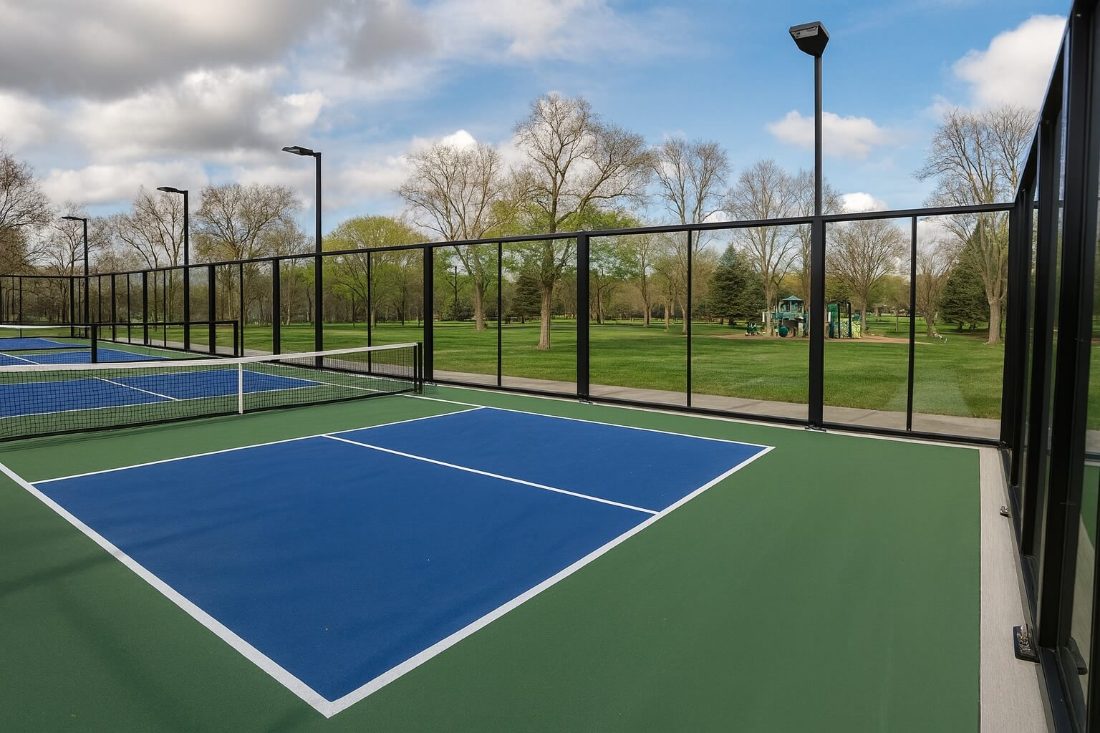
A pickleball impact is loud at the paddle and surprisingly persistent at a distance. Measured right at the point of contact, the sharp pop of a hard paddle striking a hard plastic ball peaks in the range of about 99 to 106 decibels. At a more typical residential distance of around 100 feet, a hard hit commonly registers near 70 dBA, while the same measurement for tennis sits closer to 40 dBA. Averaged across a whole match, with lighter touch shots and the silences between rallies included, the level settles to roughly 59 dBA. For comparison, a quiet residential neighborhood typically runs between 40 and 55 dBA in the background.
Those are the headline numbers, and they are the right place to start. But the decibel figure alone does not explain why pickleball generates the reaction it does, and anyone using these numbers to evaluate a site or write an ordinance needs the rest of the picture: how the sound is measured, why a single average understates it, the specific frequency that makes it carry, and how far it actually travels. This guide covers all of that, with the sources the figures come from.
How pickleball noise is measured, and why one number misleads
Sound is reported in decibels, almost always on the A-weighted scale written as dBA, which adjusts the measurement to match how human hearing responds across frequencies. The catch is that a single dBA reading depends entirely on two things people often leave out: how far the meter was from the court, and whether it captured the peak of an impact or an average over time.
That is why published pickleball figures vary so widely. A reading taken at the paddle captures the impact peak, which is why source measurements reach into the 99 to 106 dB range. A reading at 15 feet commonly lands around 70 to 80 dBA. A reading at 100 feet falls again, often near 70 dBA for a hard hit and lower for ordinary play. And an average taken across a full match, rather than at the instant of contact, drops to the high 50s because it folds in the quiet moments between shots. None of these numbers is wrong. They are answering different questions, and comparing a source peak to a match average is the most common error in the noise debate.
There is a deeper reason the average misleads. The pickleball impact is an impulsive sound, a sudden crack lasting only about 10 to 20 milliseconds, rather than a steady hum. Human hearing, and most noise ordinances, treat sharp repetitive impulses as far more intrusive than continuous sound at the same average level. A meter that reports a calm-sounding match average can sit right next to a resident who experiences the same court as a relentless series of pops. Both readings are accurate. Only one reflects the complaint.
It is not just how loud, it is what kind of sound
The most important finding in the acoustic research is that pickleball’s problem is its frequency signature, not raw volume. When the paddle strikes the ball, the impact radiates most of its energy near 1,000 Hz, with a distinct tonal component around 1,200 to 1,250 Hz. Acoustic analysis attributes that tone to a strongly radiating membrane-type vibration mode of the paddle face. This work has been documented by researchers including Daniel A. Russell and published through the Acoustical Society of America.
Two things follow from that frequency. First, roughly 1.2 kHz sits squarely in the range where human hearing is most sensitive, close to the pitch of the warning beep on a truck backing up. The ear is tuned to notice it, which is exactly why it cuts through other ambient noise and reaches indoors when traffic and wind do not. Second, because the offending sound is a specific high-frequency tone, it can be engineered against directly. This is the principle behind the quiet-equipment category: paddles certified under USA Pickleball’s Quiet Category are designed to shift the impact sound lower, below roughly 480 to 600 Hz, moving it out of the most sensitive and most carrying part of the spectrum. The first certified quiet paddle is reported to cut perceived noise by about half, and add-on dampening pads claim similar reductions on existing paddles.
The reframe matters for anyone planning a facility. The question is not simply how many decibels a court produces. It is what kind of sound it produces and whether the facility was designed to manage that specific signature. A court evaluated on its average decibel level alone will look acceptable on paper and still generate complaints, because the average hides the impulsive, high-frequency character that the neighbors actually hear.
The numbers in context: distance, comparison, and what changes them
The table below gathers the commonly cited figures. Treat them as ranges that depend on distance, paddle and ball, and the specific court, not as fixed constants.
| Measurement point | Approximate level | Notes |
|---|---|---|
| Impact at the paddle (source peak) | 99 to 106 dB | The crack of contact itself, measured at the source |
| About 15 feet from the court | 70 to 80 dBA | Close-range play, near courtside seating |
| About 100 feet (hard hit) | ~70 dBA | Tennis at a comparable distance is closer to 40 dBA |
| Match average over time | ~59 dBA | Includes soft shots and silences between rallies |
| Background, quiet neighborhood | 40 to 55 dBA | The level pickleball is compared against |
Distance helps, but the impulsive pop carries farther than people expect. Complaints are common when courts sit within roughly 100 to 200 feet of homes, and on quiet open sites the sound can be noticed considerably farther out, which is why some siting guidance treats several hundred feet of separation as the point where most complaints fall away. Distance alone is a blunt instrument, though. Most sites do not have hundreds of open feet to spare, and separation does nothing for the homes that are already close.
What reliably changes the experience is acoustic treatment between the court and the listener, combined with quieter equipment. A standard chain-link fence does effectively nothing for sound, because it was designed for containment rather than acoustics. Engineered acoustic barriers and enclosure systems are designed to attenuate the specific frequencies pickleball produces, and their performance is measured rather than assumed. Quiet-category paddles and softer balls reduce the sound at its source. Municipal ordinances, for their part, usually regulate by setting a dBA limit measured at the property line, which is why the measurement distance written into an ordinance matters as much as the number itself. The practical playbook for reducing the sound is covered in our guide to pickleball noise reduction, the way these figures turn into neighbor complaints is covered in understanding pickleball noise complaints, and the way jurisdictions write and measure limits is covered in pickleball noise ordinances.
The real question behind the decibel number
People search for how loud pickleball is because they are really asking one of two things: will this court be a problem, or is this court already a problem. The decibel figure is the start of that answer, not the end of it. The honest version is that pickleball is moderately loud by raw measurement, comparable in average level to many everyday activities, but its impulsive, high-pitched, repetitive signature makes it far more intrusive than the average number suggests, and it carries into homes that distance alone will not protect.
That is why the durable answer is acoustic, not numerical. A facility that is assessed for its sound during design, and built with enclosure and siting that address pickleball’s specific frequency, produces a very different lived experience than one that was measured after the fact and found to be within some average limit. PICKLETILE developed PICKLEGLASS, an acoustic-rated structural glass enclosure system, to attenuate pickleball’s acoustic signature while keeping open sightlines and integrating cleanly into residential and architectural settings, and the broader set of acoustic enclosure options compares the approaches. The decibel reading tells you how loud the court is. Whether that loudness becomes a complaint is decided by how the facility was engineered.
Frequently asked questions
How many decibels is pickleball?
At the paddle, the impact peaks at roughly 99 to 106 decibels. At about 15 feet it commonly measures 70 to 80 dBA, and at around 100 feet a hard hit registers near 70 dBA, compared with closer to 40 dBA for tennis at a similar distance. Averaged across a full match, including soft shots and the gaps between rallies, the level is about 59 dBA. The figure you cite depends heavily on the measurement distance and on whether it captures the impact peak or a time average.
How far away can you hear pickleball?
Farther than most people expect, because the impulsive pop carries well. Complaints are common when courts are within roughly 100 to 200 feet of homes, and on quiet open sites the sound can be noticed several hundred feet out. Some siting guidance treats a few hundred feet of separation as the distance where most complaints fall away, but separation alone does nothing for homes that are already close, which is why acoustic treatment usually matters more than distance.
Why does pickleball sound louder than tennis?
Because of frequency and rhythm, not just volume. A pickleball impact radiates most of its energy near 1,000 Hz with a tonal component around 1,200 to 1,250 Hz, a high pitch that sits in the most sensitive range of human hearing and is close to the beep of a truck backing up. Tennis produces a lower, softer, more muffled sound with long gaps between hits, while pickleball delivers a sharp pop about once a second. The pitch makes it carry, and the repetition makes the ear lock onto it.
Do quiet pickleball paddles work?
They reduce the most intrusive part of the sound. Paddles certified under USA Pickleball’s Quiet Category are engineered to shift the impact frequency lower, below roughly 480 to 600 Hz, moving it out of the range that carries and grates the most. The first certified quiet paddle is reported to cut perceived noise by about half, and add-on dampening pads claim similar reductions on existing paddles. Quieter equipment helps at the source, and it is most effective when combined with acoustic enclosure and sensible siting.
Is pickleball loud enough to be a real problem for neighbors?
It can be, and the average decibel level understates why. The sound is impulsive and high-pitched, and both human hearing and most noise ordinances treat sharp repetitive impulses as more intrusive than steady sound at the same average level. A court can measure within an acceptable average and still generate complaints because the neighbors hear the individual pops, not the average. This is why facilities near homes are most reliably assessed for sound during design rather than after complaints arise.
