
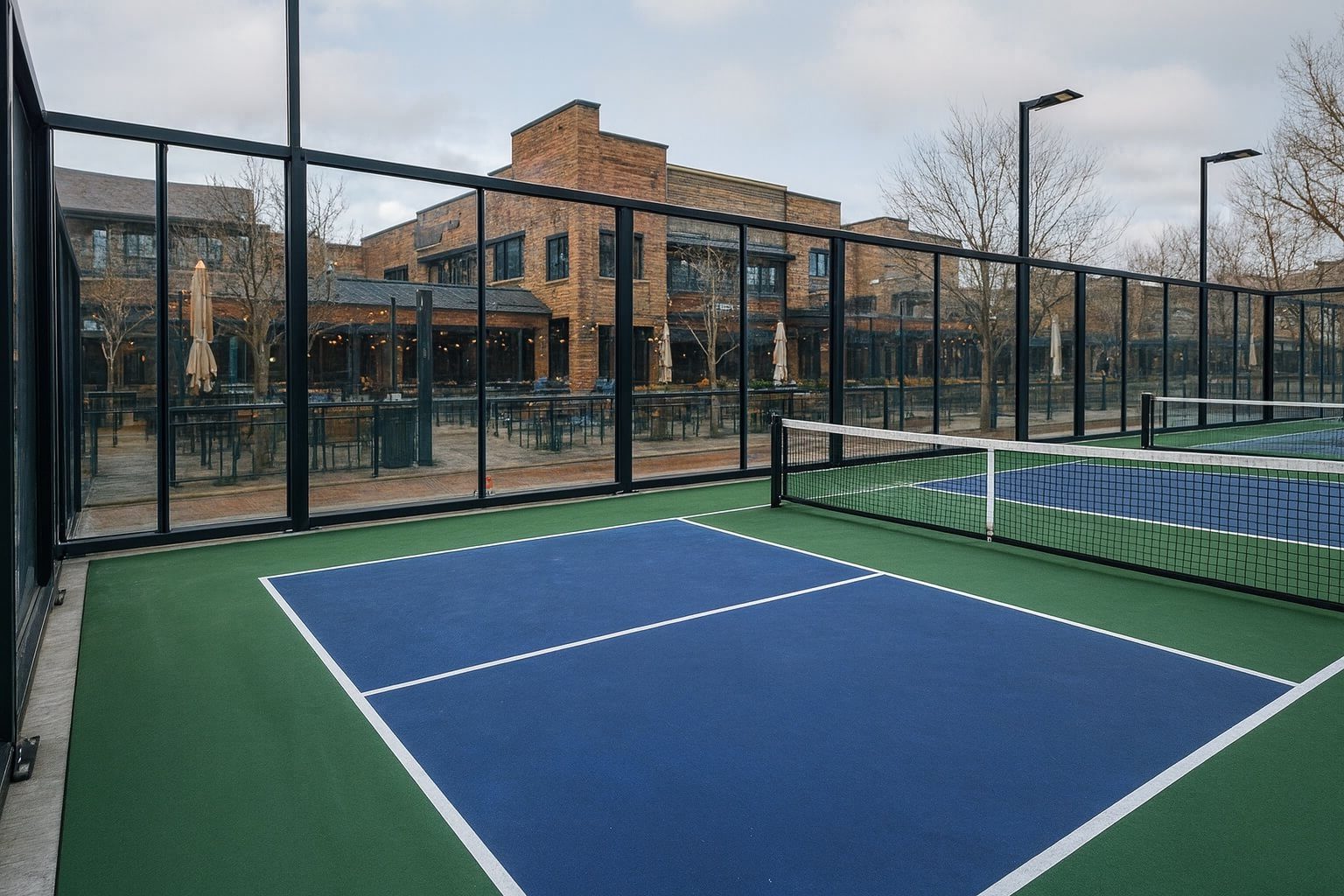
The base is the part of a pickleball court nobody sees and the part that decides how the court performs for the next twenty years. Every surface system, from acrylic coatings to cushioned overlays, transfers its loads into the slab or asphalt mat beneath it. When a court cracks, ponds water, or delaminates early, the cause is almost always in the base, not the surface. This guide covers how a pickleball court base is built: subgrade preparation, stone base, concrete and asphalt options, slab specifications, drainage, and what each approach means for cost and lifespan.
The three layers under every court
A properly engineered outdoor pickleball court is built as a stack of three layers, each with its own job.
Subgrade. The native soil, cut or filled to rough grade and compacted. The subgrade carries everything above it. Expansive clays, organic soils, and poorly compacted fill are the leading causes of slab movement and long diagonal cracking. On multi-court projects, a geotechnical review of the subgrade is standard practice before design.
Aggregate base. A layer of crushed stone, typically 4 to 6 inches, placed and compacted over the subgrade. The stone base distributes loads, provides a uniform bearing surface, and creates a capillary break that keeps ground moisture from migrating into the slab.
Structural base. The concrete slab or asphalt mat that becomes the court itself. The finished playing surface is applied on top of this layer.
Concrete base: the specification most facilities choose
Post-tensioned or reinforced concrete is the base most commonly specified for club, resort, and municipal courts because it offers the longest service life and the flattest, most stable platform for acrylic surfacing.
Typical specifications for a concrete pickleball court base:
| Element | Common specification |
|---|---|
| Slab thickness | 4 to 5 inches (5 to 6 inches for vehicle-accessible or freeze-thaw sites) |
| Concrete strength | 3,000 to 4,000 PSI |
| Reinforcement | Welded wire mesh, rebar grid, or post-tensioned cables |
| Finish | Medium broom or fine float, no steel trowel (surface must accept acrylic bond) |
| Slope | 0.83% to 1% in one plane, side to side or end to end |
| Vapor control | Vapor barrier over the stone base where site moisture requires it |
| Cure before surfacing | Typically 28 days before acrylic application |
Post-tensioned slabs deserve a specific mention. Steel cables run through the slab in both directions and are tensioned after the concrete cures, placing the entire slab in compression. A post-tensioned slab resists the shrinkage and settlement cracking that plagues conventional slabs, can be poured in larger panels with fewer joints, and performs well on marginal soils. For multi-court pours, post-tensioning is frequently the difference between a monolithic, joint-free playing field and a grid of panels with maintenance-prone joints. It carries a cost premium over mesh-reinforced concrete, and on stable soils a well-jointed reinforced slab remains a sound choice.
Joints matter for play. Saw-cut control joints and expansion joints must be planned around court layout so that joints do not cross critical play areas where possible, and joint filler must be compatible with the surfacing system. This is a design task, not a field improvisation.
What concrete finish does a pickleball court need?
A pickleball court slab is finished with a medium broom or a fine float, never a hard steel trowel. The finish is a bonding decision before it is a playing decision: acrylic color coatings key into a slightly open, uniformly textured surface, and a burnished steel-trowel finish closes the concrete so tightly that the coating has little to grip.
Why steel trowel fails. Steel troweling densifies and seals the top few millimeters of the slab. The result is a smooth, low-porosity surface that sheds the acrylic primer and resurfacer rather than absorbing them. Coating failures that show up as peeling or blistering in the first few seasons are frequently traced back to an over-troweled slab rather than to the coating itself.
What to specify instead. A medium broom finish, pulled in one consistent direction across the full court, gives a uniform texture that accepts the acrylic system without telegraphing through the finished surface. A fine float finish is the alternative where a lighter texture is wanted. Either way the requirement is consistency, because patchy texture produces patchy coating thickness, and that shows up later as color variation and uneven wear.
Finish is not the playing surface. Ball bounce and pace on a finished court come from the acrylic system applied on top, not from the concrete texture underneath. The concrete finish has one job, which is to hold that system for its full service life.
Coordinate the finish with slope and cure. The broom pass happens while the slab is still plastic, so the 0.83% to 1% slope and the joint layout have to be set before it. Surfacing then waits on the cure, typically about 28 days, before the first coat goes down.
Asphalt base: lower first cost, shorter cycle
Asphalt remains common, particularly on park and recreation projects, and many tennis facilities converting to pickleball already sit on asphalt. A typical section is 2 to 3 inches of asphalt in one or two lifts over 4 to 6 inches of compacted aggregate.
Asphalt’s advantages are speed and first cost: it is faster to place and usually less expensive than concrete. Its tradeoffs are structural. Asphalt is a flexible pavement that oxidizes and becomes brittle with UV exposure, and hairline cracking generally appears years earlier than on concrete. Expect a shorter interval between resurfacing cycles and a shorter overall life before major rehabilitation. Asphalt courts in freeze-thaw climates are especially dependent on drainage quality, because water that penetrates cracks and freezes accelerates failure.
Concrete vs asphalt at a glance
| Factor | Concrete | Asphalt |
|---|---|---|
| Typical service life | 25+ years with recoating cycles | 15 to 20 years with more frequent repair |
| First cost | Higher | Lower |
| Crack behavior | Controlled at joints; post-tension minimizes | Random hairline cracking as it ages |
| Time to surfacing | ~28 day cure | ~14 to 30 day cure (varies with mix and climate) |
| Freeze-thaw performance | Strong with proper mix and drainage | More vulnerable |
| Best fit | Clubs, resorts, communities, long-hold owners | Budget-driven or short-horizon projects |
For a full breakdown of how base choice flows into total project budgets, see our guide to pickleball court cost.
Drainage and slope: the quiet failure point
Water is the most common enemy of any court base. Two design elements control it.
Surface slope. Courts are built with a fall of 0.83% to 1% in a single plane so water sheets off rather than ponding. Dead-flat courts hold water; over-sloped courts play noticeably tilted. The slope is set in the base, not the surfacing.
Subsurface drainage. Perimeter swales, French drains, or under-drain systems keep water from saturating the subgrade. A saturated subgrade loses bearing capacity, and in cold climates it heaves. On multi-court sites, drainage design between adjacent courts is as important as drainage at the perimeter.
Site conditions that change the design
A base specification is not one-size-fits-all. The items below routinely move a project from a standard section to an engineered one: expansive or soft clay subgrades, high water tables, sites on structural fill, freeze-thaw exposure, courts placed over existing pavements, and rooftop or podium installations. In each case the answer is engineering review before the pour, because base corrections after construction are the most expensive category of court repair. If an existing court is already showing base-related symptoms, our pickleball court resurfacing guide explains which conditions surfacing can and cannot fix.
How the base connects to the rest of the build
The base is one stage in the larger build sequence covered in our pickleball court construction pillar guide, which walks through the full process from site work to striping. The surfacing system that goes on top, whether acrylic hard court, cushioned acrylic, or modular tile, is compared in pickleball court surface options. Fencing, lighting, and acoustic enclosures anchor into or beside the slab, so their layout should be coordinated before the pour, not after.
The stage that follows the base, and the one owners most often ask about scheduling, is covered in our guide to pickleball court installation.
FAQ
How thick should a concrete slab be for a pickleball court?
Most pickleball courts use a 4 to 5 inch slab at 3,000 to 4,000 PSI. Sites with vehicle access, poor soils, or hard freeze-thaw cycles are commonly specified at 5 to 6 inches. Reinforcement (mesh, rebar, or post-tensioning) matters as much as thickness.
Is concrete or asphalt better for a pickleball court base?
Concrete offers a longer service life, better crack control, and a more stable platform for acrylic surfacing, at a higher first cost. Asphalt costs less up front and installs faster but ages faster, with earlier cracking and more frequent resurfacing. Long-hold owners such as clubs, resorts, and communities usually choose concrete.
Can you build a pickleball court on an existing concrete slab?
Often, yes, if the slab is structurally sound, has acceptable slope, and is free of major cracking or settlement. An assessment checks flatness, slope, joint condition, and moisture. Slabs that fail assessment may still serve as a sub-base for an overlay system.
How long does a concrete base cure before surfacing?
Acrylic surfacing manufacturers typically require about 28 days of cure so excess moisture and alkalinity leave the slab. Surfacing too early is a common cause of coating failure.
What slope does a pickleball court base need?
Between 0.83% and 1% in one plane. The slope is built into the base layer so the finished surface sheds water without affecting play.
Court performance is decided below the surface. PICKLETILE engineers pickleball court infrastructure as a complete system, from subgrade and structural base through surfacing, fencing, lighting, and acoustic enclosure, so that multi-court facilities at clubs, resorts, and communities are built once and built to be quiet, durable assets. To plan a base specification for a multi-court project, request an instant estimate.
