
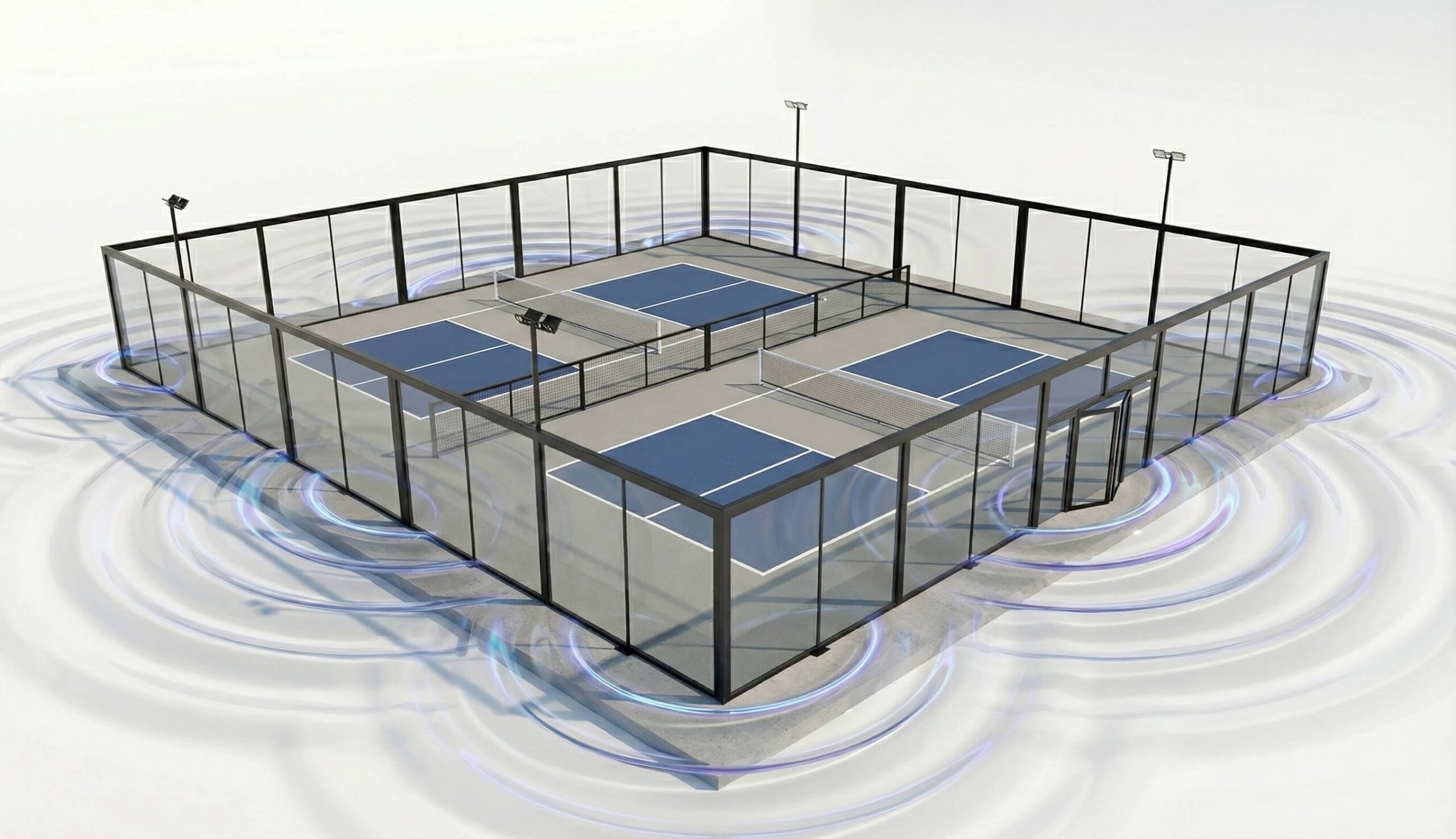
A growing number of communities are discovering that the fastest way to stop a pickleball facility is not a zoning fight or a budget cut. It is a noise complaint. Across the country, courts that were welcomed when they opened are now operating under restricted hours, facing litigation, or sitting closed entirely, because the sound of play carried farther than anyone planned for and a pickleball noise ordinance was applied after the fact.
This guide explains how pickleball noise regulations work, why the sport draws complaints that other recreation rarely does, and what communities, developers, and operators can do during planning to keep a facility open rather than defending it later.
Why pickleball generates noise complaints
The issue is not volume in the way most people assume. Pickleball’s acoustic signature is a sharp, repetitive, high-frequency pop produced by a hard paddle striking a hard plastic ball, roughly 700 to 1,000 times per hour on an active court. That impulsive, intermittent sound is far more noticeable and more irritating to the human ear than steady background noise at the same decibel level. A court can measure within a general noise limit and still generate persistent complaints, because the character of the sound, not just its loudness, is what neighbors react to.
This is why pickleball noise has become the single most common barrier to new facility development in residential and mixed-use areas. The problem is not the sport. It is that the infrastructure supporting it was, in most cases, never engineered to manage sound.
How pickleball noise ordinances actually work
There is no single national pickleball noise law. Regulation happens at the local level, and it generally takes one of a few forms.
General municipal noise ordinances. Most cities already have a noise ordinance that sets decibel limits, often measured at the property line, and may set quieter limits at night. Pickleball complaints are frequently enforced under these existing rules, even though they were not written with the sport in mind.
“Plainly audible” and nuisance standards. Some ordinances do not rely on decibel readings at all. They prohibit sound that is plainly audible at a neighboring property, or that constitutes a nuisance. These are easier for residents to invoke and harder for a facility to defend against, because they turn on perception rather than measurement.
Distance and setback requirements. Some jurisdictions are adopting setback rules, meaning minimum distances between courts and the nearest residential property line. These are increasingly written into the approval conditions for new courts.
Conditions of approval and restricted hours. Where complaints arise, the most common outcome is not closure but restriction: limited playing hours, especially early morning and evening. For a facility built to serve a community before and after work, restricted hours can undermine the entire purpose of the investment.
Because enforcement often depends on perception and property-line measurement rather than a fixed pickleball-specific limit, a facility’s exposure is decided less by the rulebook than by how far the sound travels. That is a design question, not a legal one.
The cost of treating noise as an afterthought
When acoustics are ignored during design, the sequence is predictable. The courts open, play ramps up, the nearest neighbors begin to notice the repetitive pop, complaints accumulate, and the governing body responds with the tools it has: restricted hours, mandated barriers, or in the worst cases an order to cease play while the dispute is resolved.
Every one of those outcomes is more expensive and more disruptive than planning for sound would have been. Retrofitting acoustic treatment onto a finished court costs more than designing it in. Restricted hours reduce the facility’s value to the community that funded it. And a public noise dispute damages relationships between residents, operators, and the developers or municipalities responsible, relationships that are hard to rebuild.
The communities seeing the best outcomes are the ones that treat acoustics as a planning input on the same level as drainage or lighting, rather than a problem to manage after complaints arrive.
Planning for sound before a dispute starts
Acoustic performance is an engineering problem with engineering solutions. The most effective approach addresses sound at the design stage.
Assess the site first. Before a court is sited, evaluate what surrounds it: distances to the nearest homes, prevailing wind, existing barriers, and the local ordinance’s standard. This assessment determines how much acoustic control the site actually needs, rather than guessing.
Engineer the enclosure for sound, not just containment. Chain-link contains balls and players. It does nothing for sound. Acoustic-rated and structural glass enclosure systems are engineered to interrupt the path the sound travels to neighboring properties. A system such as PICKLEGLASS™ is designed specifically to address the acoustic, aesthetic, and durability demands that conventional fencing was never built to meet. For a comparison of the full set of options, see our guide to acoustic enclosures for pickleball courts and our overview of pickleball court fencing and enclosure systems.
Treat orientation and layout as acoustic decisions. Court orientation, spacing, and the placement of barriers relative to the nearest receptors all affect how sound reaches a property line. These are low-cost decisions when made on paper and expensive ones to change after construction.
Document the acoustic plan for approval. Where setback or noise conditions apply, a documented acoustic strategy is often what allows a project to win approval and avoid restrictive conditions. It demonstrates to a planning board that sound has been engineered for, not hoped away.
For the practical techniques behind these strategies, see our guide to reducing pickleball noise and the background on pickleball noise complaints and where they come from.
Noise is an infrastructure question, not a complaint to manage
It is tempting to treat a pickleball noise ordinance as a legal hurdle, something to satisfy on paper so the courts can open. But the ordinance is only the visible edge of a deeper reality. A racquet facility is a piece of permanent infrastructure that lives inside a community, and how it sounds to that community is part of how it performs. A court that drives its neighbors to file complaints is not a successful facility operating under unfair rules. It is an under-engineered facility revealing what was left out at the design stage.
The shift that protects these investments is to stop asking how to comply with the noise ordinance and start asking how the facility should be engineered so that sound was never the issue in the first place. When acoustic performance is designed in, assessed for the site, built into the enclosure, and documented for approval, the ordinance stops being a threat and becomes a standard the facility already meets. That is the difference between managing noise complaints and engineering a facility that does not generate them.
For a complete view of the build process this fits into, see our pickleball court construction guide.
Frequently asked questions
Is there a national pickleball noise law?
No. Pickleball noise is regulated locally, usually through a municipal noise ordinance, a “plainly audible” or nuisance standard, setback requirements, or conditions attached to a court’s approval. Enforcement standards vary widely by jurisdiction.
Why does pickleball generate more noise complaints than other sports?
The paddle-and-ball impact produces a sharp, repetitive, high-frequency pop that the human ear finds far more noticeable and irritating than steady noise at the same decibel level. A court can measure within limits and still draw complaints because of the character of the sound.
What happens when a community files pickleball noise complaints?
The most common outcome is restriction rather than closure, usually limited playing hours, especially mornings and evenings, though mandated barriers, litigation, and temporary closures also occur where complaints persist.
How do you prevent pickleball noise problems before they start?
Assess the site’s acoustics before siting courts, engineer the enclosure to interrupt the sound path rather than only contain play, treat orientation and layout as acoustic decisions, and document an acoustic plan for the approval process. Designing for sound costs less than retrofitting after complaints.
