
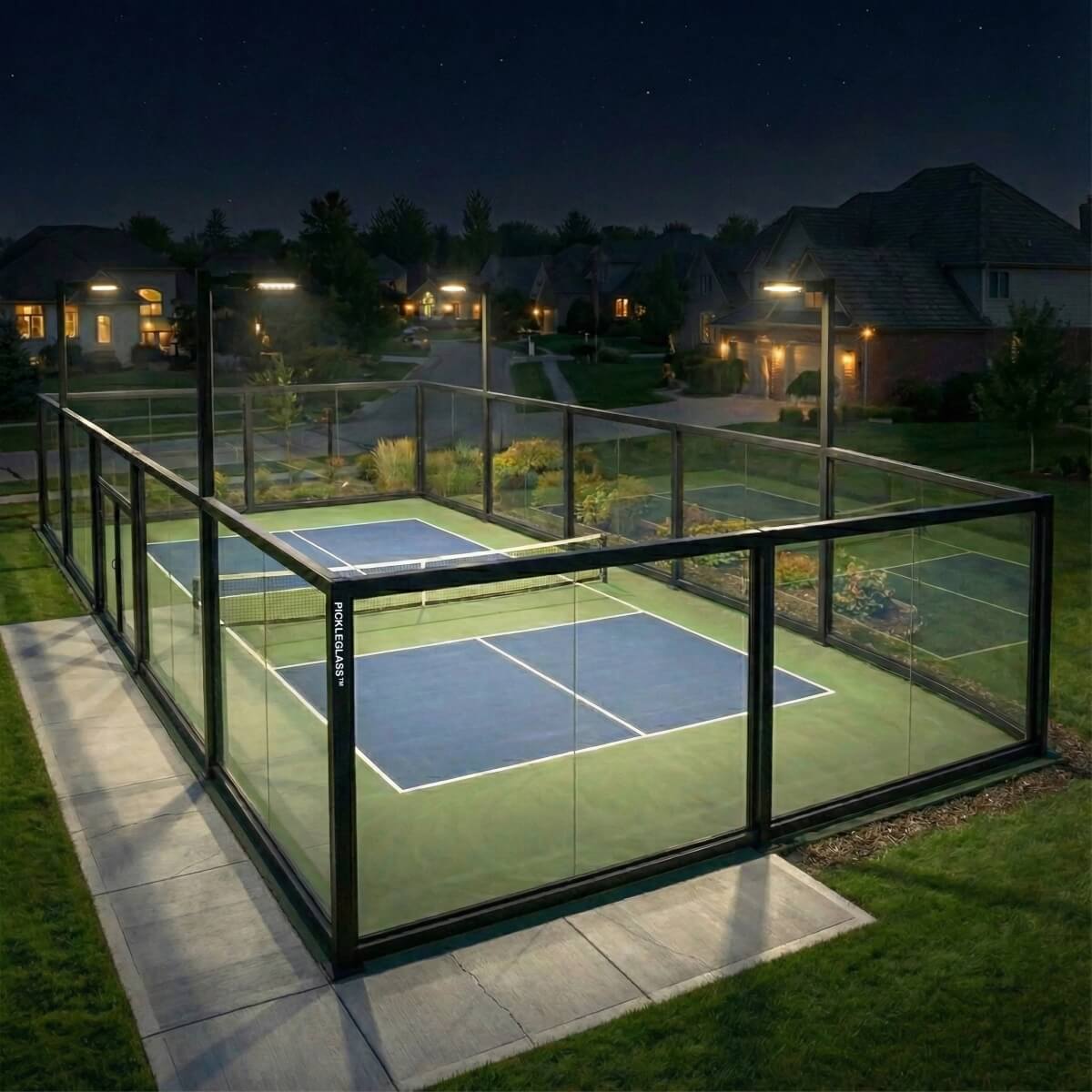
Most pickleball courts are lit as an afterthought, a few floodlights bolted onto whatever poles were already there. The result is a court that is usable at night but not good at night: bright in the middle, dark in the corners, with glare in players’ eyes on every overhead shot. Lighting is one of the few court systems that is judged every single time the court is used after sunset, and it is one of the easiest to get wrong by treating it as a fixture purchase rather than a design decision.
This guide covers what good pickleball court lighting actually requires: how much light, how evenly it needs to be distributed, how high the fixtures should sit, why LED has become the default, and how to keep light on the court and out of neighbors’ windows. These are the numbers and decisions that determine whether a court plays the same at 9 p.m. as it does at noon.
How much light a pickleball court needs
Light level is measured in foot-candles (the amount of light landing on the playing surface). The right target depends on the level of play the court is built to support:
- Recreational and residential play: roughly 30 to 50 foot-candles of maintained horizontal illuminance. Enough to track the ball comfortably for casual and club-level games.
- Competitive club and league play: roughly 50 to 75 foot-candles. Faster play and longer rallies demand more light and tighter consistency.
- Tournament and broadcast-level play: 75 to 125+ foot-candles, with the higher end driven by camera requirements rather than the players themselves.
“Maintained” matters: fixtures dim over their lifetime, so a system should be designed to still meet its target years in, not just on opening night. Specifying to the bare minimum on day one guarantees an under-lit court within a few seasons.
The number people forget: uniformity
Total light level is only half the picture. The other half is uniformity, how evenly that light is spread across the surface. A court averaging 50 foot-candles can still play badly if it is 80 in the center and 20 in the corners, because the ball appears to speed up and slow down as it crosses bright and dark zones, and the back corners (where deep shots land) become guesswork.
Uniformity is expressed as a max-to-min ratio. A well-designed court aims for a ratio of about 2:1 to 3:1 across the playing area. Hitting that target is a function of fixture placement, beam distribution, and mounting height working together, which is why uniformity is a design output, not something you can add by buying brighter lights.
Pole height, fixture count, and placement
The single biggest driver of both uniformity and glare is mounting height. Lights mounted too low throw long shadows, create hot spots, and put the glare source directly in a player’s sightline on lobs and overheads.
- Mounting height: outdoor courts are typically lit from poles 20 to 22 feet or higher. Greater height spreads light more evenly and lifts the glare source above the normal angle of play. Indoor courts are governed by ceiling height and benefit from the same principle: higher and well-shielded.
- Fixture layout: a single court is commonly lit by four fixtures on two poles (one pole on each sideline at mid-court) or by additional fixtures for higher light levels and better uniformity. The poles sit to the sides, never behind the baselines where they would shine into players’ eyes.
- Multi-court complexes: shared poles between adjacent courts can light two courts at once and reduce both cost and clutter, but the photometric layout has to be designed for the whole grid, not court by court.
Why LED is the default, and what to specify
LED has effectively replaced metal halide for court lighting, and the reasons go beyond the energy bill:
- Efficiency and lifespan: LED fixtures draw far less power and commonly last 50,000 to 100,000 hours, which on a court used several hours a night translates to many years before replacement.
- Instant on and full control: no warm-up cycle, and LED pairs with dimming, scheduling, and zone controls so a complex can run courts at full output for league night and lower output for casual play.
- Light quality: a color temperature around 4000K to 5000K and a solid color-rendering index give clean, neutral light that makes the ball easy to track without the harsh, color-shifted look of older fixtures.
- Glare control: the most important specification on any court near homes. Full-cutoff, shielded fixtures keep light pointed down onto the court instead of spilling sideways and up. This controls glare for players and limits light trespass onto neighboring properties, which is increasingly written into municipal dark-sky and lighting ordinances.
Lighting as part of the facility, not an accessory
It is tempting to treat lighting as the last item on the list, a set of fixtures chosen by wattage after the court is otherwise built. Doing so is how courts end up with poles in the wrong place, glare in players’ eyes, and complaints from the house next door about light shining through the windows at 10 p.m.
A court lit as engineered infrastructure is designed the other way around: the photometric plan, pole locations, mounting heights, and shielding are worked out alongside the surface, the enclosure, and the site itself, so the lighting performs across the full playing area and respects the property around it. Light placement also interacts with enclosure design and, on residential and mixed-use sites, with the same acoustic planning that keeps a facility welcome in its neighborhood. Lighting designed in from the start is the difference between a court that merely turns on after dark and one that plays the same at night as it does in daylight, for the full life of the facility.
For how lighting fits into the complete build (base, drainage, surfacing, enclosure, dimensions, and acoustics), see the complete guide to pickleball court construction.
Frequently asked questions
How many foot-candles do you need for a pickleball court?
Recreational and residential courts target roughly 30 to 50 maintained foot-candles, competitive club and league play roughly 50 to 75, and tournament or broadcast play 75 to 125 or more. Because fixtures dim over time, a court should be designed to meet its target years into its life, not only when it is first installed.
How high should pickleball court light poles be?
Outdoor courts are typically lit from poles 20 to 22 feet tall or higher. Greater mounting height spreads light more evenly across the surface and raises the glare source above a player’s normal sightline on lobs and overheads. Fixtures are placed along the sidelines, not behind the baselines.
Are LED lights better for pickleball courts?
Yes. LED fixtures use far less energy, commonly last 50,000 to 100,000 hours, turn on instantly, and support dimming and scheduling. They also deliver cleaner, neutral light (around 4000K to 5000K) that makes the ball easy to track, and full-cutoff LED fixtures control glare and limit light spilling onto neighboring properties.
How do you reduce glare and light trespass on a pickleball court?
Use full-cutoff, shielded fixtures that direct light down onto the court rather than sideways or up, mount them high enough to keep the glare source out of players’ eyes, and lay out the photometric plan so light stays on the playing surface. This both improves play and keeps light off adjacent homes, which many municipal lighting ordinances now require.
