
Last updated: August 26, 2026
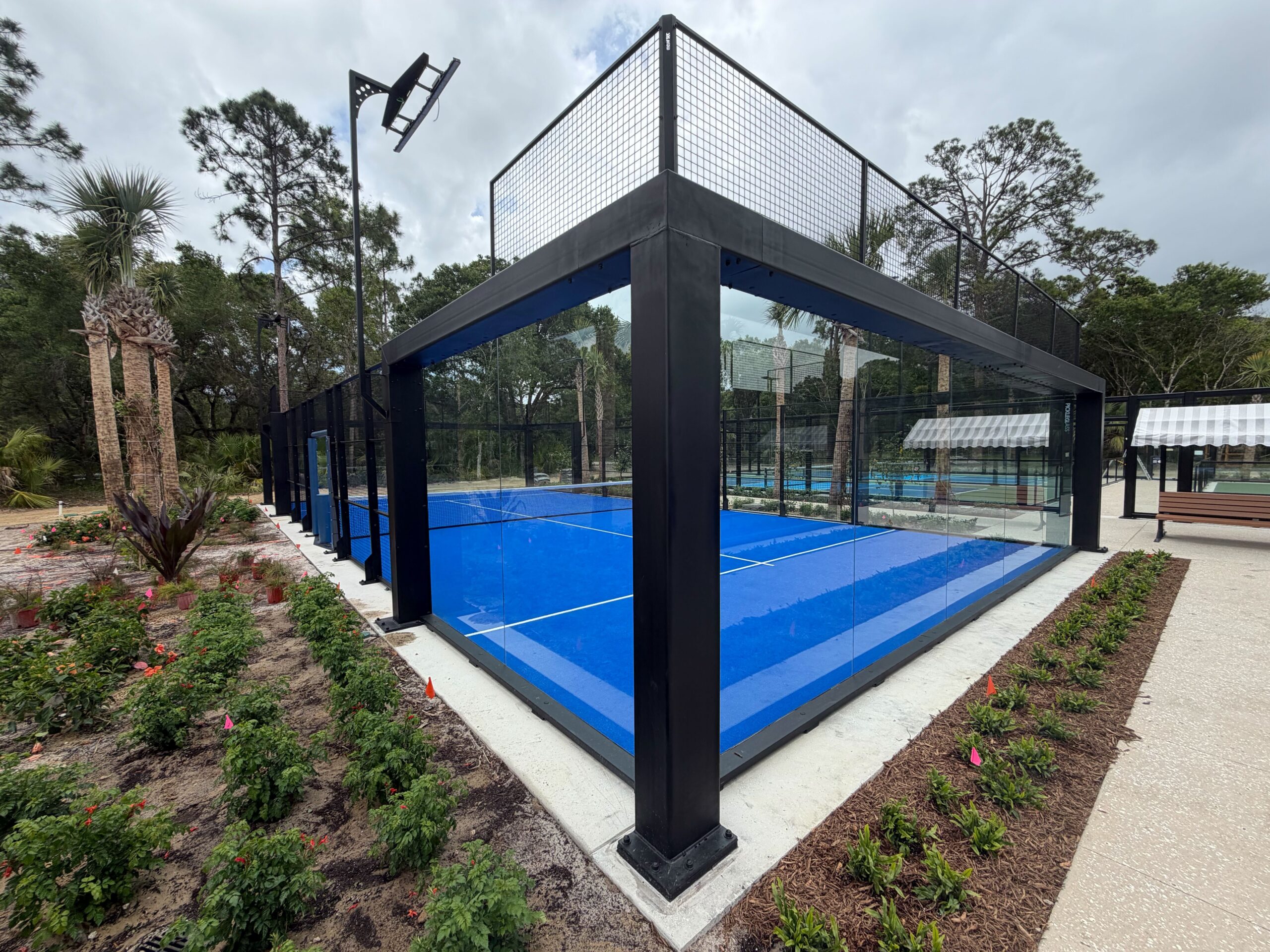
Padel court resurfacing is the process of renewing a court’s playing surface once the original turf or coating has worn past the point where brushing and sand top-ups can maintain fair, safe play. On the artificial-turf courts that make up most of the North American market, resurfacing usually means lifting the worn carpet, correcting the base if needed, and installing new turf with fresh silica sand infill. On hard (porous concrete or acrylic) padel surfaces, it means recoating rather than recarpeting. The glass walls and steel frame are a separate system and are typically retained.
This guide covers when a padel court is due for resurfacing, what the work involves for each surface type, what drives the cost, and how resurfacing fits alongside routine maintenance and a full rebuild.
When does a padel court need resurfacing?
A padel court needs resurfacing when the surface no longer delivers consistent ball bounce, footing, and drainage, and routine maintenance can no longer restore it. For artificial-turf courts, the practical signals are: infill sand that will not stay level despite regular brushing, visible fiber flattening or bald patches in the high-traffic zones near the net and service boxes, seams lifting or fraying, and standing water that points to compacted infill or a base problem underneath.
As a planning benchmark, a well-maintained artificial-turf padel surface commonly lasts in the range of 8 to 12 years before the carpet itself is due for replacement, though heavily programmed club courts at the busy end of that range wear faster. Hard-surface padel courts follow the acrylic recoat cadence more familiar from tennis, roughly every 4 to 8 years depending on climate, usage, and how well the surface has been maintained.
What padel court resurfacing involves
The scope depends on the surface system.
Artificial-turf courts. The worn turf is removed, the base slab is inspected and any cracking or unevenness is addressed, and a new turf carpet is rolled, seamed, and secured. Fresh kiln-dried silica sand is then spread and brushed into the fibers in stages so the infill sits at the correct depth across the whole court. Infill depth and distribution are what govern bounce and grip, so the sanding stage is where a quality result is won or lost. If the enclosure is being retained, the crew works around the glass and posts; if the frame is being refurbished at the same time, sequencing the two trades matters.
Hard-surface courts. Porous concrete or acrylic padel surfaces are recoated rather than recarpeted. Crack repair and cleaning come first, followed by patch leveling and new acrylic color coats. This mirrors the tennis and pickleball acrylic process, and the same rule applies: recoating renews the wearing surface but does not fix a failing base.
In both cases, resurfacing renews the surface. It does not correct a structural base failure. If the slab has heaved, settled unevenly, or cracked from below, that has to be resolved first, which moves the project from a resurfacing into a partial or full reconstruction.
What drives padel court resurfacing cost
The largest cost variables are the surface system (a full turf replacement carries a higher material cost than an acrylic recoat), the condition of the base once the old surface is lifted, court access for equipment and material handling, and how many courts are being done in one mobilization. Multi-court facilities generally see a lower per-court cost because mobilization, labor, and material delivery are spread across the batch. Because base condition is only fully known once the old surface is removed, a credible resurfacing budget carries a contingency for base repair that a routine maintenance budget does not.
For a sport as young in the U.S. as padel, published resurfacing price data is thin and varies widely by region and surface type, so a court-specific assessment is more reliable than a national average.
Resurfacing versus maintenance versus rebuild
These three are often confused, and the distinction changes the budget.
Routine padel court maintenance (brushing, sand top-ups, cleaning, drainage checks, glass and frame care) extends the life of the existing surface and is an operating expense. Resurfacing renews the wearing surface at the end of its service life and is a periodic capital expense. A rebuild replaces the base structure itself and is the largest of the three. Consistent maintenance is what pushes resurfacing further out; deferred maintenance pulls it forward and raises the odds that base problems surface at the same time.
How this fits the larger padel project
Resurfacing is one stage in a padel court’s service life, alongside the initial padel court construction, the choice of padel court surface system, and the overall padel court cost picture. For club and facility operators, the value of treating the surface as engineered infrastructure, rather than a periodic expense to minimize, is that a renewal done to spec protects the far larger investment in the enclosure, the base, and the member experience the court exists to deliver.
If you are scoping this work for your facility, an instant estimate will put real numbers behind the options discussed here, so scope, phasing, and budget can be weighed together.
Frequently asked questions
How often should a padel court be resurfaced?
Artificial-turf padel surfaces are commonly replaced every 8 to 12 years with good maintenance; hard acrylic padel surfaces are recoated roughly every 4 to 8 years. Usage volume, climate, and maintenance quality move a specific court within those ranges.
Can you resurface a padel court without replacing the glass?
Yes. On most projects the glass walls and steel frame are a separate system and are retained; the crew resurfaces around the enclosure. The glass is only involved if it is being refurbished or replaced at the same time.
Is resurfacing the same as re-sanding?
No. Re-sanding (topping up and brushing the silica infill) is routine maintenance. Resurfacing replaces the worn turf carpet itself, or recoats a hard surface, and includes new infill as part of the work.
How do you know if you need resurfacing or a full rebuild?
Resurfacing renews the surface; a rebuild replaces the base. If the base slab is sound, resurfacing is appropriate. If the slab has cracked, heaved, or settled unevenly, that base issue has to be corrected first, which turns the project into a reconstruction.
