
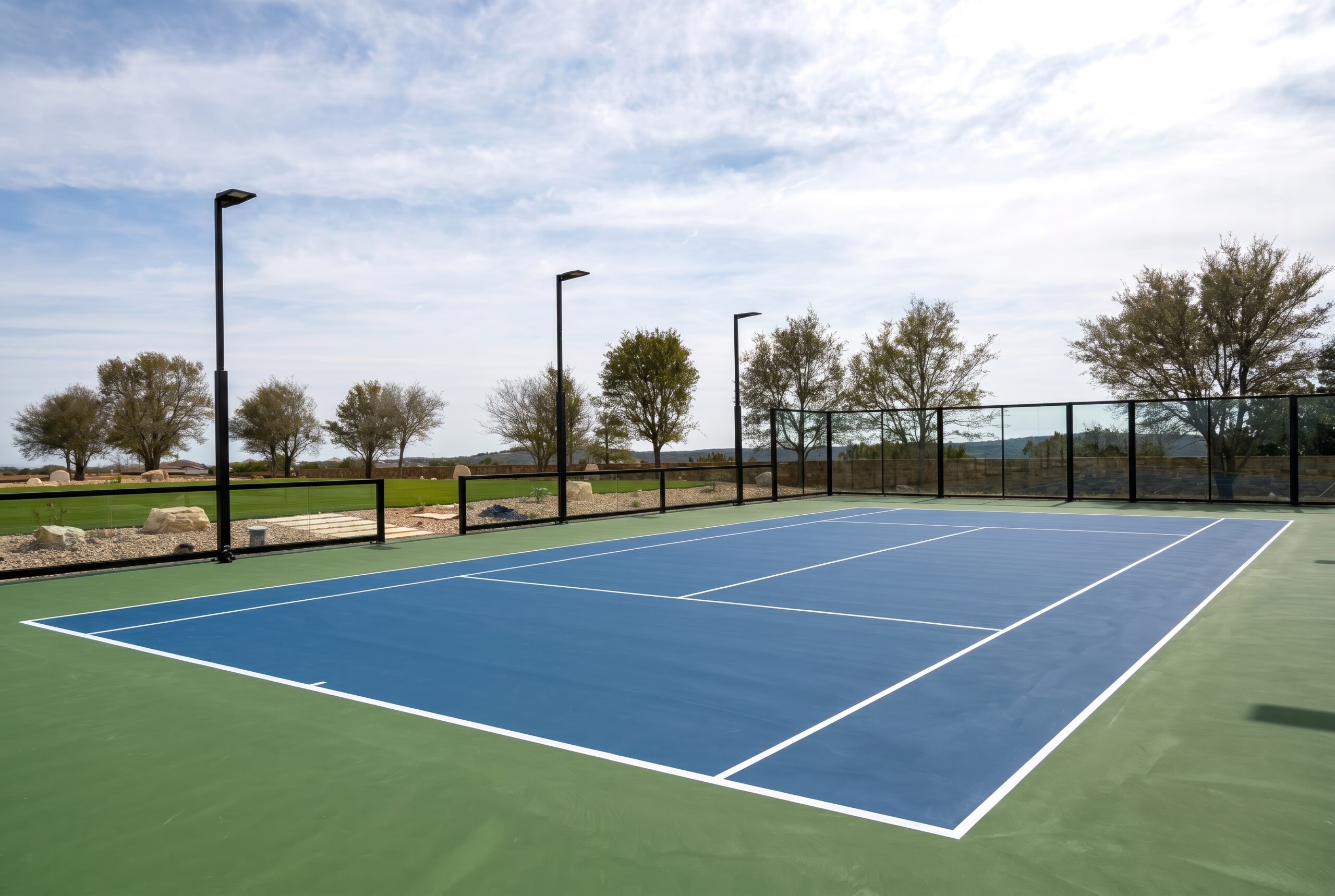
Tennis court maintenance is the routine of cleaning, inspection, and repair that keeps a court playable, safe, and structurally sound between resurfacing cycles. Done on a schedule, it protects the coating, preserves consistent ball bounce and footing, and delays the far larger cost of reconstruction. Most outdoor hard courts need light cleaning every one to two weeks in season, a full wash once or twice a year, crack inspection each spring and fall, and resurfacing roughly every four to eight years depending on climate and use.
This guide covers what to do, how often to do it, and what to budget, for the surface types facilities most commonly operate.
Routine care: the work that prevents the expensive work
The single most valuable habit is keeping the surface clean and dry. Standing water, organic debris, and biological growth are the leading causes of premature coating failure on outdoor courts.
Keep a regular rhythm on these items:
- Remove leaves, seeds, pine needles, and other debris weekly during the growing season. Organic matter traps moisture and stains the acrylic.
- Clear the surface after storms. Puddles that linger for more than an hour after rain point to a low spot or a drainage issue worth investigating.
- Wash the surface with water and a soft-bristle broom or a low-pressure rinse one to two times per year. Use a mild detergent rated for acrylic sport coatings, never a solvent.
- Treat moss, mold, and algae early. A diluted, coating-safe cleaner removes growth before it degrades the texture and creates a slip hazard. Shaded and north-facing courts need this more often.
- Keep the perimeter trimmed. Roots, overhanging branches, and encroaching turf push debris and moisture onto the court and can lift edges over time.
A note on pressure washing: high pressure can strip acrylic texture and open hairline cracks. If a facility uses a pressure washer, keep the pressure low, hold the wand at a shallow angle, and keep the tip well back from the surface. When in doubt, a soft wash is the safer choice.

Inspection: catch cracks and surface wear early
Walk the court at least twice a year, and after any hard freeze or extreme heat event. You are looking for:
- Cracks. Note the width, length, and pattern. Fine surface cracks are common and manageable. Structural cracks that widen, branch, or reappear after filling signal movement in the base and need a different repair approach.
- Low spots. Mark any area that holds water. Birdbaths flatten ball bounce and accelerate coating wear.
- Coating wear. Baselines and service areas wear first. Faded color, exposed asphalt or concrete, and a smooth, slick texture mean the playing surface is thinning.
- Net posts and anchors. Check that footings are solid and the posts are plumb.
- Lines and hardware. Look for peeling line paint, loose center straps, and worn net bands.
Logging findings the same way each time turns inspection into a trend line. A crack that grows a quarter inch over a season tells you more than a single snapshot.
Repairs: matching the fix to the problem
- Hairline and minor cracks. Clean out the crack and fill with an acrylic crack filler or a court-grade patch binder, then feather and recoat the area. This is routine upkeep.
- Working or structural cracks. These move with the slab and reopen if simply filled. Options range from a reinforced crack-repair membrane to a localized cut-and-patch of the base. The right answer depends on the cause, which is why inspection notes matter.
- Low spots. Fill and level with a court patch material, then recoat so the repair blends with the surrounding texture and color.
- Faded or worn color coat. When wear is widespread rather than local, the court is signaling that a full resurfacing is due rather than another spot repair. See our guide to tennis court resurfacing cost for what that involves and how to budget it.
Resurfacing: the planned reset
Resurfacing is not a failure of maintenance. It is the scheduled renewal of the acrylic color system that every hard court eventually needs. Typical intervals run four to eight years, shorter in high-sun and freeze-thaw climates or under heavy daily play, longer for lightly used courts in mild climates. A well-maintained court reaches the far end of that range. A neglected one reaches the near end, or needs structural work first.
Budgeting for resurfacing on a fixed cycle, rather than reacting when the surface fails, is what keeps a facility out of the reconstruction bracket. The cost detail lives in the tennis court resurfacing cost guide, and new-build economics are covered in how much it costs to build a tennis court.
Surface-specific notes
Maintenance is not identical across surfaces:
- Hard courts (acrylic over asphalt or concrete). The most common commercial surface. The routine above applies directly: clean, inspect, crack-repair, resurface on cycle.
- Cushioned acrylic. Same care as standard hard courts, with attention to the resilient layers during crack repair so the cushion is not compromised. Cushioned systems reward gentle cleaning and prompt crack attention.
- Clay (including Har-Tru and similar). A different discipline entirely. Clay needs daily brushing and rolling, watering to hold moisture, line-tape upkeep, and seasonal top-dressing to replace material lost to play and weather. Clay is higher touch day to day but avoids the freeze-thaw cracking that hard courts face.
- Grass. Rare in commercial settings and the most maintenance-intensive of all, requiring mowing, irrigation, aeration, and constant line marking.
For a fuller comparison of how each system plays and wears, see tennis court surfaces.
The surroundings count too
A court is a system, and the elements around the playing surface carry their own upkeep. Check fencing for damage, sagging, and corrosion so it keeps doing its job; see tennis court fencing. Inspect lighting for failed fixtures, alignment drift, and clean lenses, since even output matters for evening play; see tennis court lighting. Confirm that perimeter drainage still moves water away from the slab, because the base is what the whole surface depends on. Court geometry and clearances are covered in tennis court dimensions.
An annual maintenance schedule
| Cadence | Tasks |
|---|---|
| Weekly (in season) | Remove debris, clear standing water, quick visual scan |
| Monthly | Wash high-traffic areas, treat any moss or algae, check net and center strap |
| Spring and fall | Full inspection, crack and low-spot repair, deep clean, hardware check |
| Every 4 to 8 years | Full resurfacing (color system renewal); structural repair first if inspection calls for it |
| As needed | Line repaint, net and post service, drainage correction |
What it costs to maintain a court
Routine upkeep is a modest line item next to construction or resurfacing: cleaning supplies, occasional crack filler and patch material, line paint, and labor. The larger, plannable expense is resurfacing on cycle, with structural crack repair as the variable that swings a budget when a court has been left too long. The practical lesson is that consistent small spending suppresses large unplanned spending. Detailed resurfacing ranges are in the tennis court resurfacing cost guide.
Maintenance as lifecycle value
A tennis court is long-lived infrastructure, and its service life is decided less by the day it is built than by how it is cared for across the years that follow. Courts engineered and finished to a consistent standard, with sound base preparation, correct slope, and quality coatings, respond to maintenance predictably and hold their playing characteristics longer. That is the return on building to a standard rather than to a price: fewer surprises, a longer interval between resurfacings, and a court that stays true to how it played on day one. When a facility plans a court as a system and maintains it as one, upkeep stops being a cost center and becomes the mechanism that protects the original investment. The same principle carries through every stage of a court’s life, from construction to renewal.
Frequently asked questions
How often should a tennis court be cleaned?
Remove debris and clear standing water weekly during the playing season, and give the court a full wash one to two times per year. Shaded courts that grow moss or algae need cleaning more often.
How often does a tennis court need resurfacing?
Most hard courts are resurfaced every four to eight years. High-sun and freeze-thaw climates and heavy daily use push toward the shorter end. Consistent maintenance pushes toward the longer end.
Can I pressure wash a tennis court?
Yes, but carefully. High pressure can strip acrylic texture and open hairline cracks. Use low pressure, a shallow angle, and distance from the surface, or choose a soft wash with a mild coating-safe detergent.
What is the difference between crack repair and resurfacing?
Crack repair is a targeted fix for specific cracks and low spots. Resurfacing is the scheduled renewal of the entire acrylic color system. Widespread wear means resurfacing; isolated damage means repair.
Why does my tennis court hold water after rain?
Standing water usually means a low spot in the surface or a drainage problem at the perimeter or base. Both are worth correcting early, since ponding accelerates coating failure and flattens ball bounce.
Is clay court maintenance harder than hard court maintenance?
Clay is higher touch day to day, needing brushing, rolling, watering, and top-dressing. Hard courts need less daily attention but depend on periodic resurfacing and crack repair. The total effort is comparable over a year, just distributed differently.
