
Fencing is the part of a tennis court that most people stop thinking about the moment it is installed, which is exactly why so much of it ages badly. A fence keeps balls in and defines the court, but it is also the most visible boundary of the facility and, on many courts, the first thing to rust, sag, or look dated. Getting the height, material, and specification right at the start avoids years of patching and a court that looks older than it is.
This guide covers standard tennis court fence heights, the chain link options and coatings used in the United States, what fencing costs, and how the enclosure fits into the larger design of a court.
Standard tennis court fence heights
The standard height for tennis court fencing is 10 feet, which suits most recreational, club, and park courts. Competition and tournament courts often use 12 feet, in line with USTA guidance, to contain higher and harder play and to reduce ball retrieval across courts. Some facilities use a graduated approach, with taller fencing at the ends of the court behind the baselines, where most balls travel, and lower fencing along the sides. The right height depends on the level of play, how courts are grouped, and the surroundings.
Chain link fencing: the standard system
Most tennis courts in the United States are enclosed with chain link fencing, governed by ASTM F969, the standard that defines wire gauge, mesh size, post diameter, and structural requirements for fences around tennis courts. The common specifications:
- Mesh and gauge. Tennis court chain link fabric typically uses a 1-3/4 inch mesh opening with either 11-gauge or 9-gauge wire. The heavier 9-gauge is more durable and is the better choice for courts expecting hard use.
- Coatings. Fabric is finished either by hot-dip galvanization (silver) or with a vinyl or polymer coating. Coated colors include black, dark green, olive green, and brown. The coating is both protective and aesthetic, and black or green vinyl tends to visually recede so the court, not the fence, is what the eye sees.
- Framework. A complete system includes line posts, terminal posts, top rail, and tension hardware sized for the fabric height. Post spacing and footing depth determine whether the fence stays true over time or begins to lean.
What tennis court fencing costs
Tennis court chain link fencing generally costs $10 to $40 per linear foot, with the highest grades reaching around $60 per foot. Vinyl coating adds roughly $3 to $7 per linear foot over galvanized, which on a typical 360-foot court perimeter (about 120 by 60 feet) works out to about $1,080 to $2,520 more. For a full enclosure, total cost commonly falls between $5,000 and $12,000 depending on height, material grade, court length, and site conditions.
As with most court components, the cheapest option is rarely the lowest cost over time. Lighter-gauge, uncoated fabric on shallow footings costs less to install and more to maintain and replace. Heavier-gauge, coated fabric on properly set posts costs more upfront and holds up for far longer.
Beyond chain link
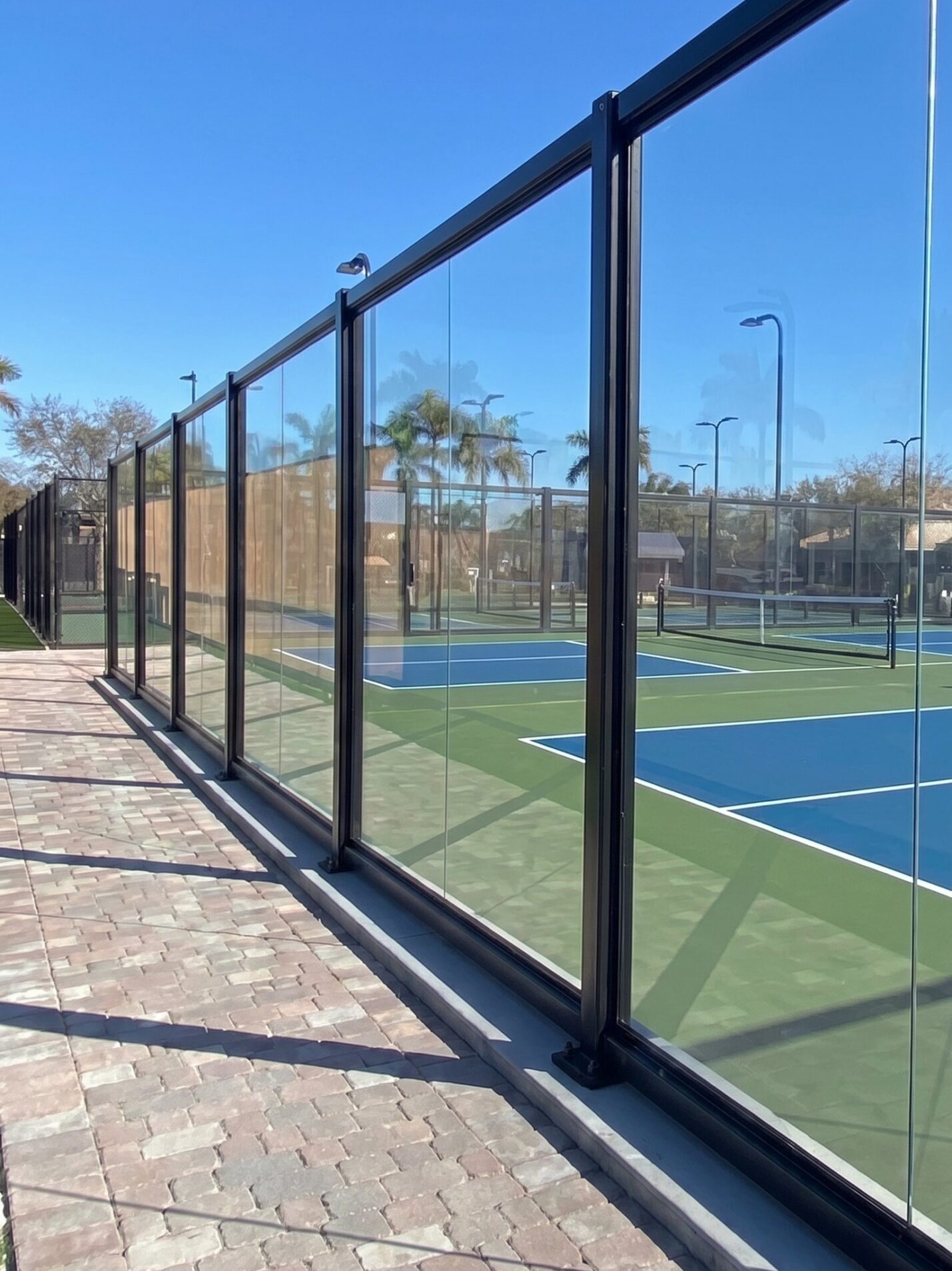
Chain link is the default because it is functional and inexpensive, but it was designed for containment, not for integration into a designed environment. For clubs, resorts, residential developments, and any setting where the courts are part of the architecture rather than tucked behind a building, the enclosure is a visible element that either complements the property or detracts from it.
This is where the enclosure conversation broadens. The same structural glass systems PICKLETILE engineers for pickleball and padel apply to tennis settings where appearance, acoustic performance, and durability matter as much as containment. A PICKLEGLASS structural glass court enclosure addresses the things chain link was never built to handle: a finished architectural look, acoustic control near homes and shared spaces, and a surface that does not rust or sag. For courts where the fence is the most visible boundary of an otherwise premium facility, treating the enclosure as a system rather than a commodity is what keeps the whole facility looking and performing the part.
Fencing as part of the court, not an afterthought
The reason so many court fences look tired is that they were specified as the last and cheapest line item, disconnected from the rest of the project. The enclosure is, in practice, one of the longest-lasting and most visible parts of a court, and it carries real functions: containment, safety, acoustic management, and the visual frame of the facility.
The more useful way to approach it is to decide what the enclosure needs to do for this specific facility, contain play, look right in its setting, and manage sound where neighbors are close, and then specify to that standard. For most recreational and club courts, a properly specified 10 or 12 foot chain link system in coated 9-gauge fabric does the job for years. For facilities where the courts are part of the architecture or sit near homes, a structural glass enclosure solves problems chain link cannot. Either way, the enclosure deserves to be designed with the court, not bolted on after it. For how fencing fits into the full build, see tennis court construction.
Frequently asked questions
How tall should a tennis court fence be?
The standard tennis court fence height is 10 feet, which works for most recreational, club, and park courts. Competition and tournament courts often use 12 feet per USTA guidance. Some facilities use taller fencing behind the baselines and lower fencing along the sides.
What kind of fence is used for tennis courts?
Most tennis courts use chain link fencing governed by ASTM F969, typically with a 1-3/4 inch mesh and 9-gauge or 11-gauge wire, finished with hot-dip galvanizing or a vinyl or polymer coating in black, green, or brown. Structural glass enclosures are used where appearance and acoustics matter.
How much does tennis court fencing cost?
Tennis court chain link fencing generally costs $10 to $40 per linear foot, up to around $60 for the highest grades. A full court enclosure commonly runs $5,000 to $12,000 depending on height, material, court length, and site. Vinyl coating adds about $3 to $7 per linear foot over galvanized.
Is vinyl-coated or galvanized fence better for tennis courts?
Galvanized fabric is the lower-cost option and performs well. Vinyl or polymer coating adds protection and an aesthetic finish, and darker colors visually recede so the court stands out rather than the fence. Coated 9-gauge fabric on properly set posts lasts longer and is often the better value over time.
What is the difference between chain link and structural glass court enclosures?
Chain link is built for containment and is inexpensive. A structural glass enclosure adds a finished architectural appearance, acoustic control, and a surface that does not rust or sag, which matters for clubs, resorts, residential developments, and courts near homes.
