
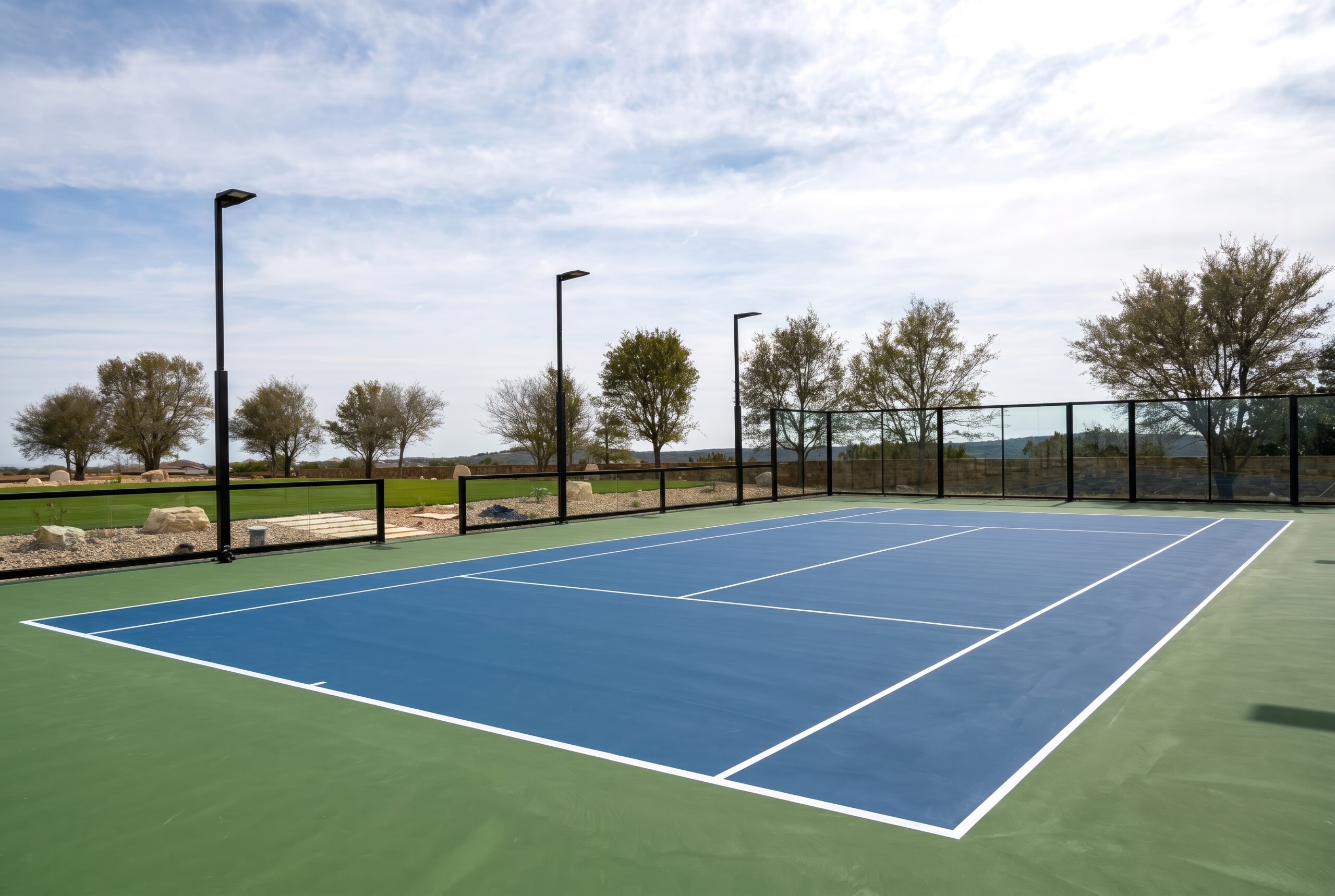
Resurfacing a standard tennis court typically costs between $9,000 and $15,000 in 2026 for a straightforward acrylic recoat, with most clubs landing in the $9,000 to $12,000 range per court when there are no structural issues. Cost rises considerably when the surface needs crack repair, patching, or structural work before the new coating goes down. The range is wide because “resurfacing” can mean anything from a clean-and-coat over a sound surface to a full rehabilitation of a court that has been neglected for years.
This guide breaks tennis court resurfacing cost into the factors that actually move the number, explains when resurfacing is the right call versus reconstruction, and shows how to read a resurfacing quote so you can compare proposals on more than price.
Tennis court resurfacing cost at a glance
| Scope | Typical 2026 range |
|---|---|
| Acrylic recoat (clean and coat, no structural issues) | $9,000 to $15,000 |
| Minor crack repair (patching, leveling low spots, isolated cracking) | $10,000 to $20,000 |
| Cushioned systems (typically 3 to 5 cushion layers) | $15,000 to $30,000+ |
| Major crack repair or membrane system | $8,000 to $20,000+ |
| Full reconstruction (demolition, new base, complete surfacing) | $75,000 to $150,000+ |
These are planning ranges, not quotes. The same court can fall anywhere in the range depending on its condition, the surface system specified, and the site. Most clean-and-coat recoats with no structural issues land in the $9,000 to $12,000 range per court.
What drives tennis court resurfacing cost
Surface condition. A court with a sound, well-draining surface needs only cleaning, minor prep, and a new acrylic system. A court with cracking, low spots that hold water, or a failing coating needs repair work first, and that prep is where cost separates. Minor crack repair covers patching, leveling low spots, and addressing isolated cracking before resurfacing. Major crack repair uses specialized membrane systems such as RiteWay, Armor, or fiberglass membranes engineered to slow cracks from returning, and the cost varies substantially depending on the extent of movement and whether repairs are localized or court-wide.
Surface system specified. A basic acrylic color coat is the lowest-cost option. Cushioned systems, which add layers that reduce joint impact and improve player comfort, cost more and are common where a court sees heavy daily use. Their cost depends heavily on the number of cushion layers, typically three to five, and on the manufacturer’s system. The system chosen affects both the upfront number and how the court plays and ages.
Court condition and drainage. Standing water after rain is a sign of a surface or base problem that a color coat will not fix. Resurfacing over a drainage problem buys a year or two, not a decade. On courts with persistent ponding or structural cracking, the honest answer is sometimes reconstruction rather than another recoat.
Number of courts and access. Resurfacing several courts in one mobilization usually lowers the cost per court. A single court on a constrained or hard-to-access site costs more per square foot than a bank of courts a crew can move across efficiently.
When to resurface versus reconstruct
Acrylic surfaces are generally recoated every four to eight years, depending on climate, use, and the quality of the original work. Resurfacing is the right call when the base and structure are sound and the surface has simply worn or faded. It restores color, traction, and line definition at a fraction of reconstruction cost.
Reconstruction becomes the better value when the problems are structural: a failing base, cracks that return no matter how often they are filled, or drainage that cannot be corrected from the surface. Full reconstruction includes demolition, excavation, a new asphalt or post-tension concrete base, drainage corrections, fencing impacts, and complete surfacing, and runs $75,000 to $150,000 or more. Asphalt courts generally trend toward the lower end, while post-tension concrete and difficult site conditions push projects toward the upper end. Repeatedly recoating a structurally failing court is the most common way owners spend reconstruction money in installments without ever getting a reconstructed court.
Resurfacing as a conversion opportunity
If a tennis court is underused, resurfacing is also the natural moment to consider adding pickleball. A regulation pickleball court fits inside a tennis court footprint, and blended or converted lines can be incorporated during resurfacing at a fraction of the cost of a separate project. We cover the layout options in the court layout options in converting a tennis court to pickleball, and the surface choices in pickleball court surface options.
How to read a tennis court resurfacing quote
Before comparing proposals on price, make each one answer the same questions:
- What surface preparation is included, and how are existing cracks and low spots handled?
- What surface system is specified, a basic acrylic coat or a cushioned system?
- How many coats, and what is the expected service life before the next recoat?
- Is drainage assessed, or is the quote a coat over whatever is there now?
- Are lines for other uses (pickleball, blended lines) an option in this mobilization?
A quote that is cheaper because it skips crack repair or drainage assessment is not cheaper. It is shorter-lived. The lowest recoat price on a structurally compromised court is the fastest path to paying twice.
The lifecycle view
A resurfacing decision looks like a maintenance line item, but it is really a question about the court as long-term infrastructure. A court maintained on a sensible recoat schedule, with drainage and cracks addressed when they appear, holds its value and its playability for decades. A court resurfaced reactively, only when it looks bad, tends to mask the structural problems that eventually force a far more expensive reconstruction. The cost-effective path is to treat resurfacing as scheduled maintenance of an engineered asset, not as cosmetic touch-up. For new builds and conversions, see our pickleball court construction guide and our overview of pickleball court resurfacing.
Frequently asked questions
How much does it cost to resurface a tennis court?
A straightforward acrylic recoat of a sound tennis court typically costs $9,000 to $15,000 in 2026, with most clean-and-coat projects landing in the $9,000 to $12,000 range per court. Minor crack repair runs $10,000 to $20,000, cushioned systems $15,000 to $30,000 or more, and major crack repair or membrane systems $8,000 to $20,000 or more. A full reconstruction runs $75,000 to $150,000 or more.
How often should a tennis court be resurfaced?
Acrylic tennis court surfaces are generally recoated every four to eight years, depending on climate, usage, and the quality of the original installation. Courts in heavy use or harsh climates fall toward the shorter end.
Is it worth resurfacing an old tennis court or should it be rebuilt?
Resurfacing is worth it when the base and structure are sound and only the surface has worn. When a court has a failing base, recurring cracks, or drainage that cannot be fixed from the surface, reconstruction is usually the better long-term value.
Can I add pickleball lines when resurfacing a tennis court?
Yes. Resurfacing is the natural time to add pickleball or blended lines, since the surface is being recoated anyway. A pickleball court fits inside a tennis court footprint, making conversion a low-incremental-cost option during resurfacing.
