
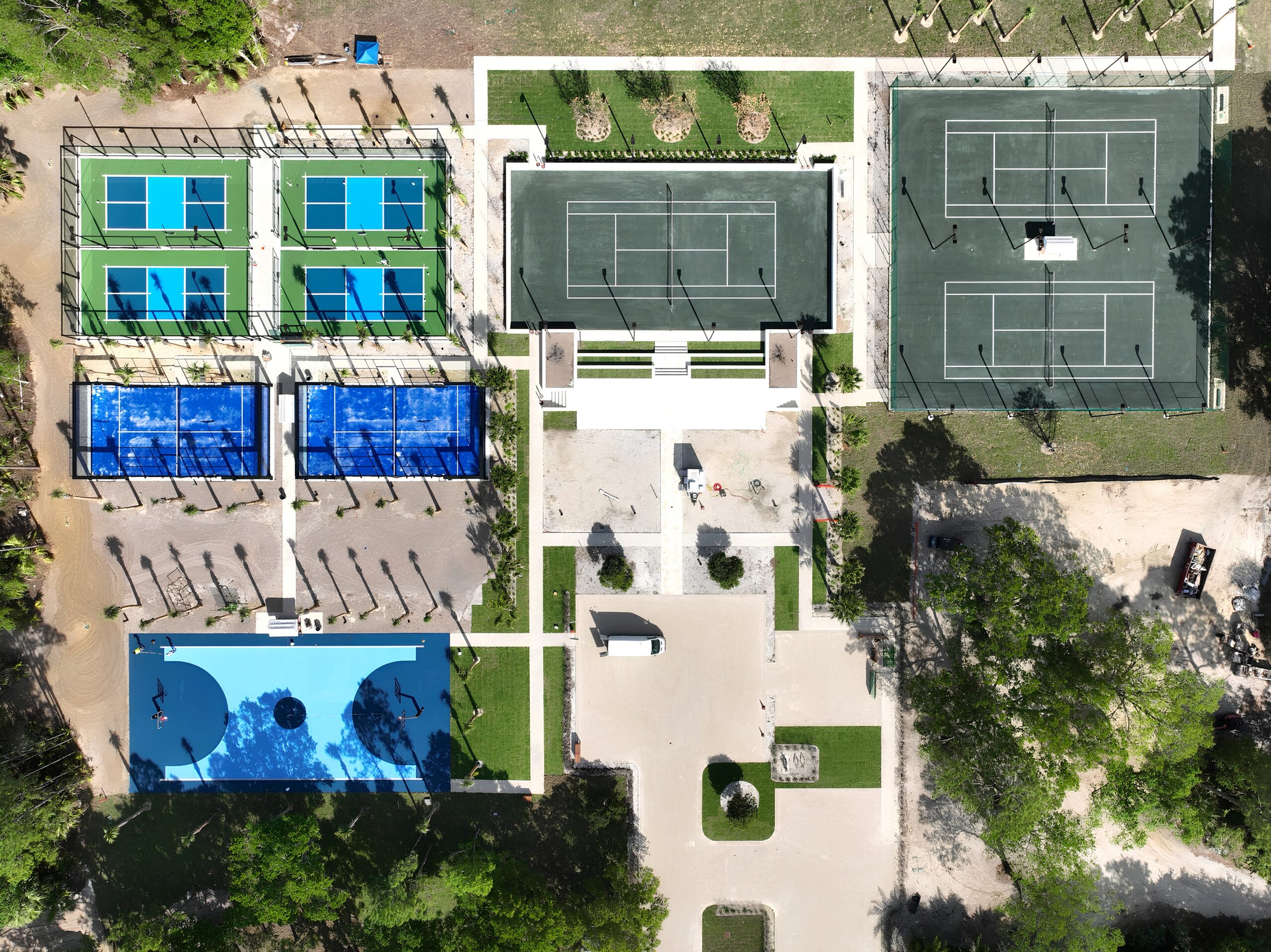
The surface is the decision that shapes how a tennis court plays, what it costs to maintain, and how long it lasts before it needs work. Most tennis players recognize the four surface families from watching the sport: hard courts, clay, grass, and the cushioned acrylic systems that have become standard at many clubs and parks. For anyone planning or renewing a facility, the choice is less about preference and more about climate, budget, lifecycle, and how the court will be used.
This guide compares the main tennis court surfaces on the factors that actually drive the decision, and explains why the surface is only one layer of a court that has to be engineered as a whole.
The four tennis court surface families
Hard courts (acrylic)
Hard courts are the most common tennis surface in the United States and worldwide. They are built by applying an acrylic color coating system over an asphalt or concrete base. They deliver a consistent, medium-paced bounce, suit every style of play, and are durable and relatively low maintenance. Among the four surfaces, a hard court is the most economical to build and the lowest maintenance. The acrylic color coat is refreshed through resurfacing every 4 to 8 years to repair surface cracks and repaint lines. With that consistent resurfacing, the court structure beneath lasts 15 to 20 years or more before it needs rebuilding.
Cushioned acrylic courts
A cushioned court is a hard court with one or more rubberized layers built into the acrylic system beneath the color coat. The result plays similarly to a standard hard court but is easier on players’ joints. Industry data indicates cushioned systems can reduce impact forces by up to roughly 15 percent, which matters for clubs whose members play frequently or whose membership skews older. The difference between standard acrylic and cushioned is mostly upfront investment rather than upkeep. The maintenance and resurfacing cycle is comparable.
Clay courts
Clay courts are built from crushed stone or brick and play slowly with a high bounce, rewarding baseline rallies. A clay court with irrigation typically runs $130,000 to $200,000 depending on fencing and drainage requirements, well above a hard court, and the long-term picture adds to that. Clay needs frequent attention: brushing to keep the surface even, rolling, watering, topping up material, and seasonal work in colder climates. The surface is preferred by certain players and clubs but carries a real ongoing labor and cost commitment.
Grass courts
Grass is the fastest surface, with a low skidding bounce that rewards quick reflexes and serve-and-volley play. It is also the most demanding to own. Grass courts require daily maintenance, including mowing, watering, reseeding, and pest control, and are realistic only for facilities with the budget and grounds staff to sustain them. For most clubs, parks, and developments, grass is a prestige choice rather than a practical one.
Comparing the surfaces
Build cost below is shown on a relative scale, from $ (most economical) to $$$$ (most premium), because the actual figure depends heavily on the base, site, fencing, and drainage.
| Surface | Relative build cost | Play characteristics | Maintenance | Lifespan / resurfacing |
|---|---|---|---|---|
| Hard (acrylic) | $$ (most economical) | Medium pace, consistent bounce, all-around | Low | Recoat every 4 to 8 years; structure 15 to 20+ years |
| Cushioned acrylic | $$$ | Similar to hard, softer underfoot | Low | Comparable to hard court |
| Clay | $$$$ ($130K to $200K with irrigation) | Slow, high bounce, baseline play | High (daily/seasonal) | Long with continuous upkeep |
| Grass | $$$$ (highest to own) | Fast, low bounce, serve-and-volley | Very high (daily) | Requires continuous renewal |
The relative figures tell only part of the story. A surface that is inexpensive to install but expensive to maintain can cost more over twenty years than a surface that costs more upfront and less to keep. That distinction is the heart of choosing well.
How to choose a tennis court surface
A few factors usually settle the decision:
- Climate. Hot, dry, or freeze-thaw climates favor acrylic hard and cushioned systems engineered for the conditions. Grass and clay are harder to sustain outside temperate regions without significant investment.
- Use and players. High-frequency play and an older membership lean toward cushioned acrylic for joint protection. Competition programs may have specific surface requirements.
- Maintenance capacity. Clay and grass are only practical with the staff and budget to maintain them. Acrylic systems are the low-labor choice.
- Budget over time. The right comparison is total cost of ownership across the surface’s life, not the install figure alone.
- The base beneath the surface. No surface performs longer than the base under it allows.
That last point is the one most often overlooked. For a facility renewing an aging court rather than building new, the surface conversation is really a resurfacing conversation, and the condition of the base and the type of system applied drive the cost. See tennis court resurfacing cost for how those numbers break down.
The surface is one layer of an engineered court
A tennis court is often discussed as if the surface were the whole product. It is not. The color coat sits on a base, the base sits on a subgrade, and the court is bounded by fencing, lit for evening play, and drained so water never sits on it. The surface can only perform as well as the system beneath and around it. A premium coating over a failing base will crack again. A perfect base under a surface chosen for the wrong climate will disappoint.
This is why surface selection should happen inside a larger design conversation rather than as a standalone catalog choice. The questions that determine how a court performs over decades, base engineering, drainage, the right surface system for the climate and use, and how the surface integrates with fencing and lighting, are engineering questions, not finishing touches. For how those pieces come together from the ground up, see tennis court construction.
The most useful way to frame the decision is not which surface is best in the abstract. It is which surface, on a properly engineered base, will perform and endure for the way this facility will actually be used. That shift, from picking a finish to engineering a court, is the difference between a surface that looks good on opening day and one that still plays well a decade later.
Frequently asked questions
What is the most common tennis court surface?
Acrylic hard courts are the most common tennis surface in the United States and worldwide. They are built by applying an acrylic color coating system over an asphalt or concrete base, and they offer consistent play, durability, and low maintenance.
What is the difference between a hard court and a cushioned court?
A cushioned court adds one or more rubberized layers within the acrylic system beneath the color coat. It plays much like a standard hard court but reduces impact on players’ joints, by up to roughly 15 percent according to industry data. The main difference is upfront cost; maintenance is comparable.
How much does it cost to build a tennis court surface?
Costs vary widely by base, site, and scope. A hard court is the most economical of the four surfaces to build, with cushioned acrylic a step up for the rubberized layers. A clay court with irrigation runs higher, typically $130,000 to $200,000 depending on fencing and drainage. Grass is the most expensive to own because of daily upkeep.
How long does a tennis court surface last?
An acrylic hard court is resurfaced every 4 to 8 years to refresh the color coat, repair cracks, and repaint lines; with that consistent resurfacing the court structure beneath lasts 15 to 20 years or more. Clay and grass require continuous maintenance rather than periodic resurfacing.
Which tennis court surface is best?
There is no single best surface. Acrylic and cushioned acrylic suit most clubs, parks, and developments because they balance cost, durability, and low maintenance. Clay and grass serve specific playing preferences but demand far more upkeep. The right choice depends on climate, use, maintenance capacity, and total cost of ownership.
