
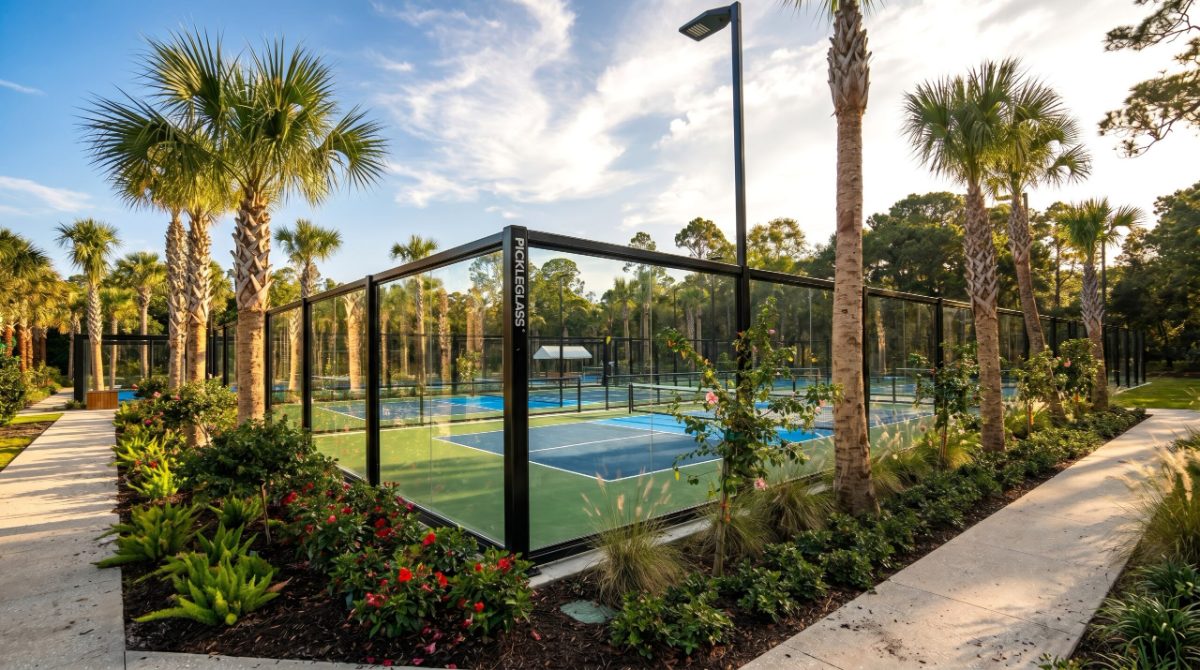
Tennis court striping is the layout and application of the painted lines that define the playing area: baselines, sidelines, service lines, the center service line, and center marks. Correct striping is what makes a resurfaced or newly built court playable to standard, and it is also where a facility decides whether the court will carry a single sport or share space with pickleball through blended lines. This guide covers the regulation dimensions, the color and material standards, the application process, and the multi-sport layout decisions that facility operators face most often.
Regulation tennis court line dimensions
A regulation tennis court measures 78 feet in length. The doubles court is 36 feet wide and the singles court is 27 feet wide, with the doubles alleys occupying the 4.5 feet on each side between the singles and doubles sidelines. The net divides the court in half at 39 feet from each baseline.
The service boxes are set by the two service lines, each running parallel to the net at 21 feet from it, and by the center service line that splits the two boxes down the middle. The center mark is a short line, 4 inches long, centered on each baseline to define the server’s position. Under the standards published by the sport’s governing bodies, lines may range from 1 inch to 2 inches in width, except the baseline, which may be drawn up to 4 inches wide. Every line is measured to its outside edge, and all lines on a court are the same color.
Getting these measurements right matters beyond play. Lines that drift even a fraction out of tolerance are visible on camera and to experienced players, and they are difficult to correct without a full recoat. This is why striping is treated as a precision step, not a finishing touch.
Color and material standards
Tennis lines are almost always white, which gives the highest contrast against the standard green and blue acrylic court colors used in most installations. The line paint is a textured, acrylic-based coating formulated to bond with the color coats beneath it, not ordinary road or field marking paint. Using the correct system keeps the line flush with the surrounding surface so it does not raise a lip that changes ball behavior or creates a trip point.
Lines are applied after the color coats have cured and are the final coating layer on the court. They are laid out with a chalk line and string, masked with tape, then coated by hand with a brush or a line applicator. On a well-run job the tape is pulled while the paint is still workable to leave a clean edge.
How a court gets striped, step by step
The striping sequence is consistent across new construction and resurfacing projects:
First, the crew confirms the surface is fully cured and clean. Striping over a color coat that has not cured leads to adhesion failure and bleed under the tape.
Second, they establish the court’s centerlines and reference points by measuring from fixed benchmarks, then snap chalk lines for every line on the layout. Diagonals are measured to confirm the court is square before any tape goes down.
Third, they mask each line with tape to the specified width and apply the line paint. On multi-sport layouts, each sport’s lines are masked and painted in sequence so colors do not bleed together.
Fourth, they pull the tape, inspect every intersection and endpoint, and touch up as needed. The court is then left to cure before play.

Blended lines: sharing a tennis court with pickleball
The most common striping question a facility asks today is whether to add pickleball lines to an existing tennis court. A standard tennis court can hold up to four pickleball courts, or one to two courts laid out for casual play, and many operators want both sports on the same slab to raise utilization.
The accepted solution is blended lines, sometimes called combination lines. The pickleball lines are painted in a color that contrasts with the white tennis lines but is muted enough that it does not distract during tennis play, often a soft blue or a tan that sits close to the court color. The tennis lines stay white and remain the visually dominant set. This keeps both sports playable and follows the guidance that the primary sport’s lines should read clearly while the secondary sport’s lines are present but secondary.
Facilities that expect heavy pickleball demand often reach a point where blended lines create confusion during competitive play. At that stage the decision shifts from shared striping to a dedicated conversion. Our guide to converting a tennis court to pickleball courts covers when a full conversion makes more sense than blended lines, and the same striping principles apply once that layout is set. For the pickleball-specific line standards, see pickleball court striping.
When striping happens in a court’s lifecycle
Striping is not a standalone service in most cases. It is the closing step of two larger jobs: new tennis court construction and tennis court resurfacing. Because line paint wears and fades with play and weather, lines are refreshed on the same cycle as the color coats, typically every four to eight years depending on climate and usage. Planning striping as part of the resurfacing budget, rather than as a separate later task, avoids a second mobilization of the crew.
If the court layout itself is being reconsidered, striping is also the moment to confirm the underlying dimensions and orientation. Our tennis court dimensions reference documents the full layout, and tennis court surfaces covers how the surface system beneath the lines affects both play and how well the striping holds up.
For multi-court facilities and clubs, striping is a small line item that carries outsized visibility. A court with crisp, correctly measured, correctly colored lines signals a well-maintained facility to every member and guest who steps onto it. It is one of the least expensive ways to make a court look and play like it was built to a professional standard.
If you are scoping this work for your facility, an instant estimate will put real numbers behind the options discussed here, so scope, phasing, and budget can be weighed together.
Frequently asked questions
What are the standard tennis court line dimensions?
A regulation court is 78 feet long, 36 feet wide for doubles and 27 feet wide for singles. Service lines sit 21 feet from the net, the doubles alleys are 4.5 feet wide, and the center mark on each baseline is 4 inches long. Lines are 1 to 2 inches wide, except the baseline, which may be up to 4 inches wide.
What color are tennis court lines?
Tennis lines are white in nearly all installations because white gives the strongest contrast against the green and blue acrylic surfaces used on most courts. All lines on a single court are the same color.
Can you add pickleball lines to a tennis court?
Yes. A tennis court can carry blended lines for both sports, with the pickleball lines painted in a contrasting but muted color so the white tennis lines stay dominant. When pickleball demand grows past the point where blended lines are workable, a dedicated conversion is usually the better path.
How often do tennis court lines need to be repainted?
Lines are typically refreshed on the same schedule as the surface color coats, roughly every four to eight years, because line paint fades and wears with play and weather. Restriping is almost always done as part of a resurfacing project rather than on its own.
What kind of paint is used for tennis court lines?
Textured acrylic line paint designed to bond with the acrylic color coats beneath it, not ordinary marking paint. The correct system keeps the line flush with the surface so it does not alter ball bounce or create a trip edge.
Internal links: tennis court construction (UP to pillar head), tennis court dimensions, tennis court surfaces, tennis court resurfacing cost, configuring tennis court to pickleball court conversions, pickleball court striping. FAQPage schema: auto-generated by pickletile-faq-schema.php mu-plugin (7/15 auto-gen) on publish. Red-line scan: no superlatives, no contractor framing, no price-leading, no “simple/easy” court framing, no inline phone CTA. Em-dash scan: 0 em/en dashes.
