
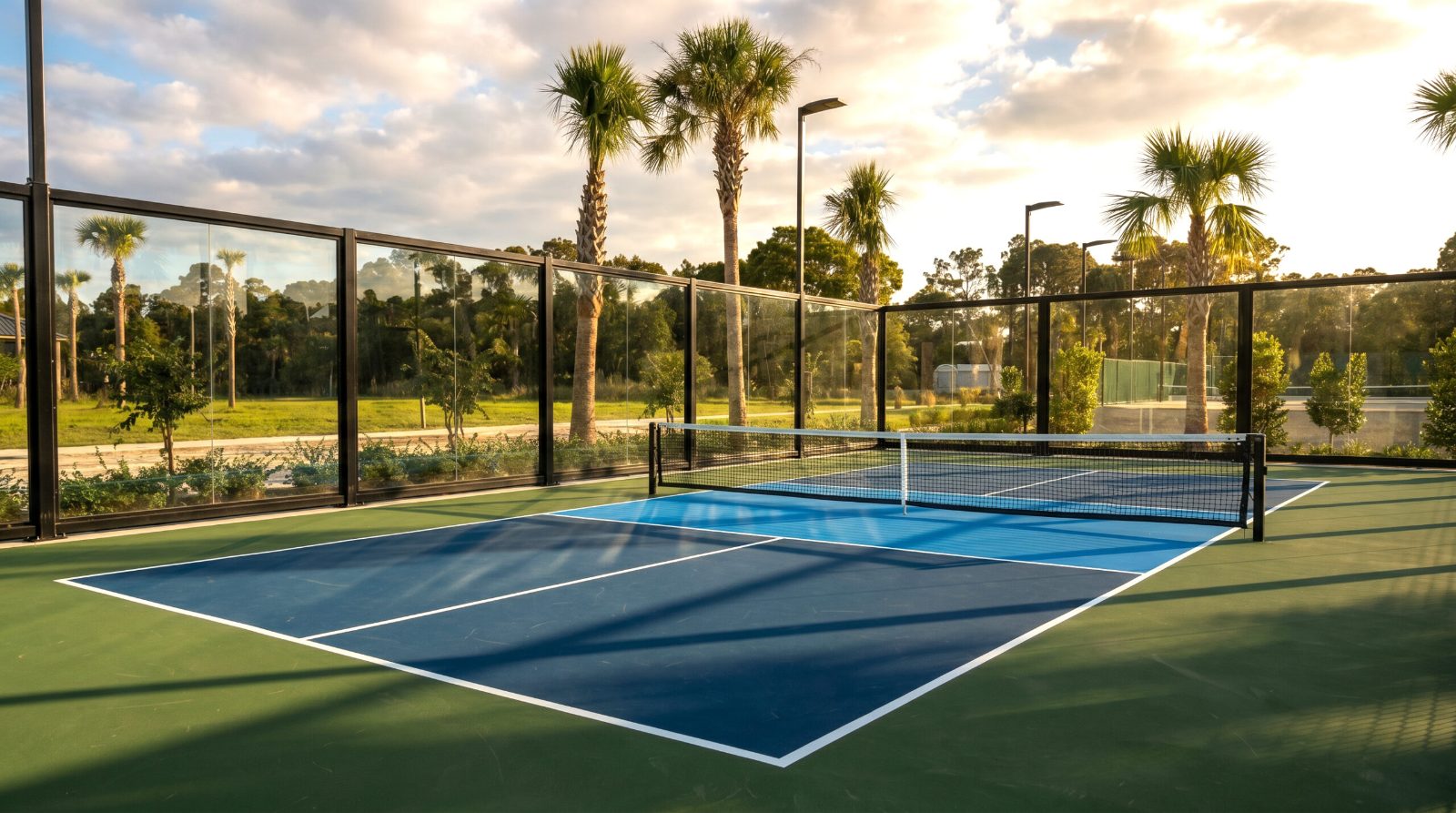
Resort pickleball courts are now a headline amenity rather than a nice-to-have. Most resorts that add pickleball build two to six courts, site them a considered distance from lodging or contain sound with an engineered acoustic enclosure, add lighting for morning and evening play windows, and program the courts with clinics, open play, and equipment service. Done well, the amenity shows up in booking decisions, guest satisfaction scores, and on-property spend.
Last updated: July 16, 2026.
Why resorts are adding pickleball
Pickleball participation has grown across every age bracket that resorts serve, and it has a property that few amenities share: it is genuinely multigenerational. A family group can put three generations on the same court within ten minutes of picking up paddles. For resort operators, that translates into an activity with broad utilization across the guest mix, morning-to-evening demand, and natural programming hooks: clinics, round robins, social play, and racquet-professional instruction.
Resorts also start from an advantage. Many already hold underused tennis inventory, and a tennis court conversion can yield two to four pickleball courts per tennis footprint, which changes the economics of adding the amenity.
How many courts a resort needs
Court count drives everything downstream: land, budget, staffing, and programming. Planning ranges we see across hospitality projects:
| Resort profile | Typical court count |
|---|---|
| Boutique property, amenity presence | 2 courts |
| Mid-size resort, programmed amenity | 3 to 4 courts |
| Large destination resort or racquet program | 6 to 8+ courts |
Two courts is the practical floor for a programmed amenity: it allows open play and instruction to coexist. Four courts supports round robins and small events. Beyond six, the amenity can anchor packages, tournaments, and destination racquet programming. Space planning starts from the court footprint: plan on roughly 30 by 60 feet per court, plus circulation, shade, and social space.
The broader sizing framework, including phasing and site selection, is covered in our pickleball facility planning guide.
The siting decision: noise is the design constraint
Pickleball’s paddle-ball impact is a sharp, repetitive sound in a frequency range that carries. On a resort property, the nearest noise-sensitive receiver is often not a neighbor across a fence; it is a guest room, a spa terrace, or a wedding lawn on the same property. Siting courts without a noise plan risks converting a revenue amenity into a complaint generator.
There are two workable approaches, often used together:
- Distance and orientation. Where the property has room, placing courts away from lodging and orienting play lines away from receivers reduces impact. The physics and mitigation options are covered in how to reduce pickleball noise.
- Engineered containment. Where courts need to sit near lodging, dining, or event space (which is often exactly where guests want them), an acoustic-rated structural enclosure such as PICKLEGLASS contains sound at the source while keeping the courts visually open. For hospitality settings, the transparency matters: the amenity stays on display to the property instead of disappearing behind a solid wall, and spectating becomes part of the guest experience.
The siting and containment decision is the one to get right before anything is poured. Retrofitting noise control after complaints is more expensive and more disruptive than designing for it.
Design elements that fit hospitality settings
A resort court complex is a guest environment, not just a playing surface. Elements that consistently earn their budget:
- Surfaces selected for the climate and for barefoot-adjacent comfort zones around courts, with color schemes that fit the property’s palette rather than defaulting to municipal green.
- Court lighting designed for evening programming without spill into guest rooms; lighting extends the amenity’s usable hours into the highest-demand windows.
- Shade, seating, and social space between and around courts; pickleball is a social sport and the gathering space drives dwell time and beverage spend.
- Wind and visual screening appropriate to the setting, integrated with the enclosure system rather than bolted on.
- Storage and service points for paddles, balls, and programming equipment.
Budget and return
Per-court construction budgets vary with base condition, surface system, lighting, and enclosure scope; the ranges are broken down in our pickleball court cost guide. For the revenue side, hospitality properties monetize courts differently from standalone clubs: through occupancy lift, package and event revenue, lesson programs, and food and beverage attach, rather than pure court fees. The business-case framework in are pickleball courts profitable applies, with the note that resort economics generally justify the amenity on guest experience and booking behavior before direct court revenue.
Planning sequence for resort operators
- Confirm demand and programming model with the racquet or activities team.
- Select the site with noise, guest flow, and future phasing in view.
- Decide the containment approach (distance, enclosure, or both) before design lock.
- Specify the court package as one system: base, surface, striping, lighting, enclosure, and furnishing.
- Phase construction around occupancy seasons so the amenity arrives without taking adjacent guest areas offline.
Resorts that treat the court complex as engineered guest-experience infrastructure, specified once and specified together, end up with an amenity that performs for a decade. Those that assemble it piecemeal tend to revisit noise, lighting, and surface decisions within the first two seasons.
Frequently asked questions
How many pickleball courts should a resort build?
Two courts is the practical minimum for a programmed amenity; three to four suits most mid-size resorts; six or more supports destination racquet programming and events. Phasing from four toward eight as utilization proves out is a common path.
How much space do resort pickleball courts require?
Plan roughly 30 by 60 feet per court, plus circulation, shade, and social space. A four-court complex with gathering areas typically wants around a half acre.
How do resorts manage pickleball noise near guest rooms?
Through siting and orientation where space allows, and through engineered acoustic containment where courts sit near lodging. Acoustic-rated structural glass enclosures contain sound at the source while keeping courts visually open to the property.
Can a resort convert existing tennis courts to pickleball?
Yes. One tennis footprint can yield two to four pickleball courts depending on layout, which is often the fastest and most capital-efficient way for a resort to add the amenity.
Do resort pickleball courts need lighting?
If the property wants morning and evening programming, yes. Purpose-designed court lighting extends usable hours into the highest-demand guest windows while controlling spill toward rooms and event spaces.
