
Last updated: July 2026.
Padel and pickleball are the two fastest-growing racquet sports, and facility operators, clubs, and developers increasingly ask the same question: which one should we build? The sports look similar from a distance, but they differ in court construction, space, noise, and equipment in ways that change what a site needs and what a project costs.
This comparison is written for the people deciding what to build. It covers how the two sports differ on the court, and what those differences mean for space planning, noise, and budget when you are the one installing the infrastructure.
Quick answer
Pickleball plays on a small open court and is the lower-cost amenity to add, especially where space is tight or a tennis court can be converted. Padel plays inside an enclosed glass-and-mesh court, needs more space and a higher build investment, and delivers a distinctive walled game that clubs use to differentiate. Many multi-sport facilities are choosing to build both, because they draw overlapping but not identical audiences.
What each sport is
Pickleball is played on a court the size of a doubles badminton court, with a solid paddle and a perforated plastic ball, over a net slightly lower than a tennis net. It is played as singles or doubles, and the ball stays in play on the open court.
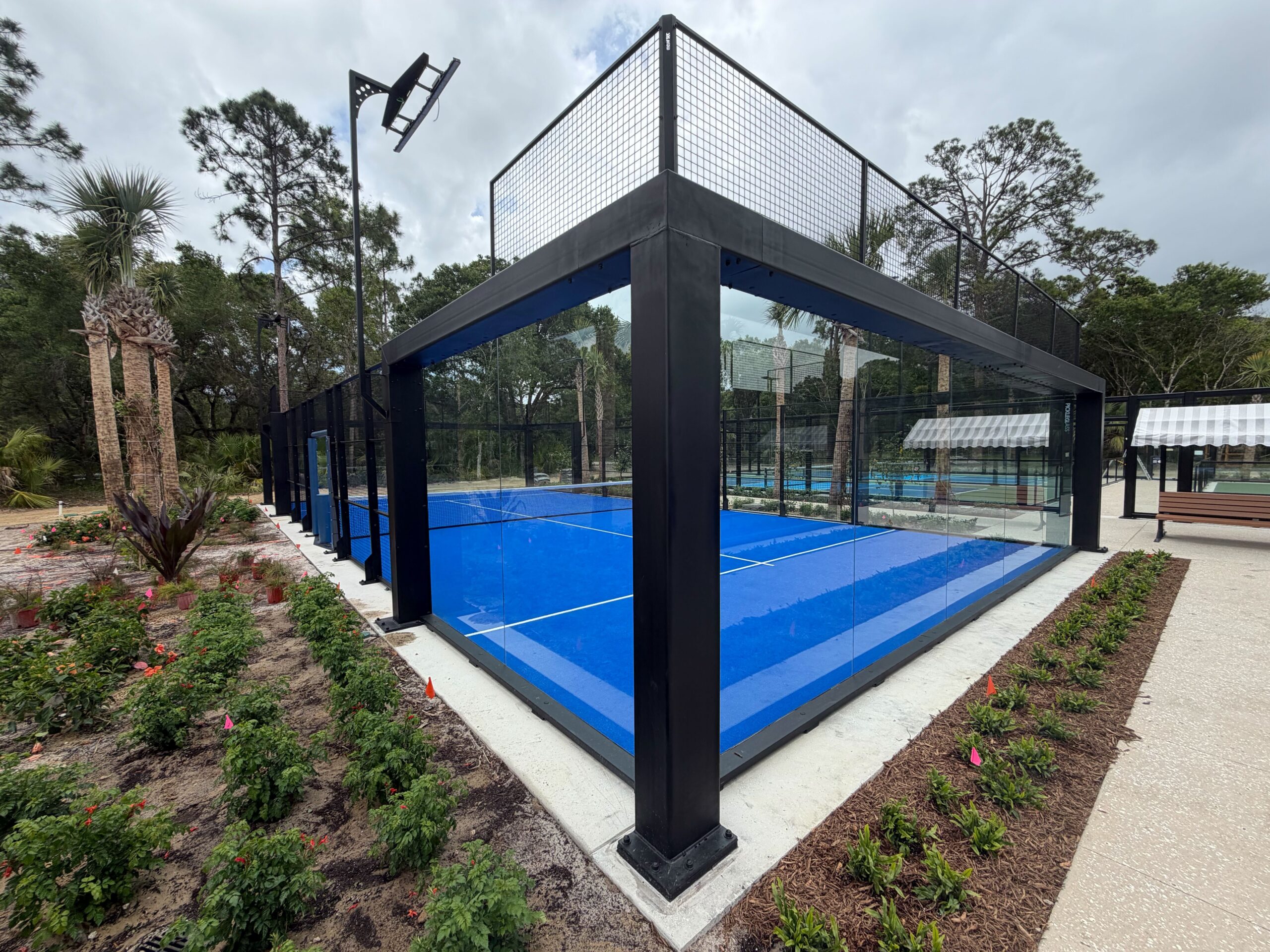
Padel is played almost exclusively as doubles inside an enclosed court, using a solid stringless paddle and a ball similar to a depressurized tennis ball. The defining feature is the walls: the glass and mesh enclosure is in play, so the ball can be played off the back and side walls, much like squash.
Court size and construction
This is the biggest practical difference for anyone building.
A pickleball court plays on a 20 by 44 foot surface, with run-off space recommended around the lines. See pickleball court dimensions for the full layout. Construction is a paved and surfaced court with net posts and perimeter fencing, comparable to a small tennis court build. Our pickleball court construction guide covers the process.
A padel court is 20 meters by 10 meters (roughly 66 by 33 feet), and the enclosing walls of tempered glass and metal mesh are structural, in-play elements, not optional fencing. That enclosure is what makes padel construction a heavier engineering job than pickleball. See padel court dimensions for the layout and padel court construction for how the enclosed court is built.
Space and site planning
Because a pickleball court is small, it fits where padel cannot: multiple pickleball courts can occupy a single tennis-court footprint, which makes pickleball the natural choice for space-constrained sites and tennis-court conversions.
A padel court needs a larger clear area and structural enclosure, so it suits sites with more room and operators who want a marquee walled court. Where both fit, the two complement each other in a multi-sport facility rather than competing for the same players.
Noise
Both sports produce a sharp impulse sound from paddle-on-ball contact, and both draw noise complaints when courts sit near homes or occupied units. Padel’s glass enclosure contains some sound by its nature, while an open pickleball court relies on added acoustic treatment.
For pickleball specifically, noise is a design-stage decision, addressed through court placement and acoustic enclosure systems such as structural glass court walls. Our how to reduce pickleball noise guide covers the full range of approaches.
Cost
Per court, padel generally carries a higher build cost than pickleball because of the structural glass-and-mesh enclosure and the larger footprint. Pickleball’s smaller court makes it the lower-cost entry point, particularly as a conversion. Both budgets move with site conditions, court count, surfacing, and enclosure and lighting scope, so plan around ranges rather than a single figure. See padel court cost and pickleball court cost for the component breakdowns.
Which should a facility build?
There is no single winner. The right answer depends on space, budget, and audience:
- Choose pickleball when space is limited, budget is tighter, or an existing tennis court can be converted to add capacity quickly.
- Choose padel when the site has room, the operator wants a differentiated walled-court experience, and the higher per-court investment fits the plan.
- Build both when the facility serves a broad membership and can support two distinct racquet-sport audiences on one property.
PICKLETILE designs and builds infrastructure for both sports, so the decision can be made on what the site and audience call for rather than on what a single-sport builder happens to offer.
Frequently asked questions
What is the main difference between padel and pickleball?
Padel is played inside an enclosed court where the glass and mesh walls are in play, similar to squash, on a court about 20 by 10 meters. Pickleball is played on a small open court of about 20 by 44 feet with a solid paddle and a perforated plastic ball, and the walls are not part of the game. The enclosure is the defining difference, and it drives most of the construction, space, and cost differences.
Which is cheaper to build, a padel court or a pickleball court?
Pickleball is generally lower cost per court because the court is smaller and does not require a structural glass-and-mesh enclosure. Padel’s in-play walls and larger footprint make it a heavier build. Both budgets depend on site conditions, court count, surfacing, and enclosure and lighting scope.
Does padel or pickleball take more space?
Padel needs more space. A padel court is about 20 by 10 meters (roughly 66 by 33 feet) plus its structural enclosure, while a pickleball court plays on about 20 by 44 feet. Several pickleball courts can fit in a single tennis-court footprint, which padel cannot.
Should a club build padel or pickleball, or both?
It depends on space, budget, and audience. Space-constrained or budget-conscious sites often start with pickleball, especially via tennis-court conversion. Sites with more room that want a differentiated walled game add padel. Many multi-sport clubs build both to serve overlapping but distinct audiences.
Is padel or pickleball noisier?
Both generate a sharp impulse sound at contact and can draw complaints near residences. Padel’s glass enclosure contains some sound inherently; an open pickleball court relies on planned acoustic treatment such as placement and glass enclosure walls to manage it.
