
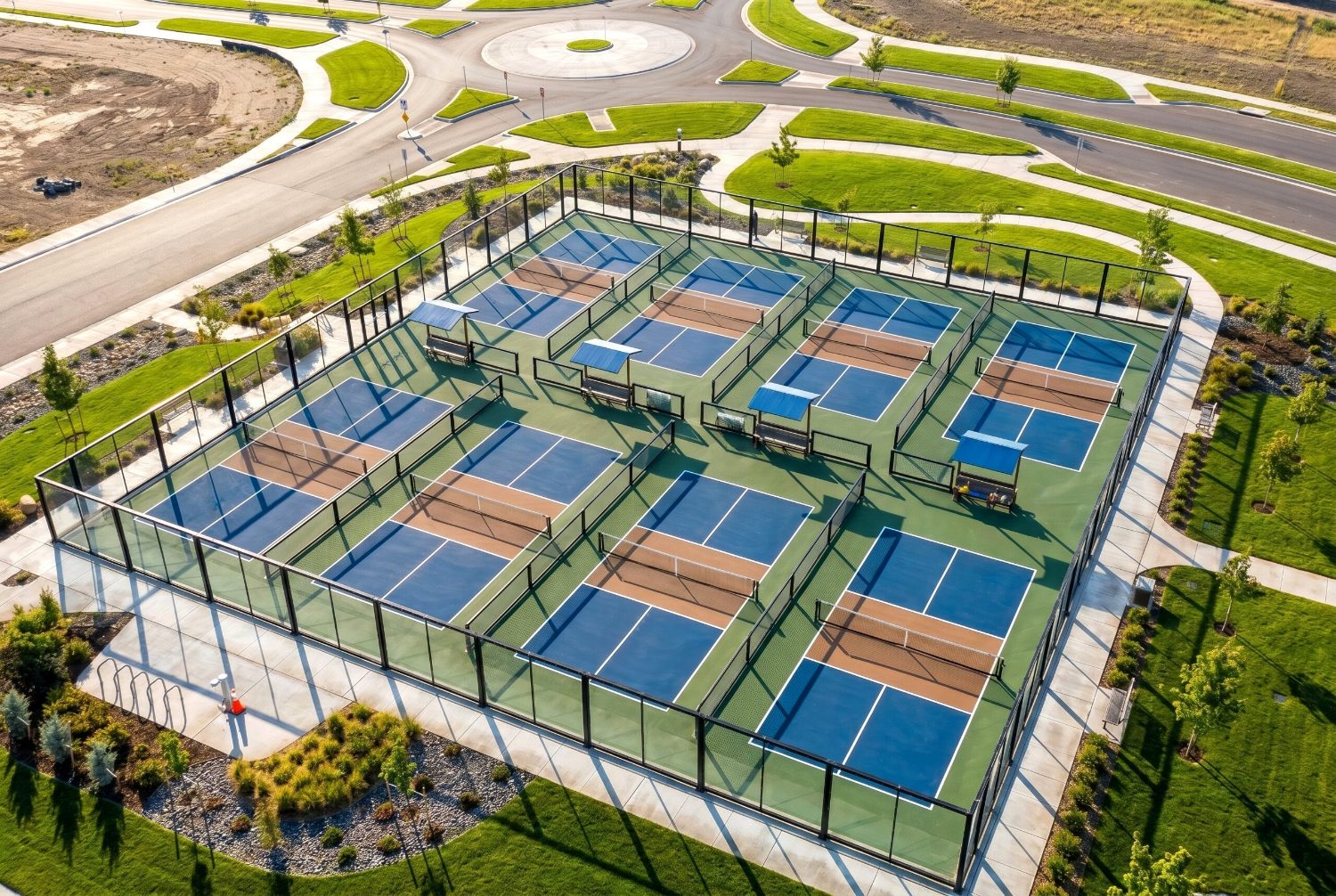
Pickleball court installation is the phase of a court project where the playing system goes in: base verification, surface application or tile placement, striping, net posts, and perimeter systems. On a sound existing concrete slab, installation of a modular tile system typically takes one to three days per court. Acrylic surfacing systems typically take one to two weeks per court because each coat must cure before the next. A full new build, including sitework and concrete cure, runs six to ten weeks or more.
Last updated: July 16, 2026.
Installation vs. construction: which one is your project?
The two terms get used interchangeably, but they describe different scopes.
Construction is the full ground-up sequence: design, permitting, excavation, drainage, base and slab work, then surfacing and appurtenances. If you are starting from raw ground, start with our guide to pickleball court construction.
Installation is the finishing sequence that turns a prepared base into a playable court. It is the right frame for projects that already have a slab (a former tennis court, a parking area conversion, an existing pad) and for facilities adding a surface system, fencing, lighting, or an enclosure to courts already roughed in.
Knowing which scope you are in changes budget, schedule, and who needs to be involved. It is the first question to settle in facility planning.
What gets installed, in order
A complete installation sequence covers five systems. Not every project needs all five.
1. Base verification and preparation
Every installation starts with the base. For existing slabs, that means a flatness and slope check (a 0.83 to 1 percent slope in one plane is the common target for drainage), crack assessment, and moisture testing. Minor cracking can be routed and filled; structural cracking or bad slope calls for grinding, overlays, or in some cases slab replacement. The requirements are covered in detail in our pickleball court base guide.
New concrete needs to cure before surfacing. Most acrylic manufacturers require 28 days of cure; modular tile systems can often go down sooner because the tile does not bond to the slab.
2. Surface system
The two dominant systems install very differently:
| System | Typical install time per court | Weather sensitivity | Base requirement |
|---|---|---|---|
| Acrylic coating system | 1 to 2 weeks (multiple coats, cure between coats) | High: needs dry conditions and surface temps roughly 50 to 90 F | Bonded: slab condition telegraphs through |
| Modular tile system | 1 to 3 days | Low: installs in most conditions | Floating: tolerates minor slab imperfections |
Which system fits your project depends on climate, slab condition, play characteristics, and maintenance appetite. The trade-offs are covered in pickleball court surface options.
3. Striping and layout
A pickleball court plays on a 20 by 44 foot lined area inside a larger pad (30 by 60 feet is the common recommendation). Acrylic courts are striped with line paint after the final color coat; tile courts are typically striped with factory-colored tile or applied lines. Layout accuracy matters most at the kitchen line. Full line specifications are in our pickleball court striping guide.
4. Net posts and hardware
Permanent net posts anchor into footings or sleeve anchors in the slab; portable systems sit on the surface. Multi-court facilities usually standardize on permanent posts for play quality and lower long-term handling.
5. Perimeter systems: fencing, lighting, enclosures
Fencing and lighting typically install after the surface is down and striped. For facilities where sound carries toward homes, lodging, or clubhouse space, an engineered enclosure such as a structural glass enclosure system can be integrated at this stage. Evening play requires purpose-designed court lighting, not repurposed area lights.
Realistic installation timelines
| Project type | Typical timeline |
|---|---|
| Modular tile on sound existing slab, single court | 1 to 3 days |
| Acrylic system on sound existing slab, single court | 1 to 2 weeks, weather permitting |
| Existing slab needing repair and leveling | Add 1 to 3 weeks ahead of surfacing |
| Multi-court installation (4 to 8 courts) on prepared bases | 2 to 6 weeks depending on system and crew sequencing |
| Full new build including sitework and concrete cure | 6 to 8+ weeks |
Two scheduling realities are worth planning around. First, acrylic work is weather-gated: rain, humidity, and cold extend the schedule, which is why northern-climate projects cluster surfacing into a seasonal window. Second, on multi-court projects, phased installation keeps part of the facility playable while the remaining courts go in, which matters for clubs and resorts that cannot take a full amenity offline.
What installation costs
Installation cost depends on which of the five systems your project needs and on base condition, and surface system pricing varies materially between acrylic and tile. Rather than quote a single number here, use the full cost breakdown in our pickleball court cost guide, which covers per-court ranges by scope.
Who handles installation
Surface systems are installed by the system provider or their trained crews; base work is typically performed by concrete and sitework trades; fencing, lighting, and enclosure systems come from their respective manufacturers or integrated providers. On multi-court commercial projects, the cleanest results come from engineering the court package as one integrated system so base tolerances, surface, striping, lighting, and acoustic enclosure are specified together rather than assembled from unrelated scopes.
That integration is where facilities avoid the most common installation failures: surfacing over a slab that was never verified, lighting that misses the court after fencing goes up, and noise problems discovered only after neighbors complain. For multi-court projects at clubs, resorts, communities, and parks, court infrastructure decisions made at installation time set the facility’s operating profile for the next decade.
Frequently asked questions
How long does it take to install a pickleball court?
On a sound existing slab, a modular tile court installs in one to three days and an acrylic court in one to two weeks. A full new build, including base construction and concrete cure, typically runs six to ten weeks or more.
Can a pickleball court be installed on an existing concrete slab?
Yes, if the slab is structurally sound with adequate slope. The slab is assessed for cracking, flatness, slope, and moisture first. Minor issues are repaired before surfacing; floating modular tile systems tolerate minor imperfections better than bonded acrylic.
What is the difference between pickleball court installation and construction?
Construction is the full ground-up build: design, permitting, sitework, base, and slab. Installation is the finishing phase that makes a prepared base playable: surface, striping, nets, fencing, lighting, and enclosure systems.
What time of year is best for pickleball court installation?
Acrylic surfacing needs dry weather and surface temperatures roughly between 50 and 90 F, so it clusters into spring through fall in most climates. Modular tile systems install in a much wider weather window.
Can courts stay open during a multi-court installation?
Usually, yes. Multi-court installations are commonly phased so a portion of the courts remains playable while the rest are installed, which is standard practice for clubs and resorts that cannot take the amenity fully offline.
