
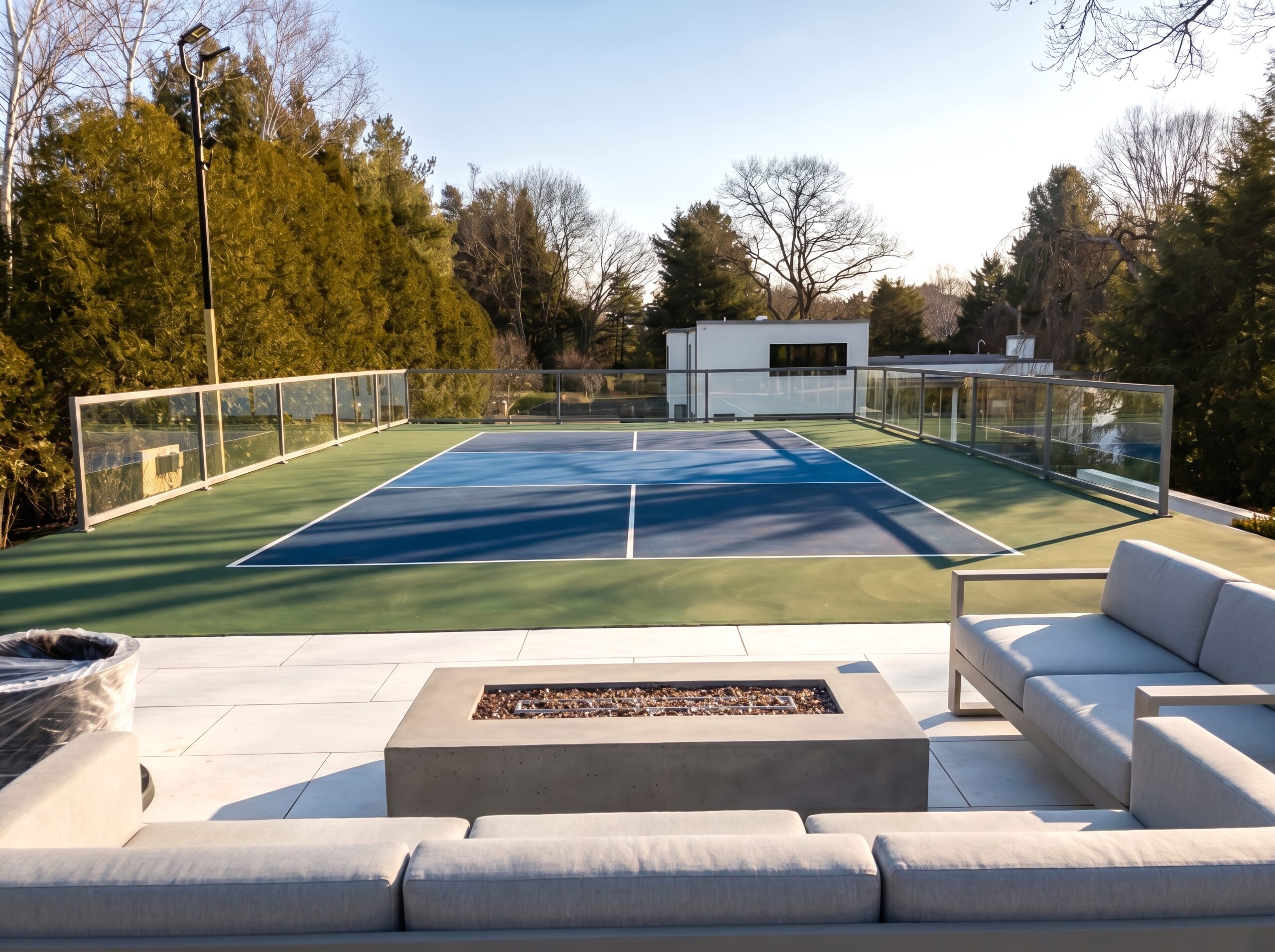
Which direction should a pickleball court face?
An outdoor pickleball court should be oriented with its long axis running north-south. Players face along the length of the court, so a north-south layout keeps the rising and setting sun out of both players’ sightlines for most of the playing day. This is the same convention used for tennis and other net sports, and it is reflected in American Sports Builders Association guidance for outdoor court construction.
The rule exists because of what a net sport asks of the eyes. Play happens at speed, at the net, with a ball arriving above the horizon line. A player looking into a low sun is not inconvenienced. They are effectively blind for the fraction of a second that decides the point. Orientation is the one glare control that costs nothing at design time and cannot be added later.
North-south is the starting answer. The rest of this guide covers the exceptions, the tolerances, and the way orientation interacts with everything else on the site plan, because on real sites orientation is a negotiation, not a compass reading.
Why north-south, precisely
The sun problem for a net sport has a specific geometry. Glare disables play when the sun is low, roughly the first and last two to three hours of daylight, and when it sits inside the cone of vision of a player looking down the court toward the opposite baseline.
Run the court east-west and the low sun sits directly in one player’s face every morning and the other player’s face every evening, during exactly the hours when recreational and league play concentrates: before work and after work. Run the court north-south and the low sun sits off to the side of both players’ sightlines. Neither player looks into it; both simply play with it in their peripheral field.
Midday sun is high enough that orientation barely matters, which is why the rule is written around mornings and evenings. Facilities that program dawn and dusk play, which in practice is most facilities in hot climates where midday is unplayable in summer, get the most value from getting this right.
Two refinements are worth knowing.
True north, not magnetic north. Site plans are drawn to true north. Magnetic declination varies by region and can be off by 10 degrees or more, so a court laid out by compass can miss the intended orientation by enough to matter.
A deliberate rotation is sometimes better than exact north-south. Some designers rotate the long axis slightly, commonly up to around 10 to 20 degrees, to bias protection toward the hours a specific facility actually plays. A venue with heavy evening league play may rotate to favor the setting sun’s arc in its latitude and season. This is a refinement, not a correction: the further the rotation drifts toward east-west, the more playing hours it costs.
When sites cannot give you north-south
Orientation competes with everything else the parcel wants to do, and it loses more often than designers admit. The realistic question on constrained sites is not whether to deviate but which deviation costs least.
The common forcing conditions are parcel geometry that runs the wrong way, existing pads being converted from other uses, setback and easement lines, and the layout efficiency of multi-court banks. When the site forces a choice, the practical hierarchy looks like this: full north-south, a rotation of up to roughly 20 degrees, a rotation approaching 45 degrees with mitigation, and finally east-west with the acceptance that low-sun hours will be compromised on open courts.
Mitigation is real but partial. Perimeter windscreens on fencing cut low-angle glare from the sides. Trees, buildings, and terrain to the east and west shorten the exposed hours. Canopy and shade systems change the calculation entirely, since a covered court takes direct sun out of play. And indoor courts make orientation irrelevant, which is one reason conversions of existing structures skip this problem completely.
One case deserves its own note. Tennis courts being converted to pickleball inherit the tennis orientation, and since tennis follows the same north-south convention, a well-oriented tennis pad yields well-oriented pickleball courts. Pickleball courts laid out sideways across a tennis footprint, however, rotate the play axis 90 degrees and turn a correctly oriented pad into an east-west problem. Court count and orientation trade against each other in conversion layouts, and our guide to tennis court to pickleball conversions covers how that trade is evaluated.
Orientation in multi-court facilities
Orientation decisions compound at facility scale. A bank of eight courts locked east-west is a facility-length mistake, repeated eight times, for the life of the concrete.
Multi-court banks are typically laid out side by side along a shared spine, all courts parallel, which means one orientation decision governs the entire bank. The site work consequences follow from that: the pad drains as one plane regardless of how many courts sit on it, so orientation, grading, and drainage get decided together. How that single-plane requirement works is covered in our guide to pickleball court drainage.
Orientation also sets up the lighting design. Fixture placement, pole locations, and aiming angles are planned around the play axis, and a north-south bank gives the lighting designer symmetrical conditions to work with. Facilities that will program night play should resolve orientation and lighting as one decision; our guide to pickleball court lighting covers the fixture side. Wind exposure follows the same logic, since fencing and windscreen loads depend on which way the long fence lines run relative to prevailing wind. Fence engineering is covered in pickleball court fencing.
Finally, orientation interacts with noise. The open ends of a court bank project sound along the play axis, and rotating a bank changes which neighbors receive that sound. On sites with residential edges, acoustic planning and orientation belong in the same conversation, early, when both are still cheap to change.
Where orientation sits in the planning sequence
Orientation is a first-week decision that behaves like a permanent one. It is fixed the moment the pad is formed, and every later system, lighting, fencing, shade, drainage, conforms to it.
In a well-run project the sequence is: program (how many courts, played when, by whom), site selection and geotechnical review, orientation and grading concept, then the layout geometry of courts, spacing, and circulation. The court dimensions themselves, including the 20 by 44 foot playing lines and the recommended margins around them, are covered in pickleball court dimensions, and the full sequencing of a build is covered in pickleball court construction. For owners and developers weighing programming, court count, and site fit before any geometry is drawn, pickleball facility planning is the place to start.
The pattern worth noticing across all of these decisions is that the cheapest fixes in court construction are the ones made on paper. Orientation is the purest example in the entire scope: it costs the same to pour a pad facing the right way as the wrong way, and no budget after that day can buy the difference back.
If you are planning a court, a bank of courts, or a facility on a site where orientation is contested, an instant estimate will put real numbers to the layout options, so orientation, court count, and site work can be weighed together rather than one at a time.
Frequently asked questions
Which direction should a pickleball court face?
Long axis north-south. Players face along the length of the court, and a north-south layout keeps the low morning and evening sun out of both players’ sightlines. The convention comes from tennis and is reflected in American Sports Builders Association guidance for outdoor courts.
Why is east-west orientation bad for pickleball courts?
An east-west court points one player directly into the rising sun and the other into the setting sun, during the early and late hours when most recreational play happens. At those sun angles a player looking down the court is briefly unable to track the ball, which affects both playability and safety at the net.
Is exact north-south required, or is a rotation acceptable?
Rotations up to roughly 10 to 20 degrees off true north are common and sometimes deliberate, biasing glare protection toward the hours a facility actually plays. Protection degrades as the axis rotates further, and layouts approaching east-west need mitigation such as windscreens, shade structures, or screening vegetation.
Does court orientation matter for indoor or covered pickleball courts?
No. Direct sun is out of play under a roof or canopy, so indoor and covered courts are oriented for building geometry, structure, and circulation instead. This is one reason covered facilities have more layout freedom on constrained parcels.
Do converted tennis courts have the right orientation for pickleball?
Usually, if the pickleball courts run the same direction as the original tennis court, since tennis uses the same north-south convention. Laying pickleball courts sideways across a tennis pad rotates the play axis 90 degrees and creates an east-west condition, so conversion layouts weigh court count against orientation.
