
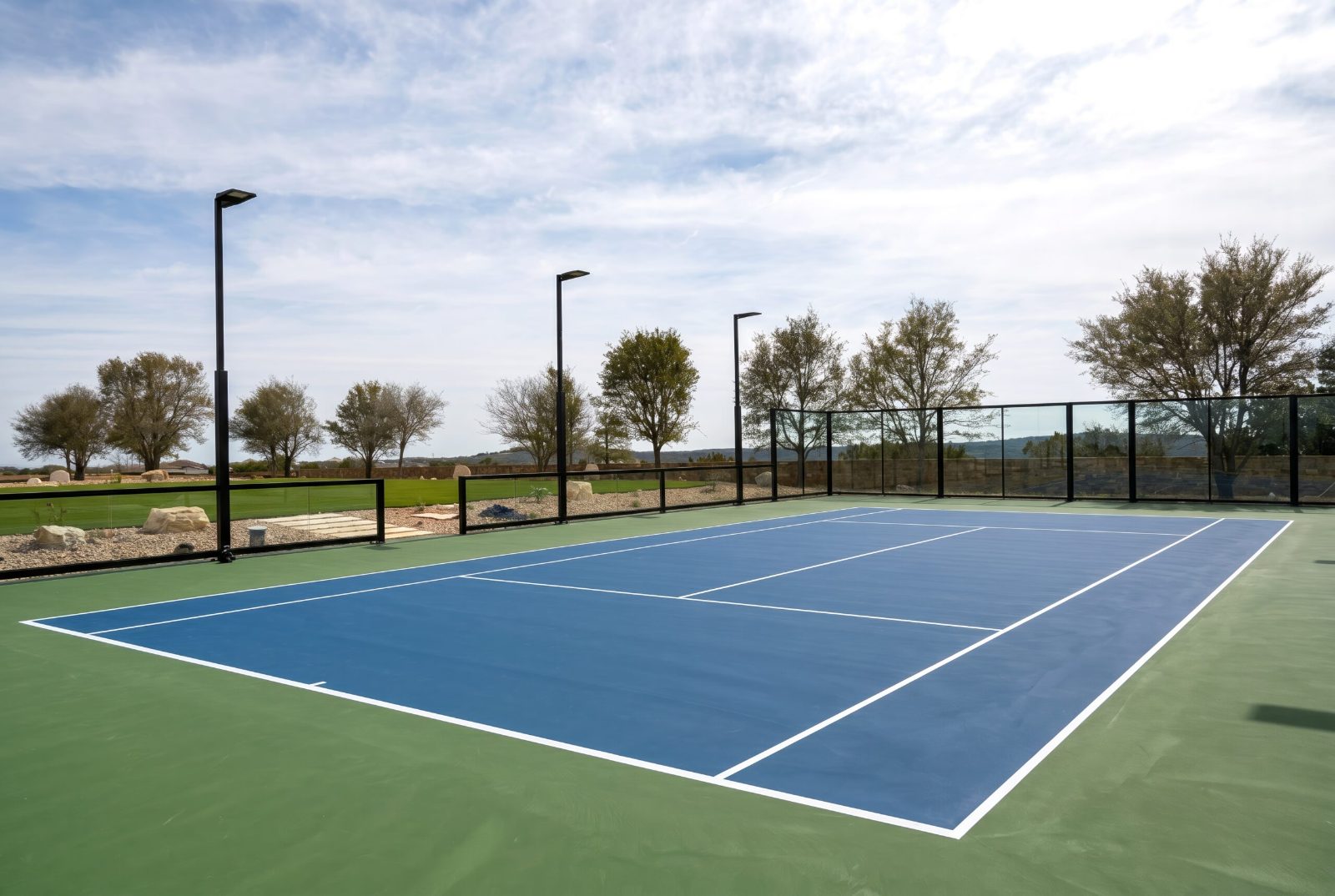
Pickleball Court Construction: The Complete Guide
Pickleball court construction is the process of designing and building a playing surface, its base, and the systems around it (drainage, surfacing, enclosure, lighting, and increasingly acoustics) into a facility that performs for decades rather than seasons. The phrase covers everything from painting lines on an existing slab to engineering a multi-court complex, which is exactly why estimates, timelines, and outcomes vary so widely.
This guide is the starting point for anyone planning a court or facility. It explains what construction actually involves, the sequence of decisions that determine quality, how long the work takes, and how to evaluate a builder before any money changes hands. Each major topic links to a deeper resource in this series so you can go as far into any one decision as your project requires.
What “pickleball court construction” actually includes
The single most useful thing to understand before budgeting or hiring is that a court is not one purchase, but a stack of engineered systems, each of which can be built well or built cheaply. The visible playing surface is the last and thinnest layer. Most of what determines whether a court still drains, plays true, and looks intentional ten years later is decided long before the color coat goes down.
A complete pickleball court project generally includes the following systems:
- Site work and base: grading, drainage, sub-base compaction, and the concrete or asphalt slab the court sits on.
- Playing surface system: the coating or cushioned system that controls ball response, traction, player comfort, and appearance.
- Dimensions and layout: the regulation playing area plus safety run-off and circulation, multiplied across however many courts the site supports.
- Enclosure: fencing, windscreen, or structural glass that contains play and, on most sites, manages sightlines and sound.
- Lighting: fixtures and pole design that extend usable hours without spilling glare onto neighbors.
- Acoustics: sound planning that, on residential and mixed-use sites, determines whether the facility can operate the hours it was built for.
Each of these carries cost and each is where scope gets quietly removed when a bid looks unusually low. We break down what each system costs and why two identical-looking courts can differ by tens of thousands of dollars in the dedicated guide to pickleball court cost.
The construction sequence, step by step
Court construction follows a fixed order because each stage depends on the one beneath it. Skipping or compressing an early stage to save time almost always reappears later as cracking, ponding, or premature failure.
1. Site assessment and design. Before any earth moves, the site is evaluated for slope, drainage, soil conditions, access, and what sits around it. This is where orientation, court count, footprint, and, critically, acoustic exposure are decided. A court designed around its site costs less to build and far less to live with than one dropped onto a site as an afterthought.
2. Excavation and grading. The area is cleared, leveled to the engineered slope, and prepared for the base. The slope is intentional: a court needs a slight, uniform pitch so water sheets off rather than pooling.
3. Base construction. A compacted sub-base is built up and the structural slab (concrete or asphalt) is poured or laid. This is the most expensive part of the project to get wrong and the least visible. Inadequate compaction or drainage here is the root cause of most courts that fail early.
4. Surfacing. Once the slab has cured, the playing surface system is applied: an acrylic coating over asphalt, or a cushioned or modular system engineered for comfort and consistent play. Lines are laid out to regulation geometry.
5. Enclosure, lighting, and amenities. Fencing or structural glass, lighting, nets, seating, and any shade or windscreen elements are installed.
6. Inspection and handover. The finished court is checked for surface tolerance, drainage performance, and line accuracy before it is put into play.
Most single outdoor courts take a few weeks of on-site work once design and permitting are complete, but weather, site conditions, and the surface system specified all move that timeline.
Pickleball court construction timeline, stage by stage
The ranges below are planning figures for a single outdoor court unless noted. Permitting varies most between jurisdictions and is the usual reason two similar projects finish months apart. For the finishing phase in more detail, see our guide to pickleball court installation timelines.
| Stage | Typical duration | What decides it |
|---|---|---|
| Permitting and approvals | Varies by jurisdiction | Zoning, and any noise or lighting conditions attached to approval |
| Repair and leveling of an existing slab | 1 to 3 weeks before surfacing | Cracking, slope, and flatness found at assessment |
| New concrete cure | 28 days before acrylic surfacing | Acrylic manufacturer requirements; modular tile can often go down sooner |
| Acrylic surfacing | 1 to 2 weeks per court | Cure time between coats, dry weather, surface temperature |
| Modular tile surfacing | 1 to 3 days per court | Slab condition; installs in most weather |
| Multi-court installation (4 to 8 courts) on prepared bases | 2 to 6 weeks | Surface system and crew sequencing |
| Full new build, including sitework and concrete cure | 6 to 8+ weeks | Site conditions, weather, and system specified |
Surface, dimensions, and enclosure: the three decisions that shape the result
Three choices do the most to determine how a finished court plays, lasts, and looks. Each has its own guide in this series.
Surface system. The surface controls ball bounce, footing, player comfort, and the resurfacing interval down the line. Coated asphalt is the lowest upfront cost; cushioned and engineered systems cost more but reduce joint impact and hold up better under heavy daily play. The surface is also a recurring cost: every court needs renewal on a cycle, which is why the resurfacing decision matters from day one. See pickleball court resurfacing for when to recoat versus rebuild and what it costs.
Dimensions and layout. A regulation pickleball playing area is 20 by 44 feet, but the recommended total court area, including run-off and circulation, is closer to 30 by 60 feet. Compressing the footprint to fit more courts or save money is one of the most common sources of regret, because it limits play quality and forecloses future changes.
Enclosure. Containment is the baseline, but on most sites the enclosure also defines the space architecturally, controls sightlines, and manages sound. Chain-link is the lowest-cost option and was designed for containment, not integration into a finished environment. Structural glass and acoustic-rated systems address aesthetic and sound performance that chain-link was never engineered to deliver. We compare the full set side by side in pickleball court fencing and enclosure systems.
Why acoustics belongs in the construction conversation
For most of the sport’s history, sound was treated as something to deal with after a court was built. That sequence is now the single largest reason new facilities get delayed, restricted, or shut down. The distinctive pop of pickleball carries further and reads as more disruptive than most ambient noise, and on residential, club, and mixed-use sites it has become a regulatory and community-relations issue, not just a nuisance.
The facilities that avoid this outcome treat acoustics as a design input during construction rather than a retrofit afterward. Planning for sound while the court is still on paper, through siting, orientation, and an acoustic-rated enclosure such as PICKLEGLASS™, is almost always less costly than reacting to complaints after the courts are in the ground. For the underlying problem and the playbook, see how to reduce pickleball noise, and for the municipal rules increasingly written into approvals, see our guide to pickleball noise regulations.
Building new versus converting an existing court
If you already have a tennis court or an unused hardcourt, conversion is frequently the most cost-effective route to playable pickleball, because the base and much of the site work already exist, and the base is the most expensive part of new construction. Whether conversion makes sense depends on the condition of the existing slab and how many courts you want to fit. We cover the layouts and economics in converting a tennis court to pickleball.
Pickleball court construction checklist: how to evaluate a builder
The search terms most people start with (“pickleball court builder,” “pickleball court contractors near me”) return a long list of providers whose proposals are difficult to compare because they describe different scopes under the same name. Before comparing on price, make every proposal answer the same questions. Use the seven items below as a pickleball court construction checklist when you review bids side by side:
- What base and drainage work is included, and what specifically happens on this site?
- What surface system is specified (coated asphalt, or an engineered cushioned system), and what is its resurfacing interval?
- What is the total court footprint, including run-off and circulation?
- What enclosure is included, and does it address sound and sightlines or only containment?
- Is the lighting designed to control glare and light spill onto adjacent properties?
- Has anyone assessed acoustics for this site, given what sits next to it?
- What is the expected service life of each system, and who is accountable if it underperforms?
A proposal that cannot answer these is not cheaper. It is less complete, and the gaps reappear as cost later. The most reliable signal of a capable builder is not the lowest number; it is the one who can explain the engineering behind each line and stands behind the whole system rather than a single trade.
From building a court to engineering a facility
The conventional way to think about court construction is as a one-time purchase: pick a builder, get the lowest defensible price, put a playable surface on the ground this year. That framing answers a narrow question and quietly accepts whatever was left out of the scope to hit the number.
The more useful frame is infrastructure. A court built as infrastructure is engineered for how it drains, how it plays, how it sounds to the people who live nearby, and how it ages alongside the architecture around it, and it is delivered as an integrated system rather than assembled from disconnected trades with no single point of accountability. That is the difference between building a court and engineering a facility, and it is the difference that shows up not in the first invoice but in the next twenty years of ownership. Communities, clubs, and developers who plan for durability, acoustics, and integration during construction consistently spend less over the life of the facility, and end up with something that still serves its purpose, and reflects well on the property, long after the cheapest version would have needed replacing.
Frequently asked questions
How long does pickleball court construction take?
Once design and permitting are complete, a single outdoor court typically takes a few weeks of on-site work: excavation and base, curing, surfacing, then enclosure and lighting. Site conditions, weather, and the surface system specified can extend that timeline; multi-court complexes take longer.
What is the right order of construction steps?
Site assessment and design, then excavation and grading, then base construction, then surfacing, then enclosure, lighting, and amenities, then inspection and handover. Each stage depends on the one beneath it, which is why compressing the early stages causes problems later.
Is it cheaper to convert an existing court than to build new?
Usually, yes. Conversion reuses the existing base and site work, the most expensive elements of new construction. The savings depend on the condition of the existing slab and the layout you want to fit.
What should I ask a pickleball court builder before hiring?
Ask what base and drainage work is included, what surface system is specified and its resurfacing interval, the total footprint including run-off, what the enclosure addresses beyond containment, whether lighting controls glare and spill, whether acoustics were assessed for the site, and the expected service life of each system. Comparing complete proposals, not just prices, is the only way to know what a number actually buys.
