
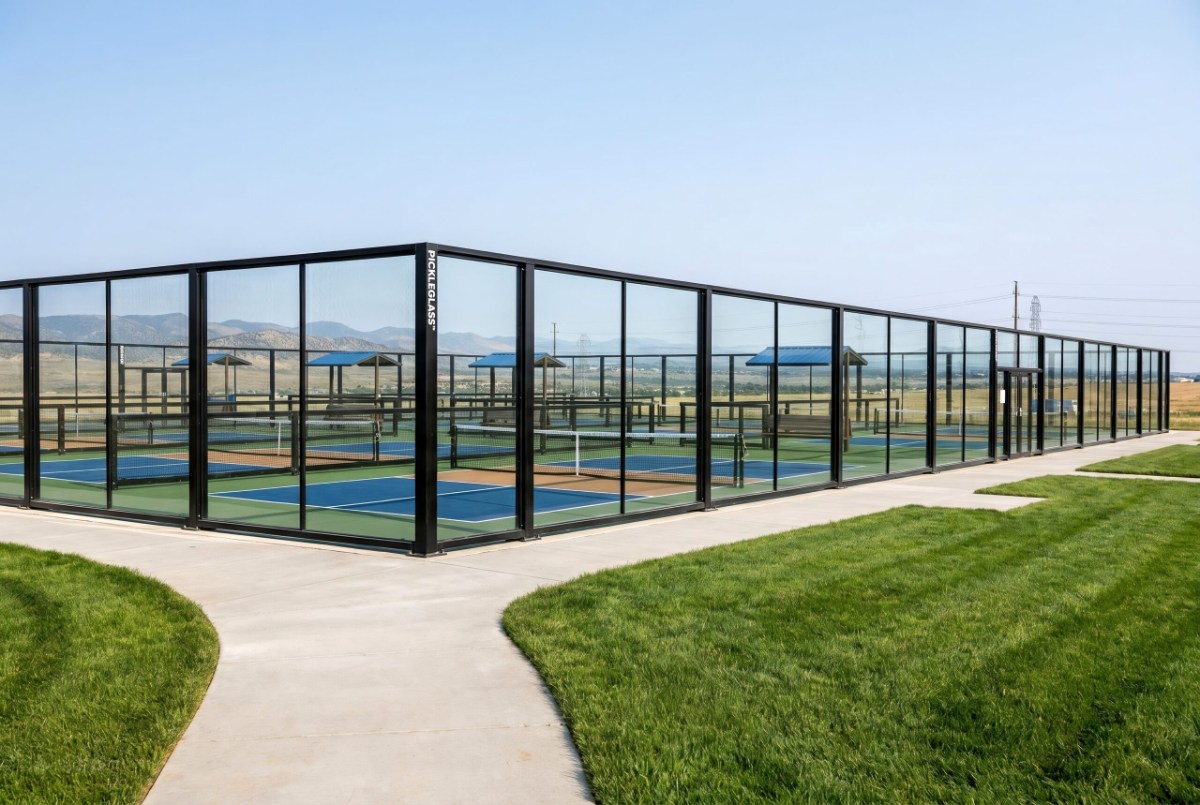
How is a pickleball court drained?
An outdoor pickleball court is drained by sloping the entire playing surface in a single plane at roughly one percent, so that water crosses the court in one direction and leaves at a defined edge. Where the subgrade holds water or the surrounding grade sends water toward the court, that surface slope is supplemented by subsurface drainage: a perimeter drain, an underdrain field, or a trench drain at the low side.
There is no drain in the middle of a court. Everything depends on getting the plane right and giving the water somewhere to go once it reaches the edge.
That sounds like a small detail. It is the detail that most often determines whether a court needs surface repair at year four or year twelve.
The one-percent standard, and what it actually means
Industry practice for outdoor hard courts, reflected in American Sports Builders Association guidance, is a slope of one percent, which is one inch of fall for every eight feet of run. Common tolerance allows a range of roughly 0.83 to 1.0 percent, and many specifications write the slope as a minimum rather than a target for exactly that reason.
Three points about that number are worth stating precisely, because they are the ones that get lost between the drawing and the field.
It is a single plane, not a crown. A crowned court, high in the middle and falling to both sides, halves the distance water has to travel but introduces a ridge across the playing area. Standard practice for pickleball and tennis is a single plane across the full court and its perimeter apron. Side-to-side is generally preferred over end-to-end, because it moves water across the shorter dimension and keeps the fall out of the direction of play.
It applies to the finished surface, not the subgrade. The subgrade, the base, and the finished coating each have their own tolerance. If the subgrade is built to the low end of tolerance and the slab is poured to the low end of its own, the finished plane can land below the specified slope even though every individual layer passed inspection. This is the most common mechanism by which a court that was designed to drain does not.
A multi-court bank is one plane, not several. Four courts side by side drain as a single sheet across the whole pad. Designing each court to its own slope creates valleys at the shared lines, and those valleys collect water precisely where players stand between courts.
The tolerance question is not academic. At one percent, a 44-foot court dimension falls about 5.5 inches end to end. Half a percent of construction error on a surface that size is enough to hold standing water in a low spot.
The nickel test, and how flatness is verified
The field check for ponding is straightforward. After the surface has been flooded or after a rain, water remaining anywhere on the court deeper than the thickness of a nickel, about 1.6 millimeters, roughly one hour after the rain stops, is generally treated as a defect requiring correction. Many specifications write it exactly that way.
Two things make this test useful. It is objective, and it is performed at a moment when correction is still the builder’s responsibility rather than the owner’s. A court accepted without a flood test is a court whose drainage performance is unknown until the first heavy rain, at which point the argument about who pays has already started.
Ask for the flood test to be a documented milestone in the construction schedule, with photographs, and ask that acceptance be conditional on passing it.
When surface slope is not enough
Slope moves water off the court. It does not address water moving toward the court, or water sitting under it. Subsurface drainage becomes necessary in a defined set of conditions.
Poorly draining subgrade. Clay and other fine-grained soils hold water. Water trapped beneath a slab or an asphalt base cycles through freeze and thaw in cold climates and contributes to differential movement in any climate. Where a geotechnical report identifies low-permeability soils, an aggregate drainage layer with a perforated underdrain beneath the base is standard.
High groundwater or seasonal water table. If the water table rises to within a few feet of the base, hydrostatic pressure acts on the underside of the pad. An underdrain system set below the base intercepts it.
Sites that receive water from uphill. A court cut into a slope receives sheet flow and, in heavy rain, subsurface flow along the cut face. An interceptor drain, a swale, or a curb on the uphill side redirects that flow before it reaches the pad. This is the failure that produces silt deposits on a court after every storm.
Enclosed and sunken courts. A court set below surrounding grade, or one enclosed on all sides such that the perimeter is obstructed, has no free edge for water to leave across. These require a trench drain at the low side, tied to a storm system or to a suitable outfall.
Expansive soils. Where soils shrink and swell with moisture content, keeping moisture content stable under the slab is a structural requirement, not a comfort one. Moisture variation at slab edges is a principal driver of the differential movement that cracks a court diagonally from a corner.
The drainage components you will see on a drawing
Perimeter drain. A perforated pipe in a gravel envelope, wrapped in filter fabric, running around the pad below base elevation. Collects water from the aggregate layer and carries it to an outfall.
Underdrain field. A grid or herringbone of perforated pipe beneath the base, used where the subgrade is broadly poor rather than only locally wet.
Trench drain, sometimes called a channel drain. A linear grated drain set flush with the surface at the low edge. Used where there is no free edge to sheet across. It is the most visible drainage element and the one most often value-engineered out, usually to the owner’s later regret on sunken sites.
Catch basin. A collection box at a low point of the surrounding grade, not on the court itself, tied into a storm line.
Filter fabric. A geotextile separating the aggregate drainage layer from the surrounding soil. Without it, fines migrate into the aggregate and the drainage layer stops draining within a few years. It is inexpensive and routinely omitted.
Outfall. Where the collected water actually goes. Daylighting to a swale, connection to a storm system, or discharge to a detention feature. A drainage system without a confirmed outfall is a system that fills up.
That last point deserves emphasis. Perimeter drain shown on a plan with no outfall detailed is a common drawing error on court projects. It is worth checking specifically.
What drainage failure looks like on a finished court
The symptoms are ordered here roughly by how early they appear.
Ponding after rain. The direct symptom. Beyond playability and slip risk, standing water is the leading cause of premature coating failure.
Surface discoloration and staining. Persistent dark patches trace the outline of where water sits, and are the visible record of a low spot even on a dry day.
Coating blistering and delamination. Water trapped between the coating and the base migrates as vapor pressure under sun load and lifts the coating. This is the mechanism that turns a drainage defect into a resurfacing bill.
Algae and biological growth. A slip hazard and an ongoing cleaning cost, concentrated in the same low spots.
Edge cracking and joint deterioration. Water infiltrating at the perimeter undermines edge support.
Structural cracking and vertical displacement. The late-stage outcome on expansive or poorly drained subgrade. When two sides of a crack sit at different heights, the problem is base movement, and resurfacing will not fix it. This is the boundary at which repair becomes reconstruction.
The distinction between the first four and the last one matters commercially. Surface-level drainage symptoms are correctable with grinding, patching, and recoating. Base movement driven by subgrade moisture is not, and correcting it means removing and rebuilding the pad.
Drainage on tennis-to-pickleball conversions
A conversion inherits whatever drainage the original court had, including its defects, and adds a constraint the original did not have.
The original tennis court was sloped in one plane across a 60 by 120 foot area. Placing two, three, or four pickleball courts inside that footprint does not change the plane, but it does change where players stand and where they expect firm footing. A low spot that sat harmlessly in a tennis doubles alley may now sit inside a pickleball kitchen.
Before committing to a court count on a conversion, flood the existing pad and map where water sits. That map, more than the dimensional arithmetic, tends to determine the workable layout. It also determines whether the conversion is a resurfacing project or a reconstruction project, which is a difference of an order of magnitude in scope.
If the existing court is cracked with vertical displacement at the crack, drainage is already failing at the base and an overlay will telegraph the same crack within one to three seasons.
Maintaining drainage after the court is built
Drainage is one of the few court systems that degrades from neglect rather than from use.
Keep perimeter drains and trench drain grates clear of leaves, seed, and silt. A blocked trench drain converts a well-drained court into a sunken basin.
Flush perforated drain lines periodically where site conditions bring in fines.
Maintain the grade immediately outside the court. Landscaping built up over years against a court edge will eventually direct water back onto the pad.
Keep the surface itself clean. Accumulated organic debris holds moisture against the coating and accelerates the same failures that ponding causes.
Re-run the flood test after any resurfacing. A recoat applied over a low spot preserves the low spot.
Frequently asked questions
What slope does a pickleball court need for drainage?
One percent in a single plane, which is one inch of fall per eight feet, with common tolerance allowing roughly 0.83 to 1.0 percent. The slope runs across the court rather than end to end wherever site conditions allow, and it covers the full pad including the perimeter apron, not just the lines of play. Crowned courts are not standard practice for pickleball.
Can a pickleball court be built completely flat?
Only indoors. An outdoor court built without slope will hold water across its whole surface, and the coating will fail early and generally. Indoor courts are built level because there is no rainfall to shed, though even indoors a floor drain is usual for washdown.
How long should water take to drain off a pickleball court?
Practical guidance is that the court should be playable and free of standing water within about an hour after rain stops. The nickel test formalizes this: water deeper than about 1.6 millimeters remaining at that point indicates a low spot that needs correction.
Does a pickleball court need a French drain?
Only if the subgrade holds water, groundwater is high, or the site sends water toward the court. On a well-draining site with positive grade away from the pad, surface slope alone is generally sufficient. The determining document is the geotechnical report, which is why skipping geotechnical investigation on a court project is a false economy.
Will resurfacing fix a court that ponds?
Sometimes. If the ponding comes from a localized low spot in the coating or from a shallow depression, patching and leveling during resurfacing can correct it. If the ponding comes from an incorrect slope built into the slab or from base movement, resurfacing preserves the geometry that causes the problem and the ponding returns. Diagnosing which case applies before scheduling a recoat is the single most useful thing an owner can do here.
Related reading
Pickleball court base, slab and subgrade specification
Pickleball court construction, the full build sequence
Pickleball court repair, diagnosing surface distress versus base movement
Pickleball court resurfacing, scheduled recoating
Pickleball court installation, what goes in and how long each stage takes
Pickleball court surface options
Configuring tennis court to pickleball court conversions
Planning a new court, or trying to work out whether an existing one can be saved? Start with an instant estimate to establish the scope you are dealing with.
