
Last updated: July 15, 2026
Country clubs add pickleball courts for one reason: members are asking for them. The planning questions that follow are the same at nearly every club. How many courts do we need? Do we convert underused tennis courts or build dedicated courts? What do we do about noise near homes and outdoor dining? And how do we build courts that look like they belong at the club rather than at a public park?
This guide walks through each of those decisions the way a club board, general manager, or racquets committee typically encounters them, from demand planning through design standards.
How many courts a club actually needs
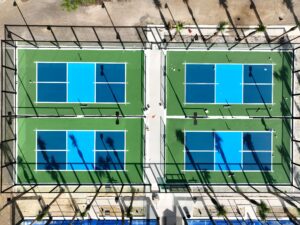
The most common planning mistake at private clubs is building too few courts. Pickleball is a social, rotation-based sport: open play, round robins, clinics, and leagues all depend on multiple courts running simultaneously. A single court serves 4 players an hour; a bank of courts serves a program.
Reasonable planning benchmarks for clubs:
Two to three courts supports casual member play but limits programming. Clinics and organized play will regularly fill it, and prime-time crowding becomes a member-relations issue quickly at clubs with active racquets programs.
Four to six courts is the practical starting point for a club that intends to program pickleball: leagues, clinics, member mixers, and open play blocks can coexist. This is the range where most clubs that started with two courts end up after their first expansion.
Eight or more courts positions the club for tournaments, interclub play, and large social events, and gives the racquets staff real scheduling flexibility.
Demand tends to grow after courts open, not before, because visible courts recruit new players from the existing membership. Clubs that phase their build should plan site area, utilities, and acoustic strategy for the full future court count even if fewer courts are poured in phase one. Our pickleball facility planning guide covers demand modeling and phasing in more depth.
Convert tennis courts or build dedicated courts
Most clubs face this choice first, because underused tennis courts are usually the most available flat, drained, fenced real estate on the property.
Conversion suits clubs with genuinely surplus tennis inventory. One tennis court footprint accommodates two to four pickleball courts depending on layout and orientation. Conversion reuses existing base, drainage, and often fencing and lighting, which shortens the schedule. The tradeoffs: shared-use striping compromises both sports, converted layouts can inherit orientation and spacing constraints, and tennis-committee politics are real. Layout options, spacing, and orientation are covered in our tennis court to pickleball conversion guide.
Dedicated construction suits clubs where tennis demand remains strong or where the club wants pickleball sited intentionally, for example adjacent to dining and social spaces rather than at the far end of the tennis complex. New construction allows correct orientation, purpose-built spacing, sound planning from the first drawing, and surfaces selected for pickleball rather than inherited from tennis. The full build sequence is in our pickleball court construction guide, and budget components are in the pickleball court cost guide.
Many clubs land on a hybrid: convert one or two tennis courts now to prove demand, with a master plan for a dedicated pickleball venue in the next capital cycle. If that is the path, the conversion should be executed to standards the club is willing to live with for years, because temporary courts have a way of becoming permanent.
Noise: the issue that reaches the board first
Pickleball’s acoustic signature, a hard paddle striking a hard ball roughly 1,000 times an hour per court, is the single most common source of conflict when courts sit near homes, patios, or quiet amenities. At country clubs the exposure is structural: many clubs are surrounded by residential lots, often owned by their own members, and outdoor dining, pools, and golf greens all compete for acoustic calm.
Noise planning belongs in the site-selection phase, not after the first complaint letter. The core variables:
Distance and siting. Sound pressure falls with distance, but on a club property there is rarely enough distance to solve the problem alone. Court placement relative to homes, dining terraces, and prevailing terrain is the first acoustic decision.
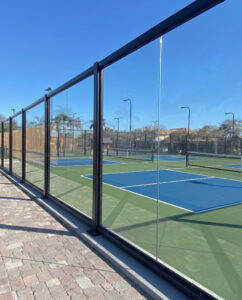
Acoustic barriers and enclosures. Engineered acoustic barriers, and structural glass enclosure systems in particular, intercept sound at the source. Glass systems address the club context directly because they attenuate noise without walling the courts off visually: sightlines, ambiance, and the social character of the racquets area survive. The engineering behind acoustic-rated structural glass enclosures is covered on our PICKLEGLASS page, and mitigation strategies more broadly in our pickleball noise reduction guide.
Playing hours and programming. Scheduling is a mitigation tool, but clubs should treat it as a supplement. A club that relies on restricted hours to manage noise has accepted a permanent constraint on its own amenity.
Local rules. Municipal noise ordinances apply to private clubs, and neighboring homeowners can and do invoke them. A pre-construction acoustic assessment, measured against the applicable ordinance and the club’s own tolerance for member complaints, is inexpensive relative to retrofitting mitigation after courts open.
Design standards worthy of the club
Members judge a pickleball facility against the standard of everything else the club builds. A chain-link rectangle with a portable net reads as an afterthought; courts integrated into the club’s architecture read as an investment in the membership. Elements that separate club-grade courts from commodity courts:
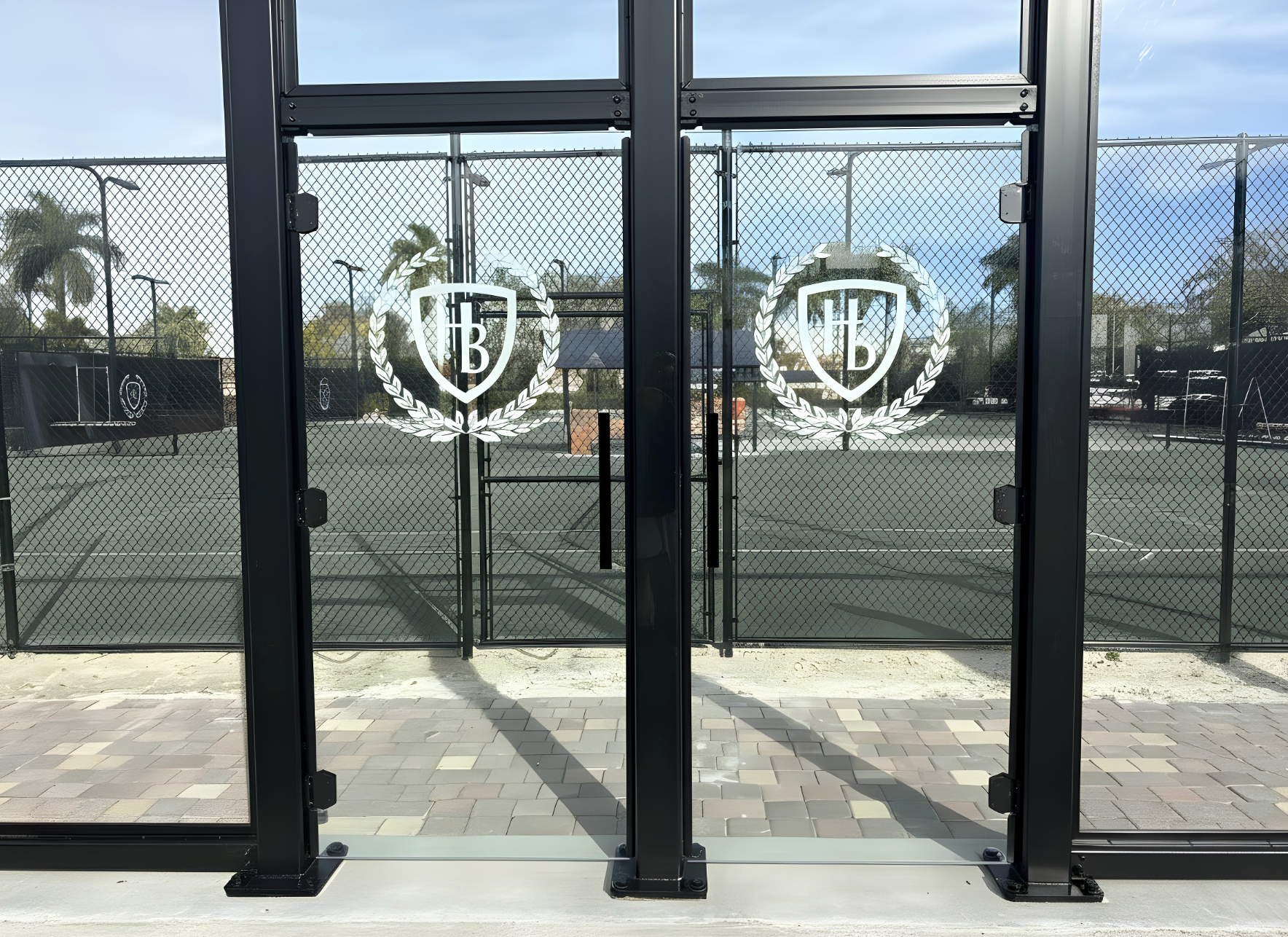
Enclosures and fencing. Fencing is the most visible vertical element on any court. Structural glass enclosures and architectural fencing systems replace the chain-link vocabulary with one that matches clubhouse architecture, and glass carries the acoustic benefit described above. Fencing options are compared in our pickleball court fencing guide.
Surfaces. Cushioned acrylic systems and engineered court tiles play differently and age differently than bare asphalt with paint. Surface selection should weigh member demographics (joint comfort matters to a large share of club pickleball players), maintenance capacity, and climate.
Lighting. Evening social play is where club pickleball programs thrive. LED systems designed for court lighting, with proper pole placement, uniformity, and glare and spill control toward neighboring homes, extend programming hours without extending the noise footprint into complaint territory. Standards are covered in our pickleball court lighting guide.
Spectator and social space. Pickleball at a club is a social program with a sport attached. Shade structures, seating between courts, proximity to food and beverage, and circulation for open-play rotation are design inputs, not landscaping afterthoughts.
The infrastructure standard
The clubs getting pickleball right treat courts the way they treat any permanent amenity: as engineered infrastructure with a design life, an acoustic plan, and an architectural identity, delivered by a partner accountable for the whole system rather than assembled from disconnected vendors. Clubs that build to that standard end up with a facility that recruits members, hosts revenue-generating programming, and coexists with the neighborhood. Clubs that build to the commodity standard end up rebuilding.
Frequently asked questions
How many pickleball courts should a country club build?
Four to six courts is the practical starting point for a club that intends to program pickleball with leagues, clinics, and open play. Two to three courts supports casual play only, and demand typically grows after courts open. Plan the site for the full future court count even if construction is phased.
Can a country club convert tennis courts to pickleball courts?
Yes. One tennis court footprint accommodates two to four pickleball courts depending on layout, and conversion reuses existing base, drainage, and often lighting. Conversion suits clubs with surplus tennis inventory; clubs with strong tennis demand usually site dedicated pickleball courts instead.
How do country clubs handle pickleball noise near homes?
Effective programs combine siting decisions made before construction, engineered acoustic mitigation such as structural glass enclosure systems that intercept sound at the source, and programming policies. Distance alone rarely solves noise on a club property, and restricted hours alone constrain the amenity.
Do glass enclosures work for club pickleball courts?
Structural glass enclosure systems address the two club-specific requirements at once: they attenuate the paddle strike noise that generates complaints from adjacent homes, and they preserve the sightlines and architectural character that clubs expect from their amenities.
What does it cost a club to add pickleball courts?
Cost depends on court count, whether the project converts existing tennis courts or builds new, and the enclosure, surface, and lighting systems selected. Component-by-component budget ranges are covered in our pickleball court cost guide.
