
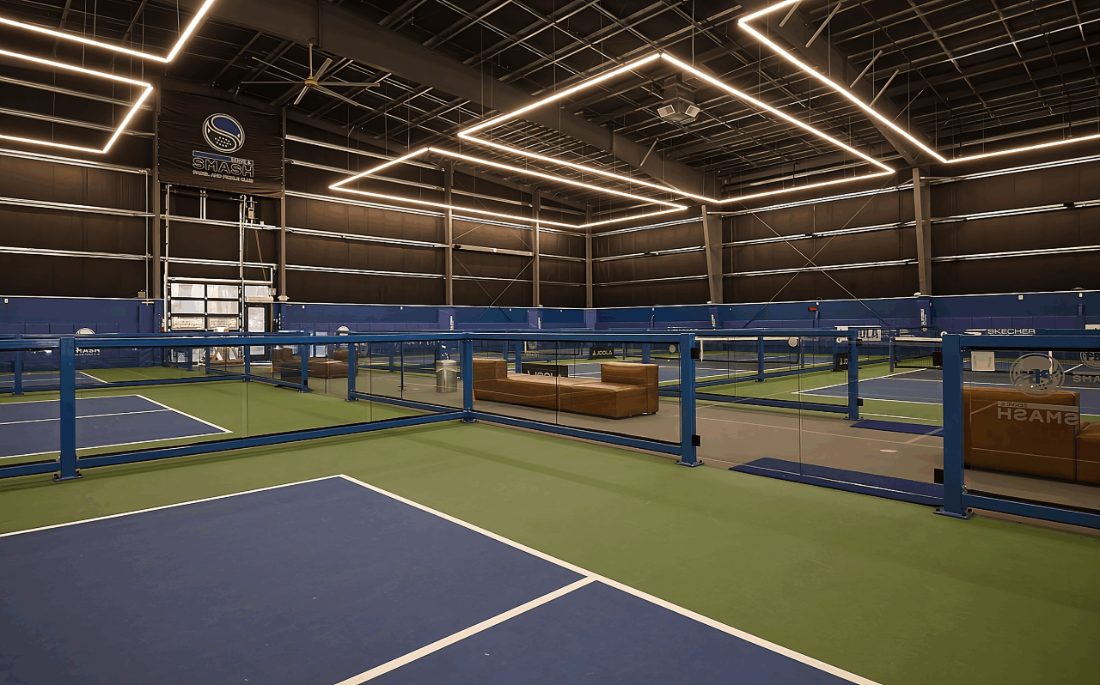
Pickleball court striping is the process of laying out and painting the regulation lines that define a court: baselines, sidelines, centerlines, and the non-volley zone. Done correctly, striping follows USA Pickleball dimensional standards, uses textured acrylic line paint compatible with the court surface, and holds crisp edges for years of play. Done poorly, it is the first thing players notice and one of the most common reasons a new court needs rework.
This guide covers the regulation line layout, the striping process, color selection, multi-sport overlays on shared courts, and when a court should be restriped.
Regulation pickleball court lines
A regulation pickleball court measures 20 feet by 44 feet, measured to the outside of the lines. Every line on the court is 2 inches wide and is considered in play.
The full line set consists of: baselines at each end of the court, sidelines along each side, a non-volley zone line 7 feet from the net on each side (creating the area commonly called the kitchen), a centerline dividing each service area from the non-volley zone line to the baseline, and the service court boxes those lines create, each measuring 10 feet by 15 feet.
Because the 20 by 44 foot dimension is measured to the outside edge of the lines, layout crews snap their reference lines to the outer boundary and paint inward. Getting this convention wrong shifts every interior line on the court, which is why professional layout starts with verified corner-to-corner diagonal measurements before any paint is applied.
The striping process
On acrylic hard courts, striping is the final step of the surfacing sequence and follows a consistent process.
First, the surface must be clean, fully cured, and dry. New acrylic color coats typically need several days of cure time before line paint is applied. Second, the court is measured and the line positions are snapped with chalk or laser layout, then masked with tape rated for textured surfaces. Third, a primer or edge sealer is often applied along the tape line to prevent bleed under the tape, which is what produces a crisp edge. Fourth, two coats of 100 percent acrylic line paint are applied, formulated with fine texture so the painted line offers the same footing as the surrounding surface. Finally, tape is pulled while the last coat is still slightly soft, and the lines are inspected against layout measurements.
The texture point matters more than most owners expect. Untextured line paint creates a slick 2 inch strip exactly where players plant for volleys at the non-volley zone line. Line systems engineered for sport surfaces maintain consistent friction across the color coat and the line.
Line color and contrast
USA Pickleball recommends line colors that contrast clearly with the playing surface. White is the most common choice and works against most standard color schemes, including blue and green two-tone courts.
The practical standard is contrast, not a specific color. On lighter surfaces, some facilities specify black or dark blue lines. What matters for play, broadcast, and dispute-free officiating is that the line reads instantly against both the court interior and the surrounding apron color. Facilities planning a multi-court complex should hold one line color standard across all courts so play reads consistently from court to court.
Striping pickleball lines on a tennis court
Shared courts are the most common striping question facility operators ask. When pickleball lines are added to an existing tennis court, the accepted practice is to paint the pickleball lines in a distinct, lower-contrast color so the tennis lines remain visually dominant for tennis play. Light blue, light green, and gray are common overlay choices depending on the base surface colors.
Overlay striping is a planning decision, not just a painting decision. Line placement depends on how many pickleball courts are being fit into the tennis footprint and whether the net will be shared, lowered, or replaced with dedicated portable nets. Those layout options are covered in detail in our guide to tennis court to pickleball court conversions. For dimensional planning, see the full breakdown of pickleball court dimensions.
When to restripe a court
Striping does not last the life of the court. Restriping is typically needed when line edges visibly fray or ghost, when line texture wears smooth ahead of the surrounding surface, or when the court is recoated. On outdoor acrylic courts, color coats are generally renewed every 4 to 8 years depending on climate and traffic, and lines are repainted as part of that resurfacing cycle. A court that needs lines refreshed well ahead of that window is usually signaling a surface preparation or materials problem from the original application.
If the underlying surface shows cracking, drainage issues, or widespread wear, restriping alone is cosmetic. The right sequence is to evaluate the surface first, then resurface and restripe together. Our guide to pickleball court resurfacing explains how that evaluation works, and our overview of pickleball court surface options covers the systems the lines are applied over.
Striping at facility scale
On a single backyard court, striping is a painting task. Across a multi-court club, resort, or municipal facility, it is a specification item inside an engineered surface system. Line geometry interacts with court spacing, fence and enclosure placement, lighting uniformity, and spectator sightlines. Facilities that treat courts as long-term infrastructure specify striping the same way they specify surfacing tolerances and lighting levels: documented, standardized across courts, and tied to a maintenance cycle rather than repainted ad hoc.
That is the approach PICKLETILE takes on multi-court projects, where striping is delivered as part of an integrated court system covering pickleball court construction, surfacing, enclosures, and lighting rather than as a trade coordinated separately by the owner.
Frequently asked questions
How wide are pickleball court lines?
All pickleball court lines are 2 inches wide under USA Pickleball rules, and every line is in play. The court’s 20 by 44 foot dimensions are measured to the outside edge of the lines.
What color should pickleball court lines be?
Any color that contrasts clearly with the playing surface is acceptable, and white is the most common standard. On shared tennis courts, pickleball lines are usually painted in a muted contrasting color so the tennis lines remain dominant.
Can I paint pickleball lines myself?
Temporary lines with tape or chalk are fine for casual play. Permanent striping requires textured acrylic line paint, correct layout to outside-edge measurements, and proper masking technique, which is why permanent lines are typically applied by the surfacing installer.
How much does pickleball court striping cost?
Striping a single court typically runs a few hundred to around one thousand dollars as a standalone service, depending on region and surface condition. When striping is bundled into a resurfacing or new construction scope, it is normally included in the surfacing line item.
How often do pickleball courts need restriping?
Lines are usually repainted with each resurfacing cycle, generally every 4 to 8 years for outdoor acrylic courts. High-traffic facilities may refresh lines sooner if edges wear or texture smooths out.
