
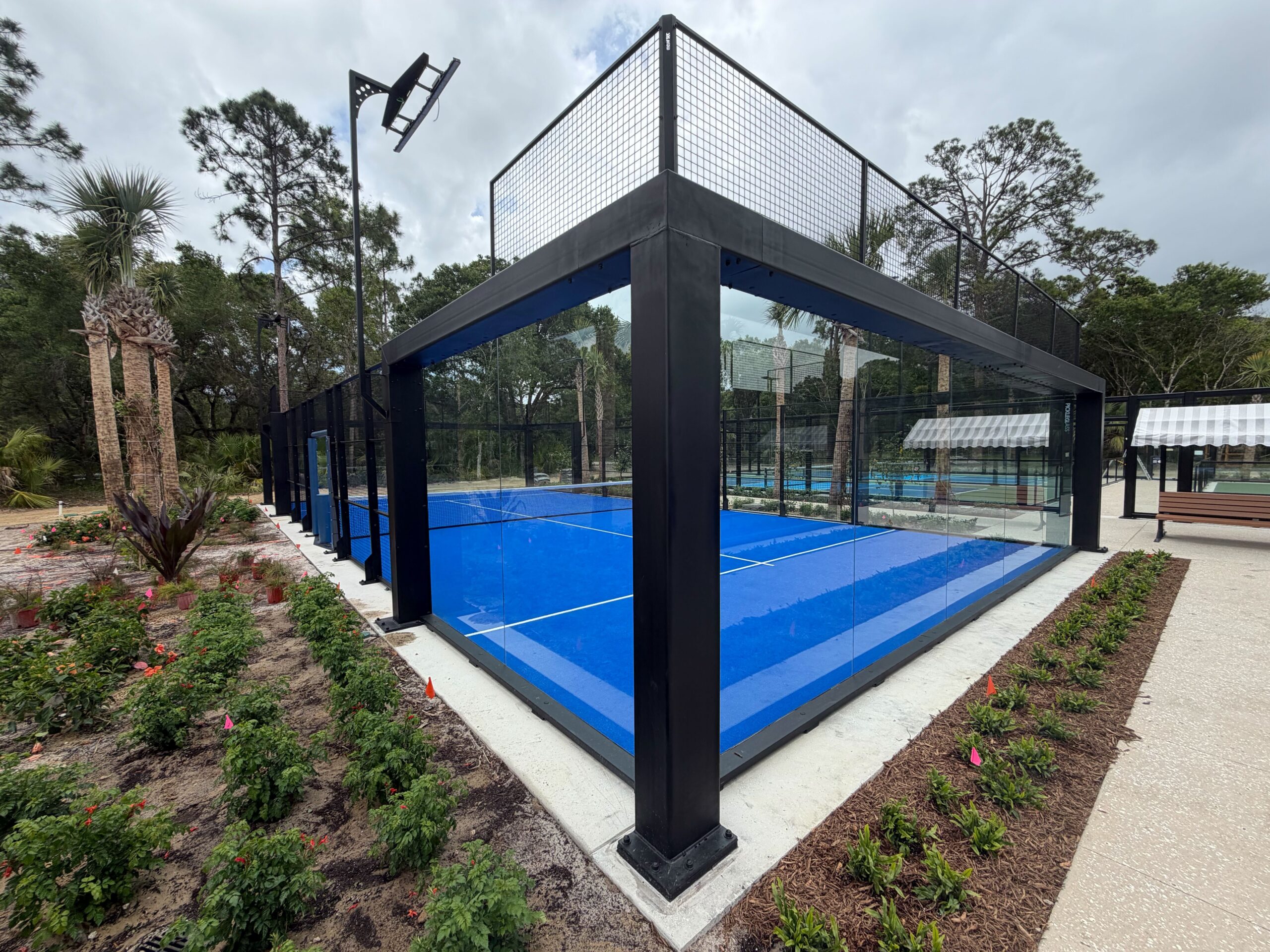
A padel court in the US typically costs $35,000 to $50,000 as a court structure, and $85,000 to $120,000 or more as a finished, installed facility. That second figure includes site work, lighting, and local requirements. That is a wide range, and the reason it is wide is the point of this guide: padel court cost is driven less by the sport and more by the structure, the setting, and the ground it sits on.
This guide breaks the number down component by component, explains which choices move it the most, and frames the spend the way an owner should, as the cost of a permanent asset rather than a one-time purchase. For what the build itself involves, see the companion guide on padel court construction.
Padel court cost, component by component
The table shows typical planning ranges for a single outdoor court in the US. Treat these as budgeting ranges, not quotes: the actual figure depends on court type, site condition, and location.
| Component | Typical planning range | Notes |
|---|---|---|
| Site work and drainage | $5,000 to $15,000 | Clearing, excavation, grading, drainage; higher on poor or sloped sites |
| Foundation / concrete slab | $3,000 to $10,000 | Level, well-drained reinforced slab; the least forgiving line item |
| Structural frame and glass walls | $15,000 to $40,000 | The enclosure, 40 to 60 percent of total; panoramic designs cost more |
| Artificial turf and infill | $5,000 to $15,000 | Padel-specific turf with silica sand; premium turf runs higher |
| LED lighting | $5,000 to $15,000 | Adds roughly 15 to 25 percent to a project when included |
| Net, posts, doors, finishing | $2,000 to $6,000 | Access doors, net system, minor finishing |
Add these up and a straightforward outdoor court lands in the range the market reports. The enclosure alone typically accounts for 40 to 60 percent of the total, which is why the court structure decision is the biggest single lever on the final number.
What moves the number most
The enclosure type. Padel courts come in classic, panoramic, and super-panoramic configurations, distinguished by how many steel posts hold the glass. Classic courts use 24 posts, panoramic 16, and super-panoramic 12. Fewer posts mean larger, thicker, more precisely assembled glass spans, so the cleaner sightlines of a panoramic court, the format used on the professional tours, come at a higher price. This one decision can move the enclosure cost by tens of thousands of dollars.
Indoor versus outdoor. An indoor court avoids weather but adds the building envelope, climate control, and ventilation, which can raise the total budget by 20 to 40 percent. An outdoor court avoids the building cost but must be specified for its climate.
Location and climate. Site conditions and regional requirements are real cost drivers. In Florida, which holds roughly 41 percent of US padel courts, corrosion-resistant hardware and hurricane-rated engineering add cost, and they are the difference between a court that lasts and one that degrades early. Poor soil, drainage challenges, or a sloped site raise the foundation and site-work lines before any glass goes up.
Lighting grade. Recreational lighting is modest, but club competition and tournament-grade lighting are not. A facility built for evening league play and events carries a materially higher lighting spend than one built for casual daytime use.
The economics of multiple courts
Most padel projects that pencil out are not single courts. Building several courts at once lowers the cost per court because site mobilization, foundation and drainage work, the perimeter or building envelope, and structural component purchasing are all shared across the courts. A developer weighing whether to build two courts or four should price them together, because the incremental cost of each additional court is lower than the first. This is where padel starts to behave like a facility rather than a purchase, and it is covered at the program level in our guide to pickleball facility planning, which applies directly to multi-court padel.
The cost the number leaves out
The build price is the visible cost. The cost that decides whether a padel facility is a good investment is the one that accrues over its life: whether the base was engineered so the glass and doors stay aligned, whether the structure was specified for its climate so it does not corrode or fail early, whether drainage protects the turf and the slab, and whether the court was sited and acoustically planned so the facility clears permitting and keeps its neighbors. The most commonly reported obstacle to opening a US padel court is not the build cost, it is permit delay driven by glass-wall ball noise, and a project that stalls for a year or two while it retrofits an acoustic and siting fix has spent far more than it saved by treating the court as a kit.
A padel court priced only on the day-one build is priced incompletely. Priced as infrastructure, engineered foundation, climate-rated structure, proper drainage, acoustic site planning, and integrated lighting, the number is higher on paper and lower over twenty years, because the failures that make courts expensive are designed out rather than repaired in. PICKLETILE’s approach to structural glass court enclosures is detailed on the PICKLEGLASS page, and the full build sequence behind these costs is in the padel court construction guide.
Frequently asked questions
How much does it cost to build a padel court in the US?
A single padel court generally costs between roughly $35,000 and $50,000 as a court structure, and $85,000 to $120,000 or more as a finished installed facility once site work, drainage, lighting, and local climate requirements are included. The range is wide because the enclosure type, the setting, and the site condition drive the number more than the sport itself.
What is the most expensive part of a padel court?
The glass and steel enclosure is the largest single cost, typically 40 to 60 percent of the total build, because the walls are part of the playing field and must be tempered safety glass on an engineered steel frame. Panoramic courts with fewer posts and larger glass spans cost more than classic courts with more posts.
Is it cheaper to build multiple padel courts at once?
Yes. The cost per court falls when several courts are built together because site mobilization, foundation and drainage work, the perimeter or building envelope, and structural purchasing are shared. Pricing courts as a facility rather than one at a time usually improves the economics.
Does an indoor padel court cost more than an outdoor one?
Generally yes. An indoor court adds the cost of the building envelope, climate control, and ventilation, which can raise the total budget by 20 to 40 percent compared with an equivalent outdoor court, though it removes weather exposure and extends the usable hours of the facility.
Does PICKLETILE build padel courts?
Yes. PICKLETILE designs and builds padel courts as complete engineered systems, from the reinforced base and PICKLEGLASS structural glass enclosure to the playing surface, integrated lighting, and acoustic treatment. The focus is multi-court projects at clubs, resorts, master-planned communities, and similar facilities, where enclosure quality, sound control, and lifecycle durability decide how the court performs and lasts.
