
Last updated: July 2026.
Cities and parks departments are under real pressure to add pickleball, and public courts carry demands that private courts do not: procurement rules, public accessibility, heavy year-round volume, and neighbors who did not choose to live next to a court. This guide covers how municipalities and parks-and-recreation departments plan public pickleball courts that hold up to public use and survive the approval and budget process intact.
What makes a municipal court different
A public court is a durable civic asset built under public rules. Three constraints define it. First, it serves everyone, which means accessibility and high, uncontrolled usage volume across all skill levels and all seasons. Second, it is built through public procurement, so scope, specification, and budget are documented and defensible from the start. Third, many park sites sit adjacent to homes, so noise becomes a public-relations matter that can reach a city council meeting.
Those constraints reward planning depth. A public court specified loosely to hit a low bid tends to return as a maintenance liability and a noise complaint. A court scoped correctly the first time serves the community for decades and keeps the department out of the news for the wrong reasons.
Siting public courts: volume and neighbors
Public courts absorb far more play than private ones, so siting has to account for both capacity and proximity. Grouping multiple courts creates the throughput a community actually needs and lets the department stage amenities like shade, seating, and lighting efficiently. At the same time, park land often abuts residential streets, so orienting play away from homes and maximizing distance to the nearest residences is the first and cheapest noise control.
Where a park cannot provide the distance, engineered acoustic mitigation becomes part of the design. Specifying that mitigation during planning, rather than after residents organize against the courts, is both less expensive and far less politically costly.

Durability for public-use volume
The defining engineering requirement for a municipal court is durability under uncontrolled, continuous use. A properly engineered base and a surface system rated for the local climate and for high traffic determine how long the court lasts between resurfacing and how much of the parks budget it consumes over time. Public courts also benefit from surfaces and structures chosen for low maintenance, because parks crews are stretched and a court that needs constant attention will not get it.
Accessibility should be designed in from the start, including accessible routes, space, and surface transitions that meet public accessibility standards, so the amenity serves the whole community and clears review without redesign.
Noise and the community
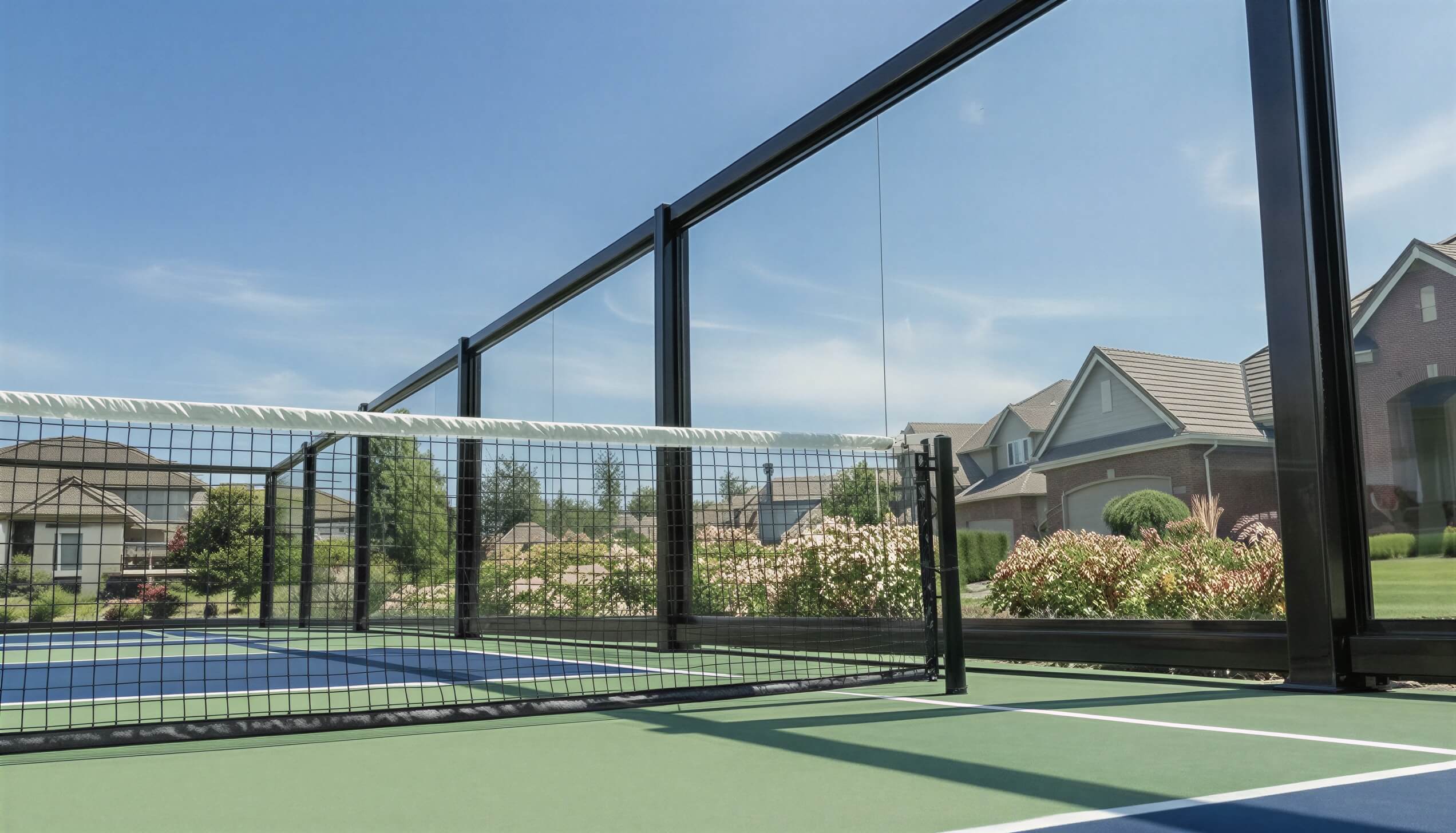
Park-adjacent noise is the issue most likely to generate organized opposition to a public court, so it deserves engineering rather than reassurance. A credible plan models expected sound levels at the nearest homes and specifies the barrier system, whether acoustic panels or structural glass enclosure systems rated by sound transmission class, that brings court-side impact levels down at the property line. Presenting that plan at the public-input stage tends to defuse opposition before it hardens. See how to reduce pickleball noise and acoustic enclosure for pickleball courts.
Procurement, budget, and approvals
Municipal courts move through a documented process: a parks or capital-planning team scopes the project, funding is identified, and the work goes out under public procurement. The most useful thing a department can do is scope the full project, including base, surface, fencing, lighting, and acoustic mitigation, before it goes to bid, so the specification protects the department from a low bid that omits the parts that matter. See pickleball court cost.
Funding for public courts often blends capital budget with grants and community programs. Because funding is a topic in its own right, our guide to pickleball court grants and funding covers the programs, including funding paths available to parks. Match the court count and scope to documented community demand using a facility-planning approach so the project is both defensible and right-sized.
Frequently asked questions
How much do municipal pickleball courts cost?
The total depends on the number of courts, the base and surface specification, and whether lighting and acoustic mitigation are included, not on the sport itself. Public projects should scope the full specification before bidding so a low bid cannot strip out durability or noise mitigation. See pickleball court cost.
How are public pickleball courts funded?
Municipal courts commonly combine capital budget with grants and community-program funding. See our overview of pickleball court grants and funding, which covers funding paths for parks and public facilities.
How do cities handle pickleball noise near homes?
By maximizing distance and orientation first, then adding engineered acoustic barriers or structural glass enclosure systems measured by sound transmission class where park land abuts residences. Presenting the mitigation plan at public input reduces opposition.
How many public courts should a city build?
Match court count to documented community demand and available park space using a facility-planning approach, which avoids both under-serving residents and over-committing the parks budget. See pickleball facility planning.
Do municipal courts need to be ADA accessible?
Public courts should be designed to meet public accessibility standards, including accessible routes and space, from the start, so the amenity serves the whole community and clears review without redesign.
PICKLETILE designs and builds engineered pickleball, padel, and tennis court infrastructure for municipalities, communities, and developments, including PICKLEGLASS structural glass enclosures, court surfacing, integrated lighting, and acoustic noise mitigation.
