
It starts the same way at almost every club where it has happened. A few members raise noise concerns with the GM informally. The GM addresses it with the racquets department, who adjusts court scheduling or asks players to be mindful. The informal adjustments hold for a while, and then they do not. The complaints return, this time from adjacent property owners outside the club, or from members whose residences border the facility. By the time it reaches the board, it is no longer an operational issue. It is a reputation issue, and in some cases a regulatory one.
The clubs navigating this cycle right now did not build poorly designed facilities. Most of them built what everyone was building when the courts went in: a standard tennis court conversion with chain-link perimeter fencing and windscreens. At the time, it was adequate. For tennis play levels and the acoustic profile of that sport, it largely was.
Pickleball changed the equation. The sport’s acoustic signature is fundamentally different from tennis, and the courts that were adequate for one are inadequate for the other. Understanding why, and what the path out of the complaint cycle looks like, is what this article covers.
Why pickleball creates a different acoustic problem than tennis
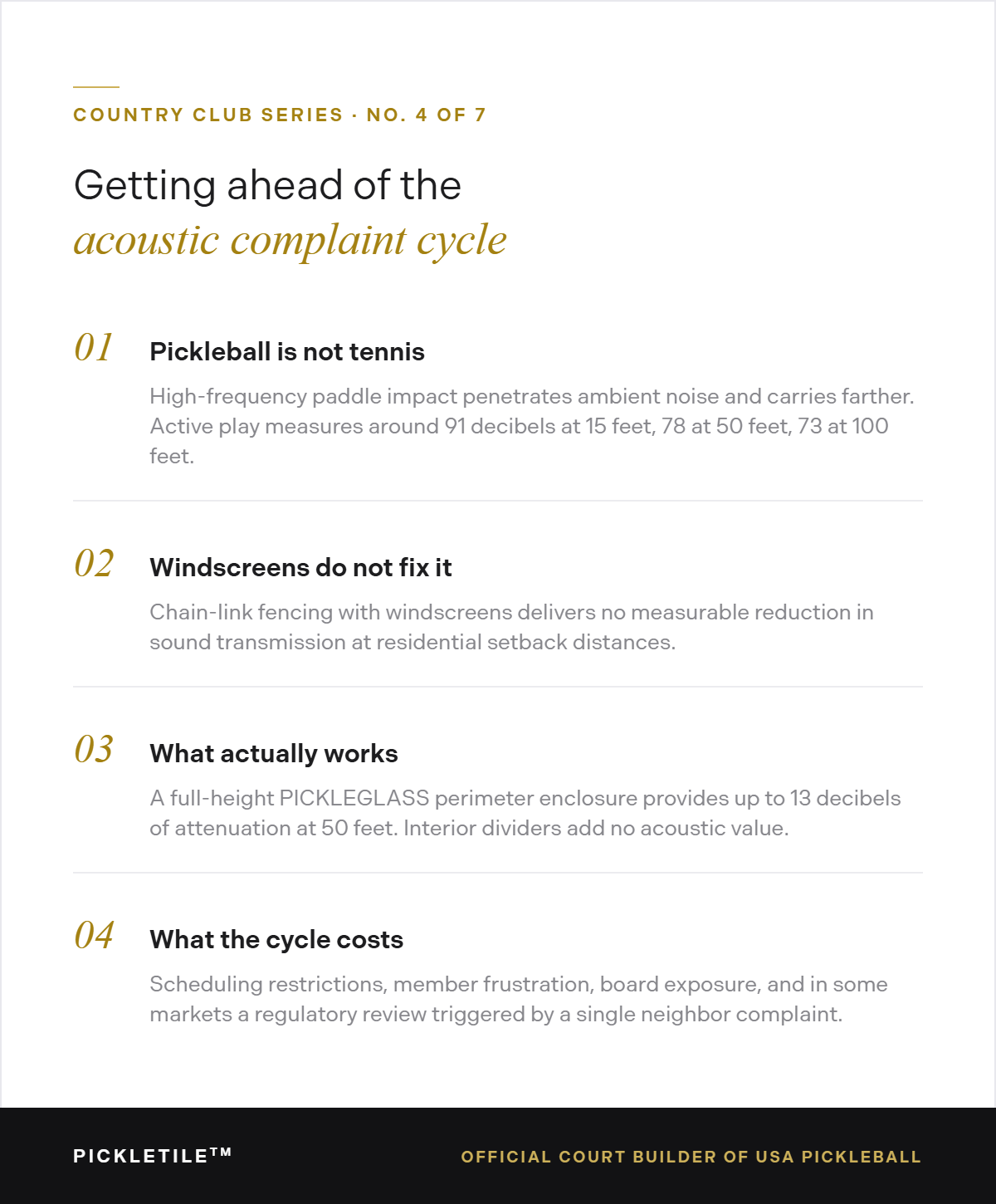
The pickleball sound is a high-frequency impact produced at paddle contact. That frequency profile behaves differently in outdoor environments than the lower-frequency sounds of tennis. It penetrates ambient noise more effectively, travels farther relative to its source level, and is perceived as more intrusive by people in its path.
At the source, active play measures around 91 decibels at 15 feet. Without an acoustic barrier, that sound reaches 78 decibels at 50 feet and 73 decibels at 100 feet. For a club with courts adjacent to residential properties, a parking area, or a clubhouse terrace, those numbers represent a noise exposure that a meaningful share of neighbors and members will find disruptive, particularly during morning and weekend peak hours when courts are busiest.
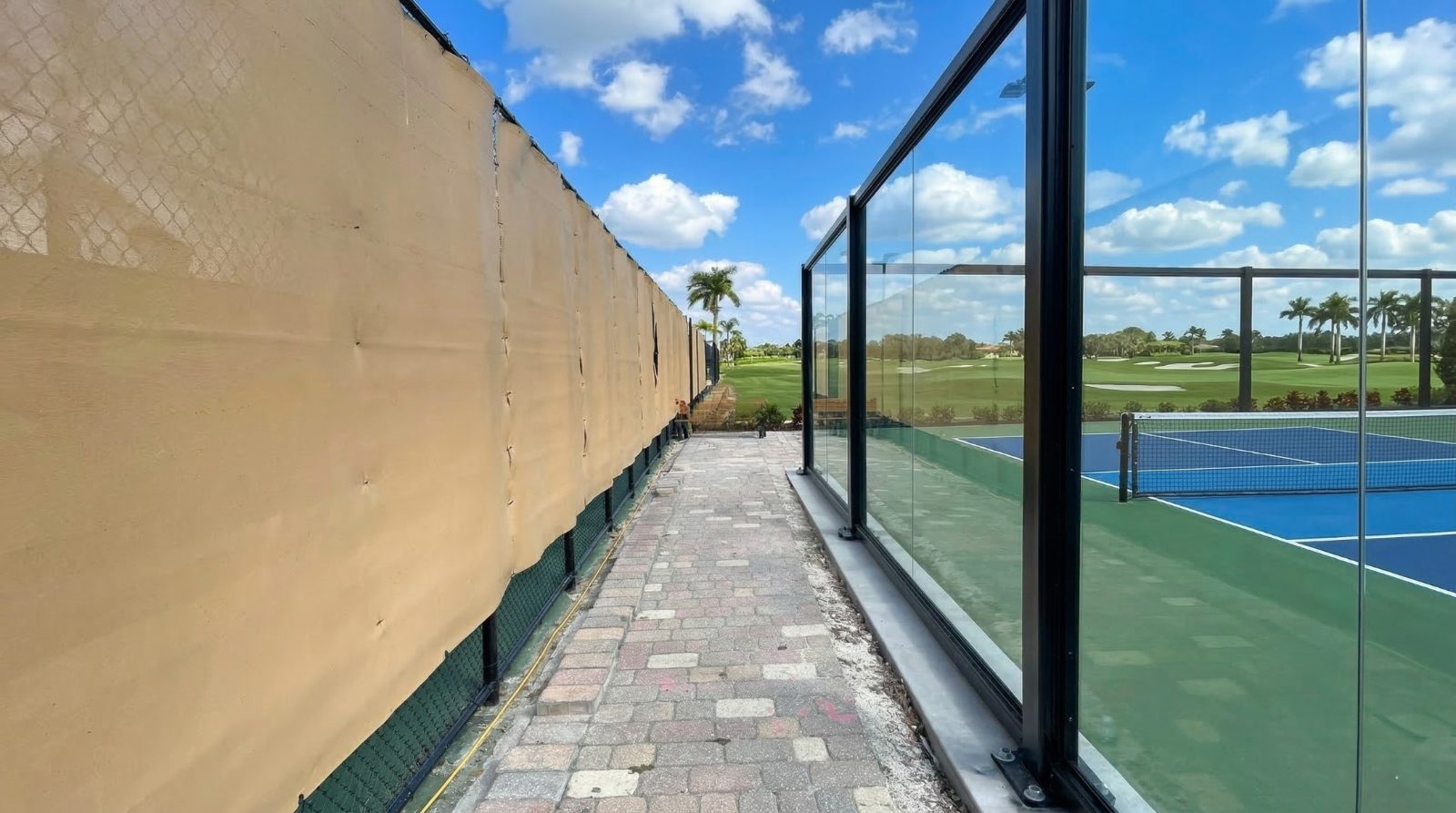
Windscreens do not meaningfully address this. They are visual barriers with minimal acoustic value. A standard chain-link perimeter with windscreens delivers no measurable reduction in sound transmission at residential setback distances. Clubs that installed them believing they addressed the acoustic question are, in most cases, still carrying the full acoustic exposure.
What the complaint cycle costs a club
The direct costs of an acoustic complaint situation at a private club are usually manageable in isolation: a call with a neighbor, a conversation at the board meeting, a scheduling restriction during early morning hours. The indirect costs are harder to quantify but more significant.
Scheduling restrictions reduce programming capacity. Reduced programming capacity creates member frustration, particularly among the active pickleball players who are now being told they cannot use the facility during the hours they want. Member frustration at a premium club does not stay local. It enters the recruitment and retention conversation through word of mouth in ways that are difficult to trace but easy to feel in the membership pipeline.
More seriously, clubs in jurisdictions that have begun applying noise ordinance standards to recreational amenities, particularly in California and Florida markets, can find a neighbor complaint triggering a regulatory review. That process is time-consuming, publicly visible in some cases, and creates a board exposure that is out of proportion to the original acoustic problem.
The clubs that are managing this situation most effectively are the ones that resolved it before the complaint cycle started.
What the right acoustic specification looks like
For the Director of Tennis/Racquets: The acoustic solution at the specification level is a full-height perimeter enclosure engineered with verified sound attenuation performance. PICKLEGLASS™, the Official Acoustic Solution of USA Pickleball, is a structural glass system that provides up to 13 decibels of attenuation at 50 feet from the court using the standard 10-foot height configuration. A 10-decibel reduction is generally perceived as cutting the sound in half.
What to be precise about when evaluating acoustic specifications: all acoustic performance comes from the full-height perimeter enclosure. Interior 4-foot divider panels between adjacent courts provide visual separation and ball containment between court zones. They have no acoustic value. A provider who presents interior panels as contributing to noise mitigation is misrepresenting the product’s function. This distinction is worth confirming explicitly in any specification review.
The right enclosure height for a given site depends on the setback distance from the noise-sensitive receiver, whether that receiver is an adjacent residence, a terrace, a parking area, or a clubhouse. An 8-foot enclosure and a 13-foot enclosure perform differently at the same distance. Selecting the right specification requires knowing those distances, which is part of what PICKLETILE™’s scoping process addresses.
For the Club President/GM: The board presentation question on acoustic risk is straightforward. The club has two choices: invest in an engineered acoustic solution before a complaint cycle develops, or manage the complaint cycle after it does. The first option is a capital decision. The second is a liability and reputation management situation. The cost difference between the two, when total exposure is accounted for, consistently favors the first.
Getting ahead of the cycle before it starts
If your club’s courts are within 150 feet of any noise-sensitive receiver, or if your courts are in a location where morning or weekend play is audible from areas where members or non-members spend time, the acoustic question is worth addressing now.
PICKLETILE’s scoping process includes a site-specific acoustic exposure assessment that identifies whether your current configuration creates a complaint risk and what the right enclosure specification looks like given your site geometry. Request a quote and we will start with that conversation.
If the acoustic question is already on your radar, the right time to address it is before the board meeting. Let’s assess your site and give you a clear answer on where you stand.
