
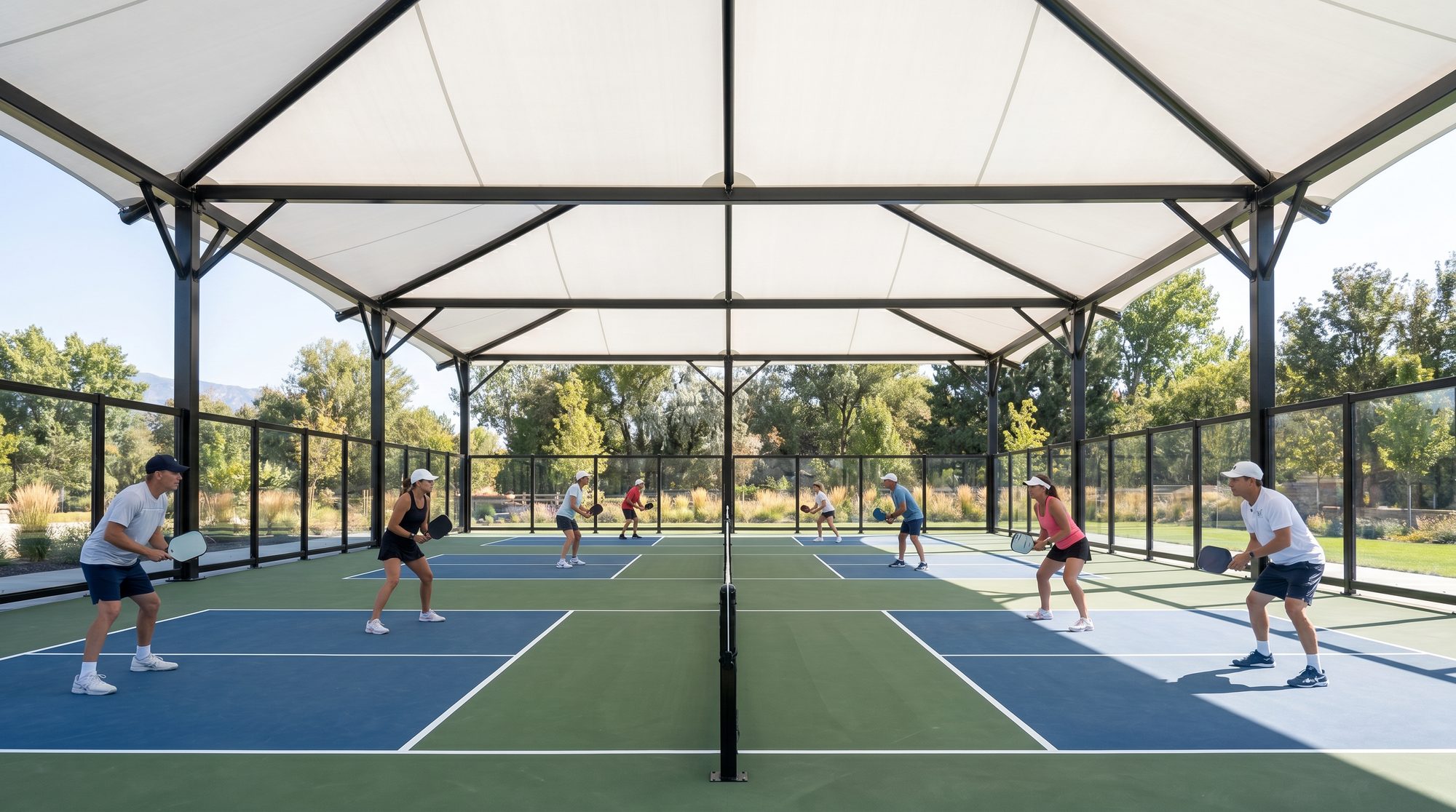
Two years ago, the racquet facility conversation at most private clubs was a maintenance conversation. Resurface the courts, fix the net posts, patch the fence where it rusted. A facilities line item, not a strategic discussion.
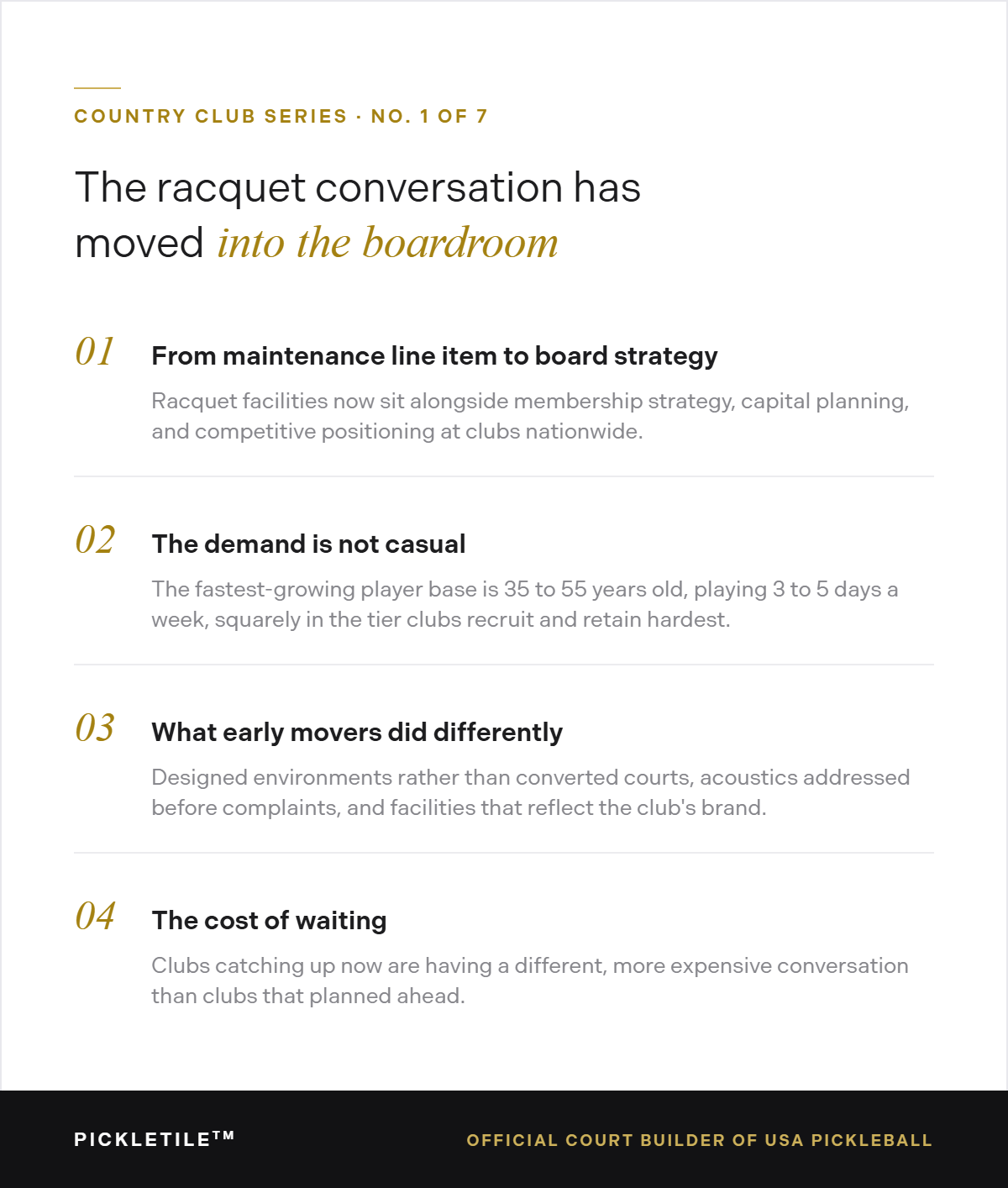
That conversation has moved. In 2026, at clubs across Texas, Florida, California, and Colorado, the racquet facility is showing up in board meetings alongside membership strategy, capital planning, and competitive positioning. Not because club leadership decided to treat it differently, but because the member dynamics around racquet sports, and particularly around pickleball, made it impossible to treat it as a maintenance line item anymore.
Understanding what is driving that shift, and what it means for your club’s planning cycle, is the purpose of this article.
What changed and why it happened quickly
Pickleball’s growth inside private club environments has followed a pattern that caught a lot of club leadership off guard. The sport did not arrive as a proposal from the racquets department. It arrived as member demand, often vocal and organized, that did not fit neatly into the existing facility footprint.
Clubs that had four tennis courts and a small fitness center suddenly had members requesting pickleball programming, court time, and leagues, without any additional courts to absorb the demand. The tension between tennis members who did not want to give up court time and pickleball members who wanted dedicated courts became a membership relations problem before it became a facilities problem.
At the same time, the demographic profile of the members driving pickleball demand is not peripheral to club health. The fastest-growing player base for the sport runs 35 to 55 years old, with strong representation in the economic tier that private clubs recruit and retain most aggressively. These are not casual participants. They are playing three to five days a week. For them, a club that cannot accommodate that playing frequency is a club that has a service gap, regardless of what else the club does well.
The clubs that recognized this dynamic early invested in dedicated facilities. The clubs that are recognizing it now are having a different, more expensive conversation about how to catch up.
What the clubs that got ahead of it are doing differently
The clubs that are now in the best competitive position on racquet amenities share a few consistent characteristics.
They treated the racquet facility as a designed environment, not a converted space. Facilities that were planned from the start as integrated pickleball and tennis infrastructure, with proper court proportions, dedicated enclosures, and acoustic engineering, function differently than facilities where two pickleball courts were marked onto a single tennis court and a windscreen was added. Members notice the difference. They notice it in the sightlines, the noise environment, the surface quality, and the overall impression the facility makes.
They addressed acoustics before complaints surfaced. Pickleball generates a distinctive high-frequency sound that carries farther than most recreational activity. Clubs in residential neighborhoods, or with clubhouse adjacency, that built enclosed courts early are not managing noise complaints today. Clubs that did not address it are. The difference in member relations, and in the board-level exposure that follows, is meaningful.
They invested in facilities that reflect the club’s brand. A premium club with a chain-link court communicates something about how seriously it takes its racquet programming, whether it intends to or not. Structural glass enclosure systems, like the PICKLEGLASS™ system PICKLETILE™ builds, communicate the opposite: that the facility was designed with the same intent and quality standard as the rest of the club’s amenity environment.
What it means for your planning cycle
If your club has not yet had a dedicated strategic conversation about the racquet facility, the member demand pressure and the competitive dynamics described here suggest that conversation is coming regardless. The question is whether it happens during a planning cycle, when you have design flexibility and budget control, or during a crisis, when you are responding to member complaints or trying to catch up with a peer club that just completed a renovation.
The planning cycle is where PICKLETILE can add the most value. Engaging an infrastructure partner during the design phase, before the capital project is finalized and before the board approves a scope, gives you access to a full engineering and design consultation that shapes the right project for your club’s specific situation.
Request a quote and we will start with a no-commitment conversation about your club’s current facility, member demand profile, and what the right infrastructure upgrade looks like.
The clubs that are ahead of this conversation started it early. Let’s understand where your facility stands and what the right next step looks like.
