
Last updated August 6, 2026.
Nearly every sport has its own soundscape. Basketball has squeaking sneakers and the swish of the net. Golf has the metallic ping of a driver. Football has the crunch of shoulder pads.
Few of them generate as much controversy as the hollow pop of a pickleball volley.
The combination of a rigid plastic ball and a stiff paddle produces a sharp report that carries. On a standard paddle, ball strike measures 85 or more decibels at roughly 1,100 to 1,200 hertz, according to USA Pickleball’s acoustic research. That frequency is the reason the sound travels the way it does. It sits in the range the human ear is most sensitive to, so it cuts through ambient traffic and conversation rather than blending into it, and it repeats every second or two for hours.
That is why noise, not cost and not space, is the objection that stalls the most court projects. It is also why the problem is solvable, because a sound with a known frequency and a known source has known countermeasures.
So how can pickleball enthusiasts address the concerns of their fussy neighbors while still enjoying the game? What steps can we take to soundproof pickleball?
There are two places to intervene: the source, meaning the paddle and the ball, and the path, meaning what sits between the court and whoever is listening. This guide covers both, in that order, and is honest about where each one stops working.
How do you make pickleball quieter?
There are two levers, and they do different jobs. Quieter equipment lowers the sound at the moment of impact and helps everyone within earshot, including players. Barriers and absorption at the court boundary reduce how much of that sound reaches neighboring property, and they are the only lever that works regardless of what equipment players bring.
For a recreational court with a sympathetic user group, equipment alone can be enough. For a facility with a property line, a rental program, or a board that has already received complaints, equipment cannot be enforced and barriers become the load-bearing solution. Most facilities that resolve the problem permanently do both.
Do quieter paddles and balls actually work, and by how much?
Yes, measurably, and the governing body now certifies it.
USA Pickleball spent 15 months characterizing the sport’s acoustic signature and then created the Quiet Category, a certification for equipment that reduces noise without degrading play. It covers paddles, balls, paddle covers, and noise mitigation screens.
The first certified paddle, the OWL by OWL Sport, delivers below 600 hertz and below 80 decibels. USA Pickleball describes it as reducing noise by 50 percent against a standard paddle at 1,100 to 1,200 hertz and 85 or more decibels. The frequency drop matters as much as the decibel drop, because moving the sound down out of the ear’s most sensitive band makes it less piercing at the same volume.
Paddles
Polymer honeycomb cores are now standard in modern paddles and absorb impact vibration far better than the wooden and aluminum paddles the sport grew up on. Beyond core material, the quietest designs add face composites and damping layers that shorten the impact ring.
Balls
The ball is the harder half of the problem. Outdoor balls are harder and heavier than indoor balls, and the holes that give them their flight characteristics are also what make them resonate. Softer and foam alternatives exist and do reduce noise, but players consistently report they change the game, and most are not approved for sanctioned tournament play. Gamma’s foam quiet ball is the cautionary example: it is now marketed as a practice ball.
The limit of the equipment lever
Equipment only helps when people use it. A private group that buys Quiet Category paddles solves its own problem. A public court, a club with rentals, or an HOA amenity cannot control what a player brings, and a posted request is not a control. If the noise question is tied to a property line or an approval, treat equipment as a supplement and the court boundary as the actual fix.
How much does pickleball noise reduction lower the sound level?
Sound is logarithmic, so the numbers are less intuitive than they look. A reduction of about 10 decibels is perceived as roughly half as loud. That is why a change that reads as a modest number on paper can be the difference between a tolerable court and a complaint file.
Two reference points from certified testing. On the equipment side, USA Pickleball’s first Quiet Category paddle is rated at a 50 percent noise reduction, moving from 85 or more decibels to below 80 and from 1,100 to 1,200 hertz down below 600. On the barrier side, PICKLEGLASS has been verified by an independent certified testing facility to reduce generated noise by 50 percent.
Anyone quoting a single guaranteed decibel figure for your site without knowing your distance to the property line, your terrain, your court count and your surrounding surfaces is guessing. Attenuation depends on all of them. What certified testing establishes is the performance of the system; what a site assessment establishes is the result at your fence line. For a breakdown of the raw measurements, see how loud pickleball actually is.
How do you stop echo on a pickleball court?
Echo and reverberation are a different problem from transmission, and they get confused constantly.
Transmission is sound leaving the court and reaching someone else. Reverberation is sound bouncing between hard surfaces and staying inside the court, which makes play louder for the players and stretches each pop into a longer sound. Indoor courts, courts in hard-surfaced courtyards, and courts boxed in by walls on two or more sides all suffer from it.
Reverberation responds to absorption, not mass. A solid barrier can reflect sound back onto the court and make reverberation worse while still reducing transmission outward. Absorptive treatment on the reflecting surfaces is what shortens the decay. Indoors this means acoustic panels or baffles on walls and ceiling. Outdoors it means treating whatever hard vertical surfaces sit near the court, and avoiding a layout that puts courts inside a hard three-sided pocket in the first place.
The practical consequence for planning: if you have a reverberation problem and you install only a reflective barrier, you may reduce complaints from neighbors while making conditions worse on court. Diagnose which problem you have before buying either solution.
What insulation and absorption options exist for a pickleball court?
Court acoustics use a small set of materials, and they are not interchangeable.
Mesh windscreens are the most common thing already on a fence and the least effective acoustically. They are designed to block wind, not sound. They are better than bare chain link, which does nothing at all, and that is the honest extent of it.
Acoustic blankets and wraps are purpose-built for sound and do reduce levels outside the court. Their drawbacks are cost and lifespan. Wraps for a multi-court facility can reach into the tens of thousands of dollars, they are a fabric wear item exposed to sun and weather, and their appearance is the most common objection from clubs and residential developments.
Absorptive panels target reverberation rather than transmission, and belong on the reflecting surfaces described above rather than on the perimeter.
Structural glass works on mass and sealing rather than fabric, which is why it addresses transmission rather than absorption, and why it does not degrade on a fabric replacement cycle. See acoustic enclosure options for how the approaches compare, and sound suppression systems for the engineered version.
Does noise reduction fencing work?
It depends entirely on what the fence is made of, and the word “fencing” hides the difference.
Chain link provides no acoustic benefit. Sound passes through the openings. Adding a windscreen to it produces a small improvement, mostly at higher frequencies.
A fence only attenuates sound when it is solid, sealed, heavy enough to resist being driven by the sound wave, and tall enough to interrupt the line of sight between the impact point and the listener. Gaps matter more than people expect: a barrier with a continuous gap at the bottom leaks sound and gives back much of the benefit.
Height and placement do most of the work. A barrier interrupts sound by blocking the direct path, so a shorter barrier close to the court can outperform a taller one at the property line. This is a geometry problem specific to your site, which is why it belongs in design rather than in a catalogue. More on the options in our guide to pickleball court fencing.
Soundproof barrier: PICKLEGLASS
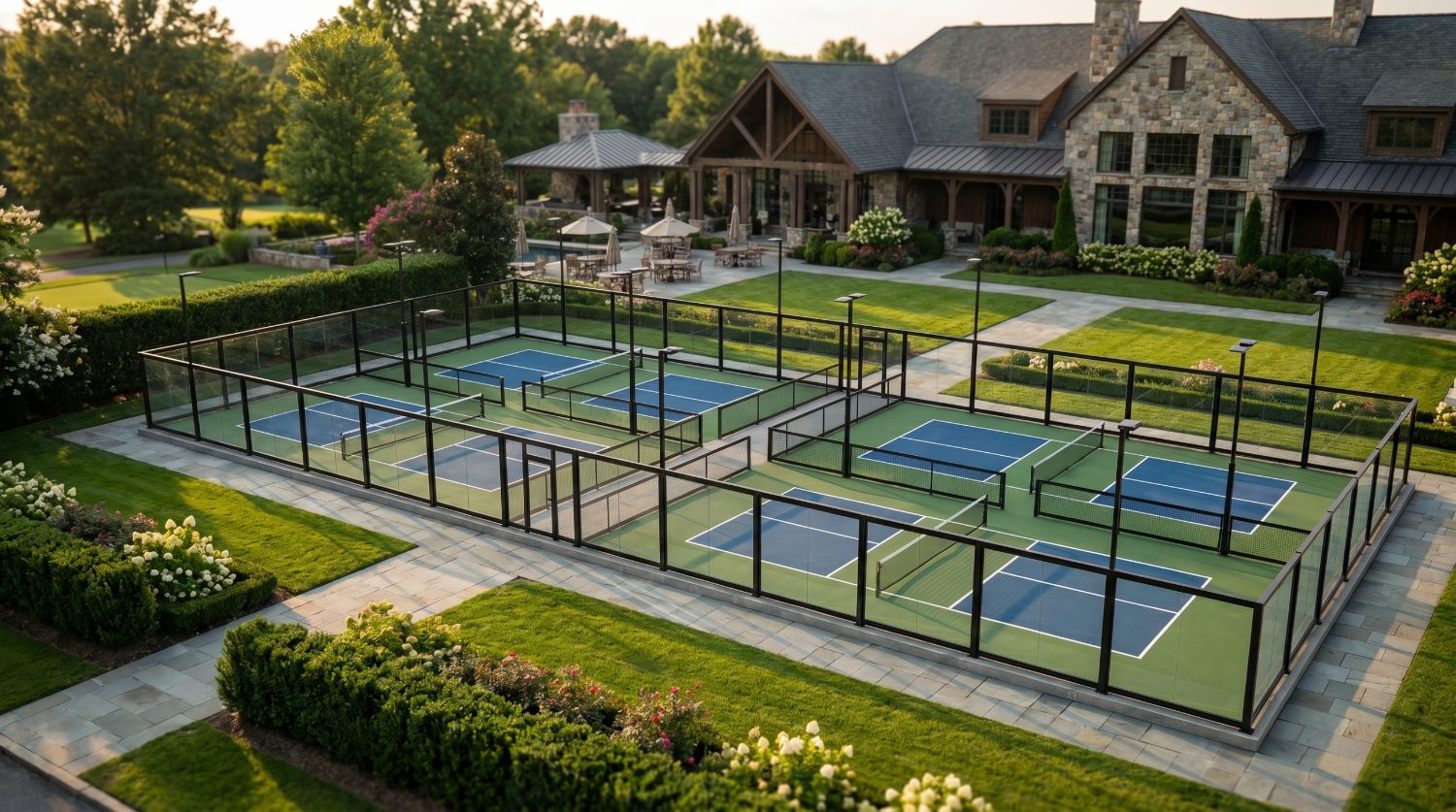
The most effective court-boundary solution is a sealed structural glass barrier in place of chain link or acoustic wrap. PICKLEGLASS has been verified by an independent certified testing facility to reduce generated noise by 50 percent.
It also solves the objection that stops most acoustic projects. Acoustic panels and wraps work, and clubs and residential developments frequently reject them on appearance. Glass keeps sightlines intact so spectators can watch play, reads as a designed element rather than a retrofit, and does not carry a fabric replacement cycle. On a project where the acoustic fix has to survive a board vote or a design review, that is often the deciding factor. See PICKLEGLASS for the system detail.
How do you build a quiet pickleball court from the start?
Retrofitting acoustics costs more than designing them in, and several of the most effective decisions cost nothing at the design stage.
Distance. Sound attenuates with distance. Every additional foot between the court and the nearest sensitive receiver reduces the level reaching it, and distance is free while the site plan is still on paper.
Orientation and screening. A barrier only works if it stands between the impact point and the listener, so which side of the court needs treatment follows from where the neighbors actually are. Existing buildings, planting and grade can be used as screening if the layout accounts for them early.
Court spacing and multi-court layout. On multi-court facilities the space between courts is a real acoustic variable, not just a circulation one. Courts packed tight concentrate several simultaneous sources into one acoustic footprint and multiply the sound arriving at the property line. Generous spacing spreads the sources, improves play, and gives room for barriers or absorptive treatment between courts rather than only around the outside. Where a barrier runs between adjacent courts, glass carries a second advantage over a solid panel: players and spectators can see through it, so a divider that improves acoustics does not turn a facility into a set of blind boxes or create a visibility hazard at the point where players run out of a court.
Perimeter system chosen at design. The boundary treatment is the one acoustic element that is dramatically cheaper to build once than to add later, because footings, drainage and the fence line all interact. Deciding the perimeter system while the slab is still being designed avoids cutting into finished work.
For how these decisions sequence against the rest of a build, see pickleball court construction.
What to do if complaints have already started
If the courts exist and the complaints are live, the order of operations changes. Establish what the actual measured level is at the receiving property rather than arguing about perception, check the standard your jurisdiction applies, and only then choose a treatment, because the required reduction determines which solutions are even candidates. Our guides to pickleball noise complaints and pickleball noise regulations cover the process and the ordinance side.
Getting a number for your site
Noise reduction is a geometry and materials problem, and the honest answer for any specific facility depends on court count, distance to the property line, existing boundary treatment, and what the surrounding surfaces do. PICKLETILE designs and builds the court, the perimeter system, the surfacing and the acoustics as one scope, which is what keeps the acoustic result from falling between separate trades.
