
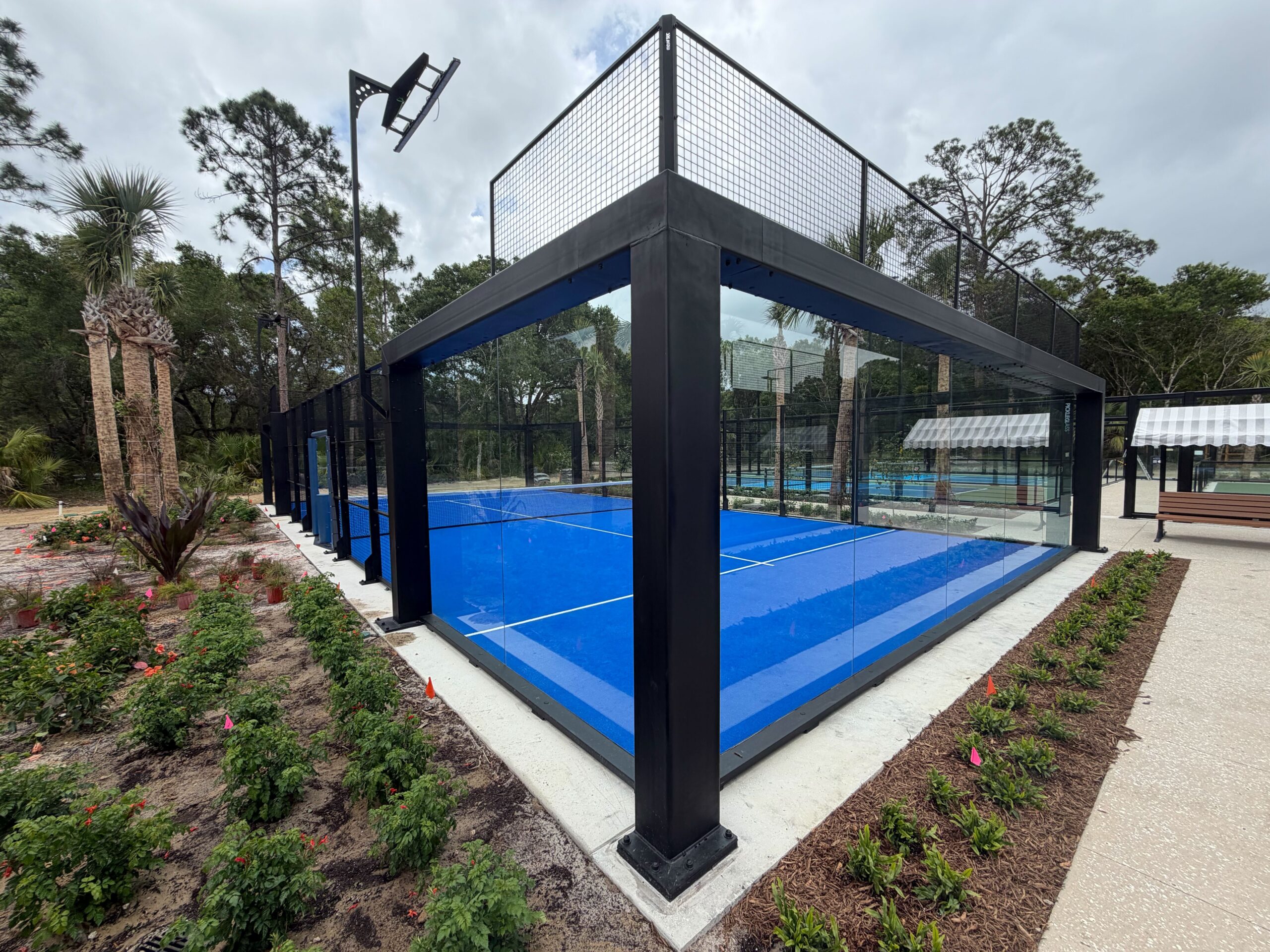
Padel court lighting is typically designed to deliver 200 to 300 lux for recreational play, 300 to 500 lux for club and league play, and 500 lux or more for competition and broadcast play, using LED floodlights mounted above the glass enclosure so the light reaches the playing surface without glaring off the walls. Most outdoor padel courts use eight to twelve LED fixtures on perimeter poles roughly 6 meters (about 20 feet) tall, positioned to light the full 20 by 10 meter court with even coverage in the corners where the glass and mesh meet.
That is the short answer. The details below cover the lux targets by level of play, fixture count and placement, pole height, uniformity and glare control, and the specification questions that most affect cost and playability.
How much light a padel court needs
Illuminance is measured in lux (lumens per square meter). The right target depends on who plays on the court and whether play continues after dark.
- Recreational and residential play: roughly 200 to 300 lux average maintained.
- Club, membership, and organized league play: roughly 300 to 500 lux average maintained.
- Competition, tournament, and any court intended for filming or streaming: 500 lux and above, with broadcast-grade installations reaching 750 lux or more.
“Maintained” matters. LED output declines over the life of the fixture, so a system should be designed to hold its target lux at end of life, not only on day one. A common approach is to specify initial output about 20 to 30 percent above the maintained target so the court still meets its number years later.
Uniformity and glare, the two specifications that decide playability
Average lux alone does not describe a good lighting system. Two courts can share the same average and play completely differently.
Uniformity (often expressed as U0, the ratio of minimum to average illuminance) describes how evenly the light is spread. Padel is played into the corners and off the back glass, so dark corners hurt play more than they would on an open court. A uniformity ratio of 0.6 to 0.7 or better is a reasonable target for club-level courts, and competition courts are usually specified tighter.
Glare control is specific to padel because the court is enclosed in glass. A fixture aimed carelessly will reflect off the back and side glass straight into a player’s eyes. This is why padel fixtures are mounted above the top of the enclosure and angled down and inward, and why fixture optics and shielding are part of the specification, not an afterthought.
Fixture count, placement, and pole height
Padel courts are lit from the perimeter, not from a single central mast, because the enclosure would shadow a center-lit court.
- Fixture count: a typical outdoor court uses eight fixtures for club play and ten to twelve for competition, though the exact number depends on the output and optics of the chosen luminaire.
- Placement: fixtures are grouped on poles or masts along the two long sides, mounted above the glass and mesh so the beam clears the top of the enclosure. Four poles (two per long side) is a common layout, with fixtures distributed to cover both service boxes and both back-glass zones.
- Pole height: roughly 6 meters (about 20 feet) is common for outdoor courts. The pole must clear the enclosure (glass to about 3 meters, mesh above it to about 4 meters) with enough additional height to control the beam angle and glare.
- Fixture type: LED floodlights in the range of roughly 150 to 300 watts each, selected for output, beam pattern, and enclosure-friendly optics.
Color temperature is usually specified between 4000K and 5700K, a neutral-to-cool white that reads cleanly on the surface and on camera, with a color rendering index (CRI) above 80 so ball and line colors stay accurate.
Indoor padel lighting differs
Indoor and covered courts change the calculation. Fixtures can be mounted to the structure rather than on poles, ceiling height governs mounting and beam spread, and reflected light off a roof deck can raise effective uniformity. Indoor installations still have to solve glare off the glass, and low ceilings can force more fixtures at wider beam angles to avoid hot spots. Anyone planning a covered or indoor court should treat lighting as part of the building design, not a fixture bought at the end.
What drives the lighting budget
The largest cost drivers are the target lux level (competition lighting can require roughly double the fixtures of recreational lighting), the number of courts sharing a control and power infrastructure, pole and foundation work, and controls such as zoning, dimming, and scheduling. For a facility-level view of how lighting fits alongside surfacing, enclosure, and site work, see our guide to padel court cost, and for the footprint and clearances that set the lighting layout, see padel court dimensions. Lighting design should be coordinated with the full build, covered in padel court construction.
Padel court lighting as part of the venue, not a fixture list
Lighting is where a padel court stops being a slab with walls and becomes a venue that people want to book after work and after dark. The enclosure that defines padel is also what makes its lighting a design problem rather than a catalog purchase: the same glass that gives the game its character will throw glare back at players if the light is placed without care. Getting the lux, the uniformity, and the fixture geometry right is what lets a court hold up for evening leagues, member play, and, for the venues that want it, competition and broadcast. Treated as part of the court’s design from the start, lighting protects both the playing experience and the investment in everything below it.
Frequently asked questions
How many lux does a padel court need?
Roughly 200 to 300 lux for recreational play, 300 to 500 lux for club and league play, and 500 lux or more for competition or broadcast play, specified as maintained illuminance so the court still meets its target as the LEDs age.
How many light fixtures does a padel court use?
Typically eight LED floodlights for club-level play and ten to twelve for competition, mounted on perimeter poles above the glass enclosure rather than on a single central mast.
How tall are padel court light poles?
About 6 meters (roughly 20 feet) is common for outdoor courts, high enough to clear the glass and mesh enclosure and to control the beam angle so light does not glare off the walls.
Why is glare a bigger issue for padel than for other courts?
Because the court is enclosed in glass. Poorly aimed fixtures reflect off the back and side walls into players’ eyes, so padel fixtures are mounted above the enclosure and angled down and inward, with optics and shielding chosen to control reflection.
What color temperature is best for padel court lighting?
Most installations use 4000K to 5700K neutral-to-cool white with a color rendering index above 80, which keeps the surface, lines, and ball colors accurate for both players and cameras.
