
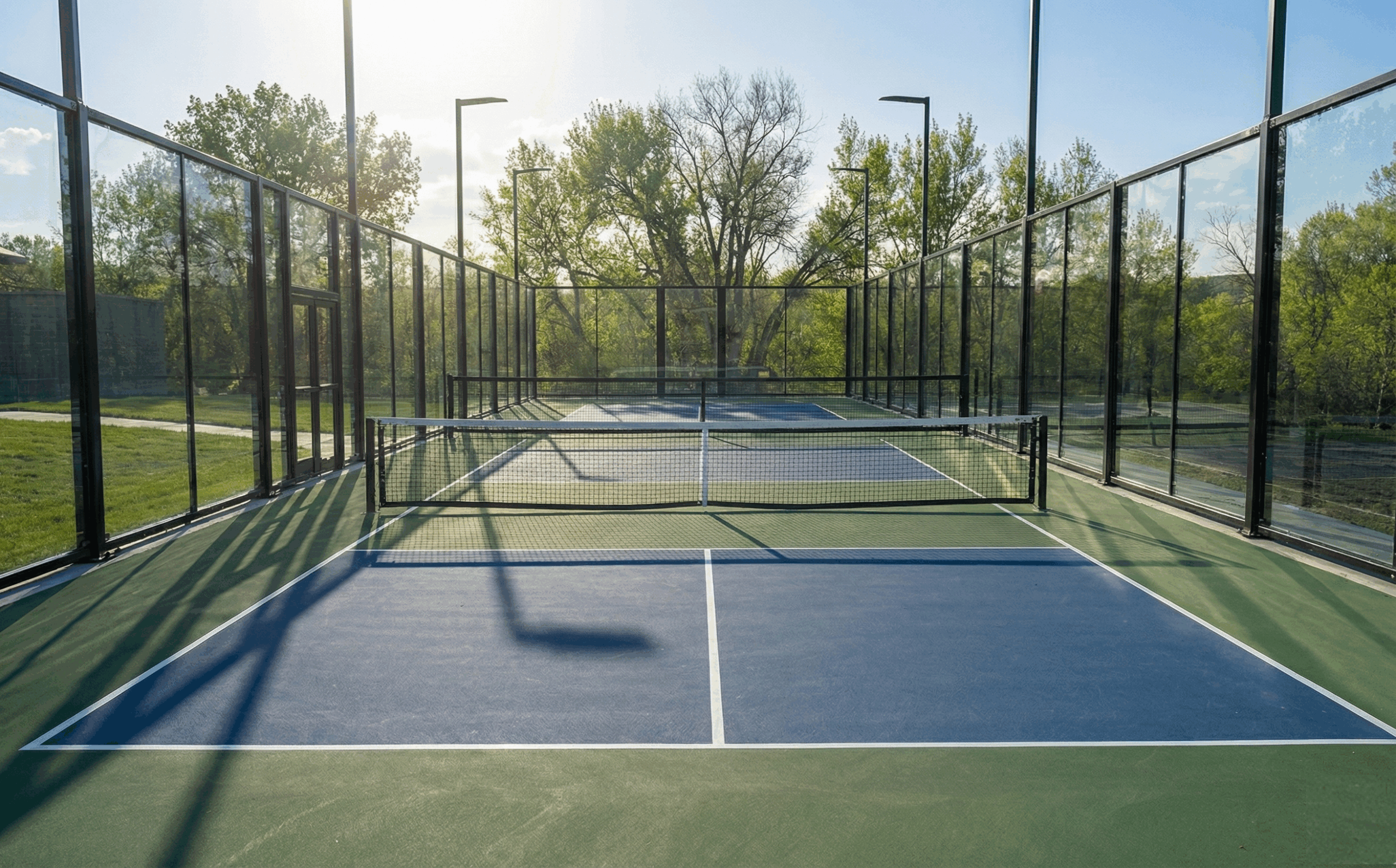
The pickleball court amenity has become table stakes in almost every category of development that competes on lifestyle. Master-planned communities, active-adult and 55+ properties, luxury multifamily, mixed-use, hospitality, and country club redevelopment projects have all converged on the same conclusion. Residents and members want courts. Absorption improves when the courts are there. Property values move when the courts are there.
The problem is the other conversation that has emerged alongside the amenity conversation. Pickleball noise complaints are now the single most common post-completion issue on residential-adjacent court builds, and they are increasingly the reason boards, HOAs, and municipalities are pushing back on court approvals in preliminary planning.
This is a resolvable problem, and it is resolvable in design rather than after construction. This article is about the technical and commercial case for engineering the acoustic performance into the enclosure system at the front end of a project, and why that decision is now table stakes on any court amenity in a residential context.
The complaint isn’t about pickleball. It’s about the sound.
Every developer who has built pickleball courts in the last five years has heard some version of the same feedback loop. Residents love the amenity in principle. They ask for it during discovery. They use it heavily once it opens. And then within the first season of play, a small number of residents whose homes are within a few hundred feet of the courts begin filing complaints, and the complaint pattern accelerates.
The specific complaint is not about the sport. It is about a very particular sound profile. Paddle-on-ball impact produces a high-frequency, high-amplitude, and highly repetitive acoustic signature. In unmitigated conditions, a single court propagates roughly 82 dBA at 25 feet, 78 dBA at 50 feet, and 73 dBA at 100 feet from the court perimeter. Two courts running simultaneously push those numbers 2 to 4 dBA higher. That range sits inside the threshold at which the human auditory system registers sound as intrusive rather than ambient, and the repetition pattern makes it more disruptive than a comparable dBA level from traffic or HVAC.
A conventional chain-link enclosure with vinyl or mesh windscreens has a Sound Transmission Class rating of zero. It is not an acoustic system. It is a ball-containment system. It provides no meaningful attenuation across the property line, and it has never been designed to.
When a project relies on chain-link and windscreens as the enclosure spec, the developer is not deferring a decision. The developer is choosing to accept whatever the ambient sound propagation happens to be at the site and to manage the community response after the fact. That choice used to be reasonable because there was no alternative. It is no longer reasonable, because there is one.
What engineered acoustic performance looks like
PICKLETILE™ is a racquet sports infrastructure and engineering partner. The company designs and delivers court and enclosure systems as engineered infrastructure rather than as assembled construction. The flagship enclosure system, PICKLEGLASS™, was engineered specifically around the acoustic performance problem that chain-link enclosures do not address.
PICKLEGLASS is a full-height structural glass enclosure system carrying a Sound Transmission Class rating of 36 and delivering 10 to 16 dBA of noise attenuation depending on barrier height and receiver distance. A 10 dBA reduction is perceived by the human ear as approximately half as loud. Ten to sixteen dBA of measured attenuation is the difference between an unusable amenity in a residential context and a fully approvable one.
The performance data was independently modeled by Trinity Consultants and Cerami Longman Lindsey using CadnaA acoustic simulation software against ISO 9613-2 outdoor sound propagation standards. The full noise study is a formal, reference-quality document with propagation modeling across single-court and double-court configurations at four barrier heights and four receiver distances. It is a document that boards and municipal planning committees respond to, because it is the type of document they were expecting the developer to produce and are usually surprised to receive.
The relevant numbers on a residential site with courts positioned inside the setback range where noise complaints usually originate:
- 10-foot PICKLEGLASS at 100 feet from source: 12 dBA attenuation. Received sound level 62 dBA. Below intrusion threshold in a suburban ambient environment.
- 13-foot PICKLEGLASS at 100 feet from source: 14 dBA attenuation. Received sound level 59 dBA. Fully compatible with residential setback conditions on almost any site.
- 13-foot PICKLEGLASS at 200 feet from source: Received sound level 54 dBA. Effectively equivalent to ambient outdoor conditions.
Ten-foot height is the default specification on most PICKLEGLASS installations. Thirteen-foot is specified when a project has particularly tight setbacks, elevated noise sensitivity, or aggressive HOA sound governance. In either case, the acoustic story is a document the developer can put in front of a decision-maker with the numbers already carrying the argument.
PICKLEGLASS is the Official Acoustic Solution of USA Pickleball. PICKLETILE is the Official Court Builder of USA Pickleball.
The architectural argument that runs alongside the acoustic one
Acoustic performance is the technical reason PICKLEGLASS exists. The architectural argument is the reason developers keep specifying it after they see the first project delivered.
Chain-link and windscreens read as utility infrastructure. On a site plan, the enclosure occupies as much visual real estate as the courts themselves, and that visual real estate reads as fence line rather than as amenity. On aerial marketing renderings, chain-link creates the visual signature of a public works project. On the ground, windscreens are the first component on any amenity to look tired, and within a few years on any wind-exposed site they will be partially detached and flapping.
PICKLEGLASS reads architecturally. The frame is HSS ASTM A500 Grade B steel with a matte black powder coat certified to AAMA 2604/2605 architectural standards. The glass is 1/2 to 3/4 inch tempered, joined with a premium clear adhesive rather than aluminum framing, which produces a seamless visual continuity across the enclosure perimeter. The system has an EnduroShield polysiloxane surface treatment that repels water, dirt, and coastal contaminants. Wind engineering is 125 to 200 MPH depending on exposure category. Warranty is ten years on the no-rust guarantee.
The functional result is a court that continues to look the way it looked on opening day at year ten. The marketing result is a facility that renders cleanly on a project’s sales collateral and reads as premium infrastructure in an aerial photograph rather than as fence line.
For a developer competing on the quality of a lifestyle amenity, the architectural expression of the court facility is not a secondary consideration. It is part of the product being sold.
Where this matters commercially
The commercial case for engineered acoustic performance is not primarily about avoiding lawsuits, though the litigation environment around pickleball noise is real and worth tracking. The commercial case is about the projects that never move forward, or that move forward with reduced court counts or reduced operating hours because the noise concern was not resolvable in the approval conversation.
Board approval on active-adult and country club redevelopments. Boards at established communities have become dramatically more resistant to court additions in the last three years, and the resistance is almost always about anticipated noise complaints. Presenting the acoustic study at the approval meeting is the single most effective way to convert a resistant board into an approving board. This is the mechanism that drives the majority of PICKLEGLASS approvals in country club settings.
Municipal and HOA approvals on new communities. Master-planned communities in noise-sensitive municipalities are increasingly seeing preliminary planning pushback on court amenities. The acoustic study clears this. In many cases it is the difference between a court count that stays at the approved density and a court count that gets reduced by half.
Absorption and rent premium in luxury multifamily. Properties with amenity courts absorb faster and support higher rent per square foot than comparable properties without them. Properties with amenity courts that generate resident complaints in the first year lose that premium quickly and often end up restricting court hours to manage the complaint volume. The net effect on NOI is significant.
Post-completion capital exposure. The single most expensive scenario is a court amenity delivered under a chain-link and windscreen spec that generates enough complaint volume post-CO to require an acoustic retrofit. That retrofit typically costs multiples of what the original enclosure would have cost specified correctly the first time, and it happens on a live property with residents on-site and marketing already in motion.
The commercial argument for PICKLEGLASS at the front end of a project is not about the incremental cost between the two enclosure approaches. It is about the difference between an amenity that performs as intended for the full holding period and one that becomes a liability inside the first two years.
What the next step looks like
If a project is currently in preliminary design, or moving toward board or municipal review, or in a redevelopment planning cycle where court amenity is on the site plan, the acoustic conversation should happen before the enclosure spec is finalized.
Send us the site, the site plan setbacks, and the court count under consideration. We will come back with:
- A preliminary acoustic modeling summary for the specific site geometry
- A scope-level budget for the PICKLEGLASS system at 10-foot and 13-foot heights
- The full PICKLETILE Environmental Noise Study document, ready to attach to board or planning committee materials
- A review conversation with our engineering team if the site conditions warrant it
The intake is straightforward, and the modeling summary is typically back in the developer’s hands within a week.
The acoustic study is the document that gets the courts approved. It is worth having it in the room before the approval meeting rather than after.
PICKLETILE is the Official Court Builder of USA Pickleball. PICKLEGLASS is the Official Acoustic Solution of USA Pickleball.
