
Last updated: July 2026.
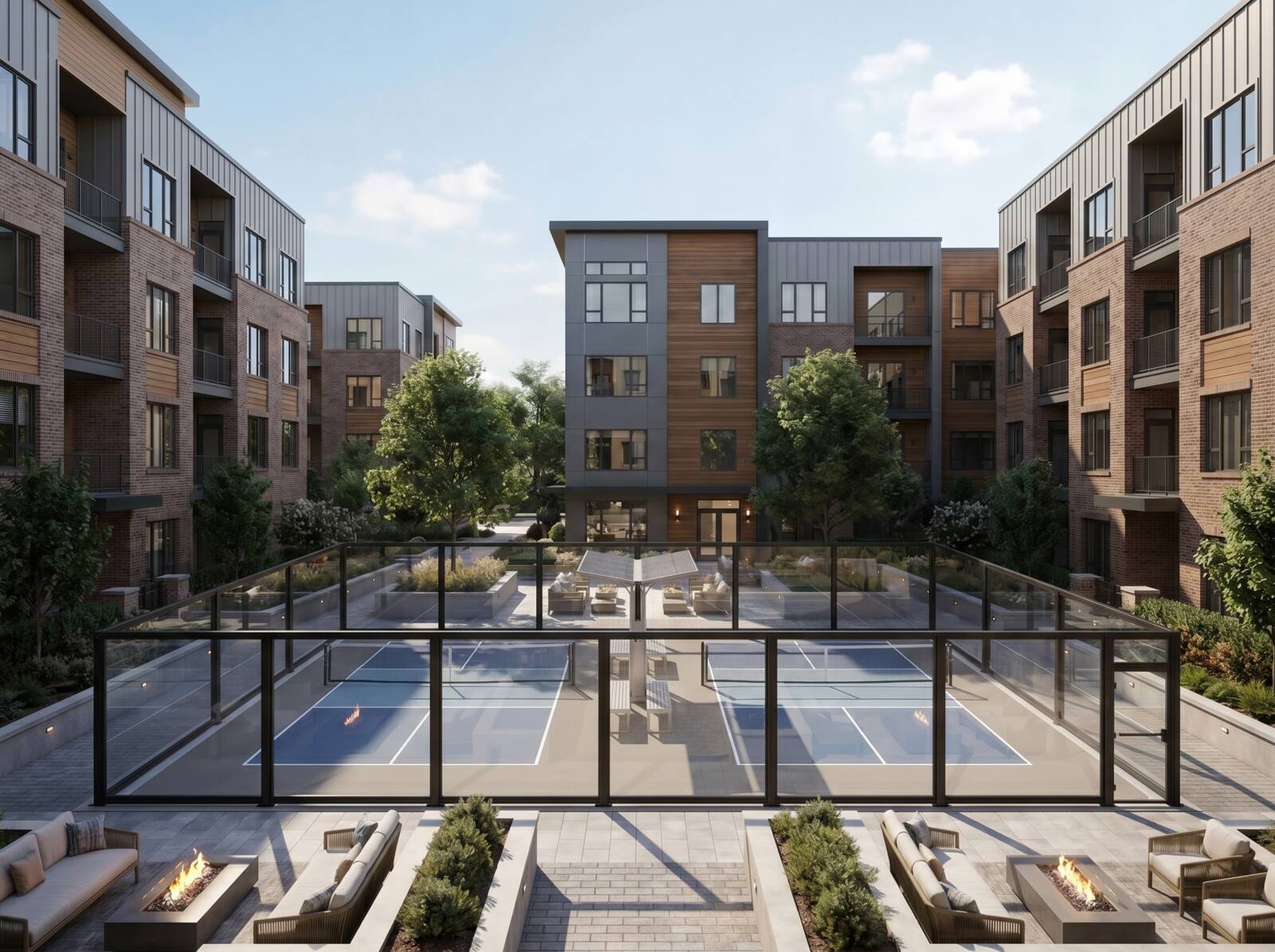
Homeowners associations are adding pickleball faster than almost any other residential amenity, and boards are discovering that the decision is less about the court itself and more about noise, neighbor relations, and long-term reserves. This guide walks a board or amenity committee through what actually drives a successful community pickleball court: siting it away from homes, engineering the sound, and building it to survive decades of shared use.
What makes an HOA pickleball court different
An HOA court is a shared, governed amenity. Three things separate it from a private or backyard court. First, it sits inside a residential community, so the nearest homes are often within earshot of play. Second, it is funded and maintained through the association’s operating budget and reserve study, which means the board answers to residents for both the upfront cost and the decades of upkeep that follow. Third, adding it usually requires a defined approval path: committee review, a board vote, and in many communities a membership notice or vote depending on the governing documents.
Those three factors reshape every downstream decision. The court that works for a single homeowner rarely works for an association, because the association has to balance the residents who want to play against the residents whose patios face the court.
Siting the court: distance is the first noise control
The single most effective noise strategy is distance, and it costs nothing to plan for. Pickleball’s sound signature is a sharp, high-frequency impact that carries farther and reads as more intrusive than the lower tones of tennis. Placing courts as far as the site allows from the nearest residences, and orienting the long axis so play faces away from homes, resolves a large share of complaints before any barrier is specified.
Where distance runs out, engineered noise mitigation takes over. Acoustic barriers and structural glass enclosure systems measured by their sound transmission class can bring court-side impact levels down at the property line. Specifying that mitigation during design, rather than retrofitting it after the first complaints arrive, is both cheaper and far less contentious with residents.
Noise engineering for residential proximity
Residential-proximity noise is the issue most likely to stall or reverse an HOA court decision, so it deserves engineering attention up front rather than a generic fence. A credible approach models expected sound levels at the nearest homes, then specifies the barrier system that closes the gap between those levels and the community’s tolerance.
Effective mitigation combines mass, height, and coverage. A tall, dense barrier on the sides facing homes blocks the direct sound path; acoustic-rated panels and structural glass systems add mass without creating a windowless wall that residents dislike looking at. Because HOA courts are permanent community assets, the mitigation should be part of the enclosure design from the start, integrated with fencing and lighting rather than added as an afterthought. See acoustic enclosure for pickleball courts and PICKLEGLASS structural glass enclosures.
Court surface, structure, and lifecycle
A community court gets heavy, continuous use across a wide range of players, so the substructure and surface matter more than they would for a lightly used private court. A properly engineered base, correct slope for drainage, and a surface system rated for the local climate determine how long the court goes between resurfacing and how it plays in year ten. Cutting the base or the surface specification to save money early is the most common source of premature cracking and the reserve-eating repairs that follow.
Because the association carries the court on a reserve schedule, boards should plan for the full lifecycle: routine cleaning, periodic resurfacing, and eventual surface renewal. Building to a higher structural standard raises the upfront number but lowers the reserve contribution over the life of the amenity, which is usually the more defensible position when a board explains the decision to residents.
Budgeting and the approval path
HOA court budgets span a wide range because the drivers are the site and the scope, not the sport. Number of courts, base and surface specification, fencing, lighting for evening play, and the level of acoustic mitigation each move the number materially. The most useful step a board can take is to price the full scope, including noise mitigation and lighting, before presenting anything to members, so the figure that goes to a vote is the figure that gets built. See pickleball court cost.
The approval path typically runs through an amenity or facilities committee that scopes the project, a board that authorizes design and funding, and a member communication or vote where the governing documents require one. Bringing residents into the noise conversation early, and showing them the mitigation plan, tends to convert the loudest opponents into supporters.
Case study: HOA approval without objection at Sterling Ranch
Sterling Ranch, a master-planned community of roughly 30,000 residents in Douglas County, Colorado, wanted pickleball, but the planned court location sat close to existing homes. That is the exact scenario that turns a wanted amenity into a standing noise complaint and a recurring board issue.
Rather than chain-link fencing and hope, the community built an eight-court facility inside a full PICKLEGLASS enclosure rated STC 36, roughly a 10 dBA drop at the nearest property line. The sound was modeled before construction using ISO 9613-2 methodology and independently validated by an acoustics firm, so the board could see the projected result before it approved the build.
The governance outcome is the part most boards care about: the project was approved in a single board meeting with no HOA objection, and the community signed off before construction started. Since opening, the courts have run with zero operational restrictions due to sound and became the most used amenity in the development, ahead of the trails, pools, and fitness centers.
Read the full Sterling Ranch case study for the acoustic modeling, access control, and single-source delivery details.
Frequently asked questions
How much does an HOA pickleball court cost?
It varies widely with the number of courts, the base and surface specification, and whether lighting and acoustic mitigation are included. Because these drive the total more than anything else, boards should price the full scope, including noise mitigation, before taking a figure to members. See our overview of what shapes a court budget on the pickleball court cost page.
How far should an HOA court be from homes?
As far as the site reasonably allows. Distance is the cheapest and most effective noise control, and it should be maximized before specifying barriers. Where distance runs out, engineered acoustic mitigation closes the remaining gap.
Can pickleball noise be controlled in a residential community?
Yes. A combination of distance, court orientation, and engineered acoustic barriers or structural glass enclosure systems, specified during design and measured by sound transmission class, brings court-side impact levels down at the property line.
Does an HOA board need a member vote to add pickleball courts?
It depends on the governing documents. Many associations can authorize an amenity through a board vote and reserve allocation, while others require a membership notice or vote. Check your CC&Rs and bylaws early in the process.
How many courts should an HOA build?
That depends on community size, demand, and available space. A facility-planning approach that matches court count to expected use avoids both under-building and over-committing reserves. See pickleball facility planning.
PICKLETILE designs and builds engineered pickleball, padel, and tennis court infrastructure for communities, clubs, and developments, including PICKLEGLASS structural glass enclosures, court surfacing, integrated lighting, and acoustic noise mitigation.
