
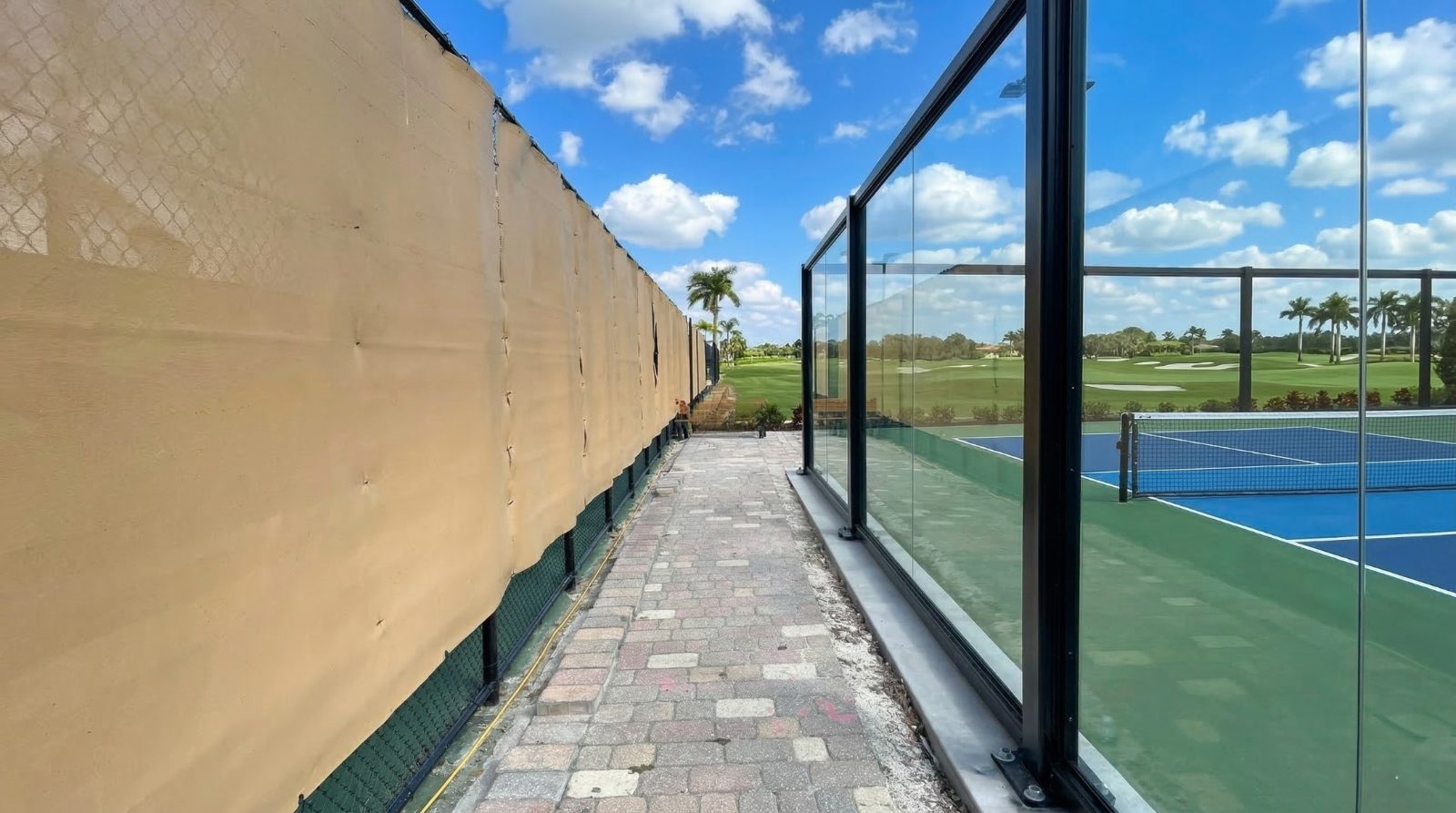
If you install fencing around residential-adjacent pickleball courts, you have already had this conversation. The homeowner, the HOA, the property manager, or the club GM asks whether the chain-link and windscreens will handle the noise. You have to answer honestly, which is that windscreens help a little at close range and do very little at the setback distances where the actual complaints are going to come from.
You have two choices in that moment. You can bid the job with a scope you know will not resolve the customer’s underlying concern, and hope they either forget about the noise question or absorb the complaint volume after the fact. Or you can offer them a real answer, hand them off to a partner who owns the acoustic side of the scope, and get paid on the referral without building anything you were not planning to build anyway.
This article is about the second option, and about why it is the smarter answer both for the customer and for your business.
The reason chain-link and windscreens don’t work
Chain-link and windscreens work fine as a ball-containment system, which is what they were designed to be. They do not work as an acoustic system, because they were never designed to be one. The lattice structure of chain-link fabric has a Sound Transmission Class rating of zero. Windscreens are optical and wind-mitigation products, not acoustic products. Attaching windscreens to a chain-link fence does not turn a fence into an acoustic barrier, and no manufacturer of chain-link or windscreens claims otherwise.
The pickleball noise problem is real. A single court propagates roughly 82 dBA at 25 feet, 78 dBA at 50 feet, and 73 dBA at 100 feet from the court perimeter. The paddle-on-ball impact carries a high-frequency signature that reads as sharp and repetitive to the human ear at those distances. That is inside the range where residents, HOA boards, and municipalities are filing complaints, and outside the range where a chain-link enclosure is going to help.
When a customer asks whether the fence you’re bidding will handle the noise, and you tell them yes, one of two things happens. Either the complaints come and the customer knows who told them the fence would work. Or the complaints come, the customer has to spend real money retrofitting an acoustic solution onto a finished court, and you get pulled back into a coordination conversation you did not price for. Neither of those is a good outcome, and both of them are avoidable.
What PICKLEGLASS™ is, and why it solves the problem
PICKLETILE™ is a racquet sports infrastructure and engineering partner. PICKLEGLASS is the flagship full-height structural glass enclosure system, engineered specifically as an acoustic solution rather than as a ball-containment system.
PICKLEGLASS carries a Sound Transmission Class rating of 36 and delivers 10 to 16 dBA of noise attenuation depending on barrier height and receiver distance. The performance was independently modeled by Trinity Consultants and Cerami Longman Lindsey using ISO 9613-2 acoustic propagation standards, against live pickleball noise measured at 91 dBA at 15 feet from the source. A 10 dBA reduction is perceived as approximately half as loud by the human ear. Ten to sixteen dBA is the difference between a court that draws complaints and a court that doesn’t.
PICKLEGLASS is the Official Acoustic Solution of USA Pickleball. PICKLETILE is the Official Court Builder of USA Pickleball. Both credentials matter in the conversation with the customer, because they signal that the acoustic performance is not a claim, it is a category-level standard.
The structural side of the system is engineered to match the acoustic side. The frame is HSS ASTM A500 Grade B steel with matte black powder coat certified to AAMA 2604/2605 architectural standards. Wind ratings run 125 to 200 MPH depending on exposure. The system does not have windscreens because it does not need them. There is no fabric on the enclosure to detach in a storm, no maintenance tension to check on annually, and no aesthetic decline in year three.
The customer conversation that changes when PICKLEGLASS is in the picture
When a customer asks about noise on a residential-adjacent job and the answer is chain-link and windscreens, the conversation goes one direction. The customer weighs the risk, the fence goes up, and everyone hopes.
When the answer is chain-link for the perimeter ball containment on the outer property line and PICKLEGLASS for the court enclosure, or PICKLEGLASS around the full court with no chain-link at all, the conversation goes a different direction. The customer gets a real acoustic answer. They get a document, which is the PICKLETILE Environmental Noise Study, that they can hand to their HOA board or their capital partner or their property manager, and the concern is resolved before it becomes an issue. The fence installer who brought the referral is the one who solved the problem.
You are not competing with PICKLEGLASS. PICKLEGLASS is not a fence and PICKLETILE is not in your business. You put chain-link around the outer property lines and around perimeter fields. PICKLETILE puts the acoustic glass enclosure directly around the court. Different scope, different budget line, different manufacturer.
The customer usually did not know a real acoustic option existed for the court itself, because their default reference for court enclosures has been chain-link and windscreens for forty years. When you tell them there is a category-level product that solves the specific noise problem they were worried about, and that you have a direct line to the company that makes it, you move from being a bid to being the person who solved a problem the customer did not know had a solution.
That is a different position to be in as a fencing contractor.
What the referral relationship looks like on your end
PICKLETILE runs a formal referral program for fencing contractors who bring court and enclosure scope. On any project where PICKLETILE is engaged through your referral and delivers the PICKLEGLASS scope, we pay a generous referral fee on the enclosure and court system revenue.
The mechanics are simple. You make the introduction. We take the acoustic and enclosure conversation from there. You continue to bid and install any surrounding site fencing scope on the project without conflict, because PICKLEGLASS is the court enclosure and it doesn’t compete with your work on the property perimeter or on secondary field fencing. The referral is documented ahead of the introduction. The fee is paid at project completion.
The economics work out favorably. A typical two-court PICKLEGLASS installation generates a five-figure referral. A larger installation at a country club, hospitality property, or master-planned community can generate a materially higher number. This is revenue on a scope you were not going to build yourself, on a customer relationship where you’re already the trusted contact for anything with metal and posts on the property.
The pattern that works is straightforward. Take a look at the projects on your board right now. If any of them are:
- Country club or racquet facility jobs where the customer or board has raised noise concerns
- Residential-adjacent HOA or community amenity courts
- Multifamily amenity or mixed-use developments
- Hospitality property court amenities
- Municipal or parks projects where a court is going in near residences
Those are the projects to run past us before you bid the court enclosure scope. On the ones where the customer’s underlying concern is noise, the PICKLEGLASS answer will land, and the referral will follow.
Why this is a smart channel for a fencing contractor’s business
The referral relationship works well for fencing contractors specifically because of a few things about how our two businesses fit together.
We do not compete on the same scope. PICKLEGLASS is the court enclosure. Chain-link, wood, vinyl, and ornamental fencing sit around the rest of the property. We are not going after your bread and butter, and there is no risk of a referral putting us in a position to poach the site fencing scope.
Your customer already trusts you as the fence expert. When you tell your customer that the pickleball court needs a different kind of enclosure than the perimeter fence and refer them to the acoustic specialist, you are demonstrating expertise, not admitting a limitation. You are telling them you know the difference between a ball-containment problem and an acoustic problem, and you know where to send them for each.
The introduction is short. You do not need to explain the product or the acoustic study. Send us the customer’s contact and the project summary, we run the conversation from there, and you stay looped in through project completion.
The referral fee compounds. Fencing contractors who work in specific regional segments (country clubs, hospitality, master-planned communities) tend to see the same project types on repeat. Once the referral relationship is established, it turns into a channel rather than a one-off.
The next step
If you have a project on the boards right now where the customer has asked about noise, or where the site is residential-adjacent and the noise question is going to come up before the enclosure gets specified, that is the project to run past us.
Send us the site, the court count, the setback conditions, and the customer contact. We will come back with a preliminary acoustic modeling summary and a scope-level budget for the PICKLEGLASS enclosure. If it moves forward, the referral is documented ahead of the introduction.
The intake is short and the value on the referral is real. It is the easiest way to give your customer a real answer to a question you have been getting on every residential-adjacent job for the last three years.
PICKLETILE is the Official Court Builder of USA Pickleball. PICKLEGLASS is the Official Acoustic Solution of USA Pickleball.
