
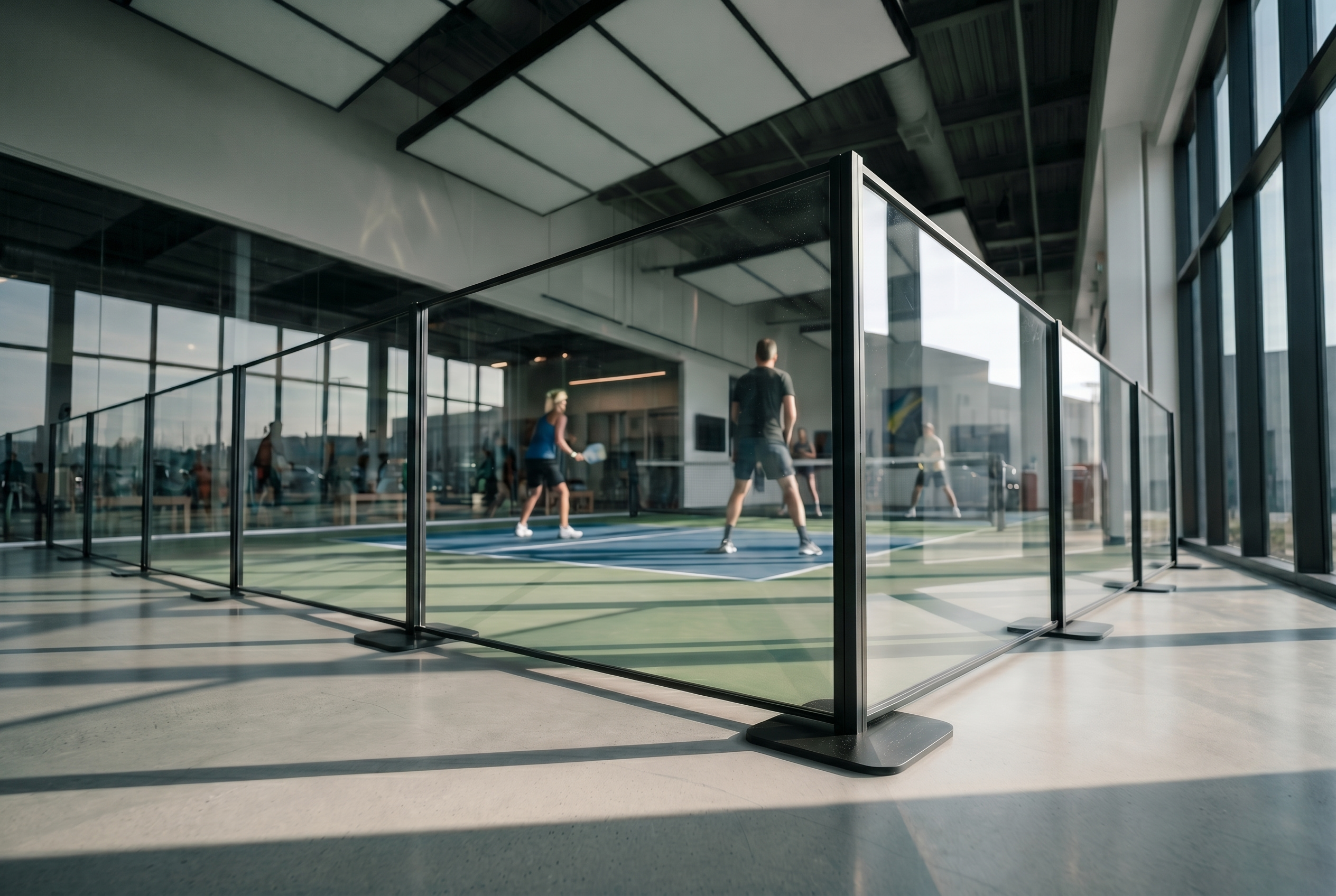
Pickleball court dividers are barriers placed between adjacent courts to stop balls from rolling into neighboring play, control sightline distraction, and define each court as its own space. On any facility with two or more courts, dividers are the difference between constant play stoppages and a facility that runs clean, simultaneous games. They range from portable netting on weighted bases to engineered structural glass panels, and the right choice depends on how permanent the facility is, how it is programmed, and what the owner wants the space to feel like.
This page covers the main divider types, how they compare, and how divider selection fits into multi-court planning. It is written for clubs, resorts, communities, and parks departments planning facilities of two to twenty or more courts.
Why multi-court facilities need dividers
A pickleball only needs to roll a few feet to interrupt the next court. On facilities without dividers, players chase balls across live courts, games pause, and injury risk rises as people move through play. Dividers solve three problems at once. They contain balls within each court, they give players a visual boundary that reduces distraction between adjacent games, and they create a sense of defined space that makes a busy facility feel organized rather than chaotic.
Tournament and league play raise the stakes. Sanctioned play expects containment between courts, and facilities that host events treat dividers as part of the competition infrastructure, not an accessory.
What are the main types of pickleball court dividers?
Three families cover nearly every installation.
Divider netting on portable bases. Lightweight mesh panels, typically 3 to 10 feet tall, supported by freestanding frames or weighted bases. This is the entry option: low cost, movable, and quick to deploy or store. The tradeoffs are appearance, wind performance outdoors, and daily labor to reset panels that get bumped out of line. Netting suits indoor facilities, temporary layouts, and programs that reconfigure court space often.
Flexible and rolling divider systems. Engineered dividers that move on tracks or integrated rollers, letting staff open a wall between courts for events or classes and close it for normal play. These systems combine containment with reconfigurability, and they suit clubs and indoor facilities whose programming changes through the day. The InfinityFlex divider is PICKLETILE’s flexible divider system in this class.
Structural glass dividers. Fixed, engineered glass panels between courts. Glass dividers contain play completely while preserving sightlines across the facility, which matters for coaching, spectating, and the open feel of a premium facility. They are the most permanent and the most architectural option, common at country clubs, resorts, and flagship facilities where the divider is part of the facility’s identity. The glass court divider page covers PICKLEGLASS divider construction and specification.
How do the divider types compare?
| Divider type | Containment | Reconfigurable | Sightlines | Permanence | Typical setting |
|---|---|---|---|---|---|
| Portable netting | Partial | High, manual | Reduced by mesh | Temporary | Indoor, temporary, budget programs |
| Flexible or rolling system | Full when closed | High, engineered | Good | Semi-permanent | Clubs, indoor facilities, mixed programming |
| Structural glass | Full | Fixed | Full transparency | Permanent | Country clubs, resorts, flagship facilities |
The selection logic follows the facility. A recreation program renting gym time needs netting it can strike in minutes. A club that runs open play in the morning, clinics at midday, and league play at night benefits from dividers that move with the schedule. A facility built as a long-term amenity, where appearance and spectating matter, is usually best served by fixed glass with flexible systems in the zones that need to open up.
Divider height, placement, and spacing
Most divider systems run 8 to 10 feet tall in the zones where containment matters most, with lower panels acceptable between recreational courts. Placement follows the court layout: dividers run along the shared boundary between adjacent courts, and the space they occupy has to be planned in the court spacing from the start. Facilities that set courts at minimum spacing and then try to add dividers afterward discover there is no room for bases, tracks, or foundations without crowding the out-of-bounds runoff players need.
That makes dividers a facility planning decision, not a purchase made after the courts are striped. Divider selection interacts with court fencing at the perimeter, with lighting pole placement along shared boundaries, and with the slab and footing plan for any fixed or tracked system, which belongs in the construction sequence.
Indoor versus outdoor divider selection
Indoors, wind is not a factor, so netting and rolling systems dominate, and the decision is mostly about programming flexibility and appearance. Outdoors, every divider is a wind load. Mesh netting sheds some wind but racks and topples in gusts if bases are undersized. Fixed glass and engineered flexible systems are designed with wind loading in their anchorage, which is one reason outdoor premium facilities trend toward engineered dividers over portable netting. Any outdoor divider decision should include the site’s wind exposure alongside the programming questions.
Planning dividers into a multi-court project
The questions to settle early are how many court boundaries need containment, which zones need to open for events or clinics, what the owner wants the facility to look and feel like, and how the divider system coordinates with spacing, fencing, lighting, and footings. Settled at design time, dividers integrate cleanly. Retrofitted later, they compete for space and foundations that were never planned for them.
If you are scoping dividers as part of a multi-court facility, you can request an estimate.
Frequently asked questions
What are pickleball court dividers?
Barriers placed between adjacent courts to stop balls from entering neighboring play, reduce visual distraction, and define each court as its own space. They range from portable mesh netting on weighted bases to rolling divider systems and fixed structural glass panels.
How tall should pickleball court dividers be?
Most systems run 8 to 10 feet in zones where full containment matters, such as between competition courts. Lower netting is common between recreational courts where occasional ball crossover is acceptable.
What is the best divider for an outdoor facility?
Outdoors, wind drives the decision. Portable netting requires substantial bases and still racks in gusts, so outdoor facilities built as long-term amenities generally use engineered systems, either fixed structural glass or flexible dividers designed with wind loading in their anchorage.
Can court dividers be added after the courts are built?
Sometimes, but it is the expensive path. Divider bases, tracks, and foundations occupy space that has to exist in the court spacing, and fixed systems need footings coordinated with the slab. Facilities planned at minimum court spacing often cannot retrofit engineered dividers without crowding player runoff.
Are glass court dividers worth it?
For facilities where appearance, spectating, and permanence matter, fixed glass dividers provide full containment with uninterrupted sightlines and become part of the facility’s architecture. For programs that need to reconfigure space daily, a flexible or rolling system may fit better, and many facilities combine the two.
