
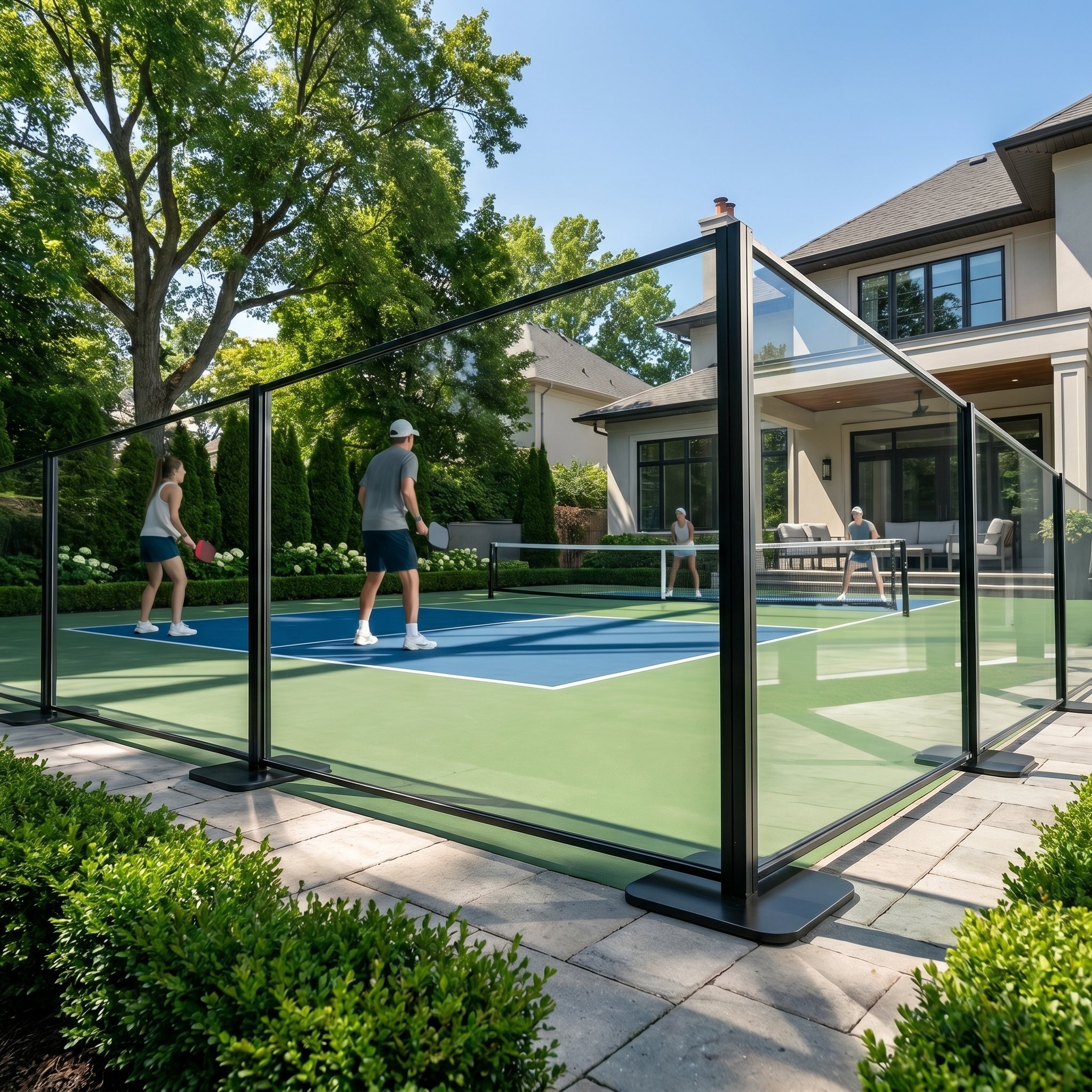
A single outdoor pickleball court typically costs between $25,000 and $55,000 to build in 2026, and a tournament-grade or fully enclosed court can run well beyond that. The range is wide because “a pickleball court” can mean very different things, from a painted surface on existing asphalt to an engineered facility with acoustic enclosure, integrated lighting, and a cushioned playing system designed to perform for decades.
This guide breaks pickleball court cost into the components that actually drive the number, shows where the ranges come from, and explains how to read a quote so you can compare proposals on more than price.
Pickleball court cost at a glance
| Scope | Typical 2026 range |
|---|---|
| Resurface or overlay an existing slab | $5,000 to $15,000 |
| New single court (base, surface, net, lines) | $25,000 to $55,000 |
| Add lighting | $4,000 to $12,000 per court |
| Add fencing or windscreen | $5,000 to $20,000 per court |
| Add acoustic or structural glass enclosure | varies by system and site |
| Multi-court complex (per court, at scale) | often lower per unit |
These figures are planning ranges, not quotes. Two courts of the same dimensions can differ by tens of thousands of dollars depending on site conditions, the surface system specified, and whether the court is built as a standalone amenity or as part of an integrated facility.
What you are actually paying for
The most common mistake in budgeting a court is treating it as a single line item. A court that performs, meaning it drains correctly, plays consistently, manages sound, and still looks intentional ten years later, is the sum of several engineered systems. Each one carries cost, and each one is where corners get cut when a bid looks suspiciously low.
Site preparation and base. Everything sits on the base. Grading, drainage, sub-base compaction, and the concrete or asphalt slab are the least visible part of the project and the most expensive to fix later. A court built on an inadequate base will crack, pond water, and fail prematurely regardless of how good the surface coating is. On sloped, poorly draining, or previously disturbed sites, base work alone can be the largest cost in the project.
Playing surface system. Surface options range from acrylic coatings applied directly over asphalt to cushioned and modular systems engineered for player comfort and consistent ball response. Cushioned systems cost more upfront and reduce joint impact and fatigue, a meaningful difference for facilities with heavy daily play. The surface is also where color, line geometry, and texture are controlled, so it carries both performance and aesthetic weight. We compare the choices in pickleball court surface options.
Dimensions and footprint. A regulation pickleball court playing area is 20 by 44 feet, but the recommended total court area, including safety run-off and circulation, is closer to 30 by 60 feet. Squeezing the footprint to save money is one of the most common sources of regret, because it limits play quality and forecloses future options. For the full layout standards, see our guide to pickleball court dimensions and layout.
Enclosure and fencing. Containment is the baseline function of fencing, but on most sites the enclosure is doing more than that, controlling sightlines, defining the space architecturally, and increasingly, managing sound. Chain-link is the lowest-cost option and was designed for containment, not for integration into a finished environment. Structural glass and acoustic-rated systems address aesthetic and sound performance that chain-link was never engineered to deliver. We compare the full set of options in pickleball court fencing and enclosure systems.
Lighting. Quality LED lighting extends usable hours and is essential for any facility expecting evening play. Cost depends on pole count, fixture quality, and whether the design controls glare and light spill onto neighboring properties, a factor that matters as much for community relations as for playability. See pickleball court lighting for design standards.
Acoustics. On residential, club, and mixed-use sites, sound is not an optional add-on. It is a design input that determines whether a facility can operate the hours it was built for. Courts planned without acoustic assessment are the ones that end up with restricted playing hours after neighbors complain. Acoustic enclosure systems such as PICKLEGLASS are engineered specifically to address this, and the cost of planning for sound during design is almost always lower than retrofitting after a dispute. For the underlying problem, see how to reduce pickleball noise.
Why the same court can cost twice as much
When two quotes for “one pickleball court” differ dramatically, the gap is almost always in the parts you cannot see in a rendering:
- Base and drainage engineering: a properly engineered base versus a thin slab poured on uncompacted ground.
- Surface system: a coated asphalt surface versus a cushioned, engineered playing system.
- Enclosure performance: basic chain-link versus an acoustic or structural glass system.
- Site conditions: flat, well-draining, accessible sites cost far less to build on than constrained, sloped, or poorly draining ones.
- Integration: a standalone court dropped into a space versus a facility designed to fit its architectural and acoustic context.
A lower number is not automatically a better value. It often signals that something, whether base depth, drainage, surface quality, or acoustic planning, has been removed from the scope. Those omissions reappear later as cracking, ponding, noise complaints, and resurfacing costs that arrive far sooner than they should.
Converting an existing court can lower cost
If you already have a tennis court or unused hardcourt, conversion is frequently the most cost-effective path to playable pickleball courts, because the base and much of the site work already exist. The economics and layout options depend on the condition of the existing slab and how many courts you want to fit. We cover this in detail in converting a tennis court to pickleball.
How to read a court construction quote
Before comparing proposals on price, make each one answer the same questions:
- What base and drainage work is included, and what happens on this specific site?
- What surface system is specified, coated asphalt or an engineered cushioned system?
- What is the total court footprint, including run-off and circulation?
- What enclosure is included, and does it address sound and sightlines or only containment?
- Is lighting designed to control glare and spill onto adjacent properties?
- Has anyone assessed acoustics for this site, given what is next to it?
- What is the expected service life of each system, and what is the resurfacing interval?
A quote that cannot answer these is not cheaper. It is less complete. Comparing complete proposals is the only way to know what a number actually buys.
The real question is not what a court costs to build
The upfront price answers a narrow question: what it will cost to put a playable surface on the ground this year. It says nothing about what the facility will cost to own, operate, and maintain over the next twenty years, or whether it will still serve its community and reflect well on the property by then.
That is the difference between building a court and engineering a facility. A court is a one-time purchase optimized for the lowest number today. A facility is long-term infrastructure, engineered for how it drains, how it plays, how it sounds to the people who live near it, and how it ages alongside the architecture around it. The communities and developers who plan for acoustics, durability, and integration during design, rather than reacting to problems after they appear, consistently see better outcomes and lower lifetime cost, even when their upfront number is higher.
For a complete view of the build process, see our pickleball court construction guide.
Frequently asked questions
How much does it cost to build a pickleball court in 2026?
A new single outdoor pickleball court typically costs between $25,000 and $55,000, depending on site conditions, the surface system, enclosure, and lighting. Resurfacing an existing slab is far less; a fully enclosed, acoustically engineered court is more.
Is it cheaper to convert a tennis court to pickleball?
Usually, yes. Conversion reuses the existing base and site work, which are among the most expensive elements of new construction. Final cost depends on the slab’s condition and the layout you want.
What makes one pickleball court cost more than another?
The biggest drivers are base and drainage engineering, the surface system (coated versus cushioned), the enclosure (chain-link versus acoustic or structural glass), site conditions, and whether the court is built standalone or designed as an integrated facility.
Do I need an acoustic enclosure for a pickleball court?
On residential, club, and mixed-use sites, planning for sound during design is what determines whether a facility can operate its intended hours. Addressing acoustics upfront is typically far less costly than retrofitting after noise complaints lead to restricted hours.
