
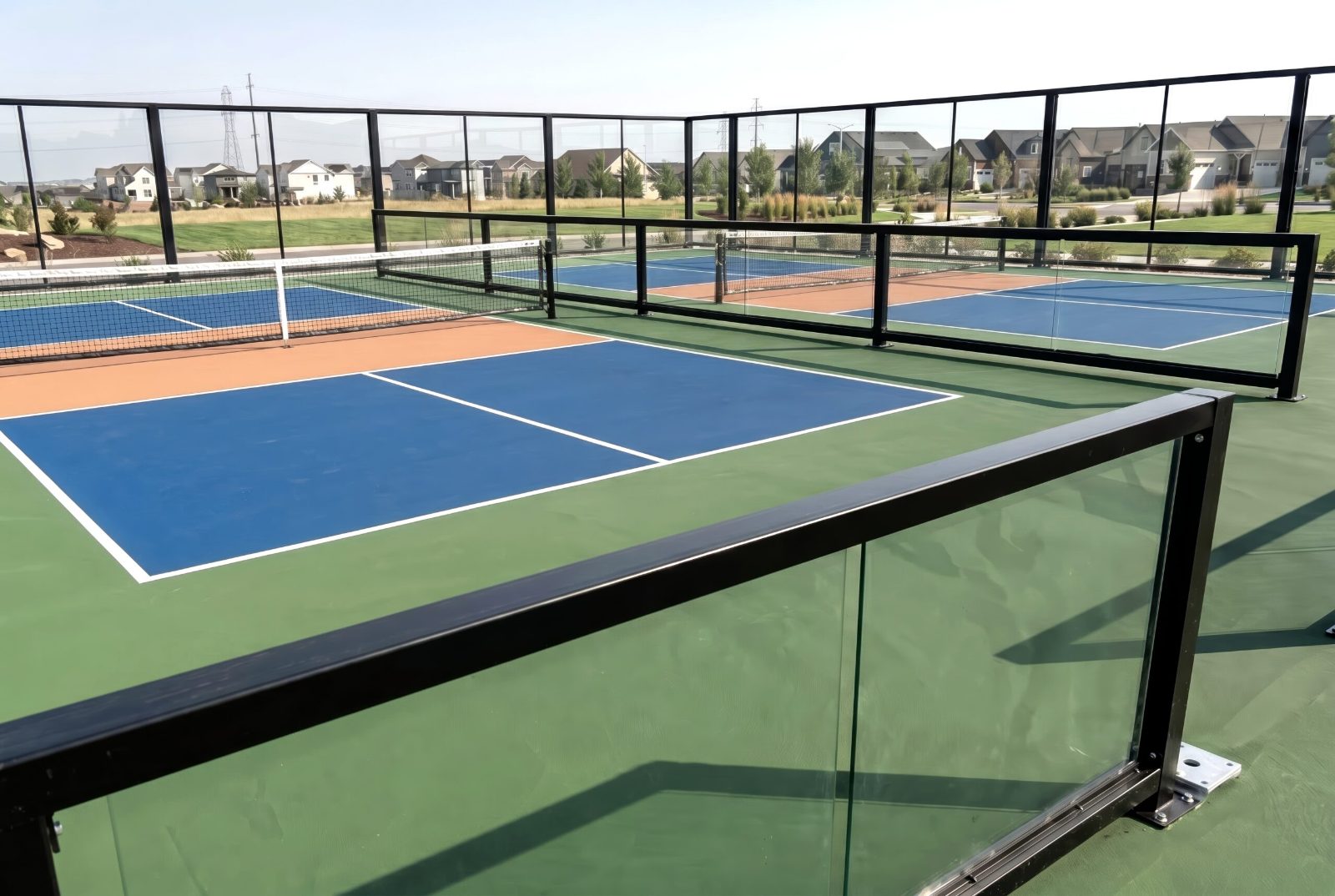
Pickleball Court Resurfacing: When to Recoat, What It Costs, and When to Rebuild
Pickleball court resurfacing is the process of renewing a court’s playing surface (cleaning, repairing, and reapplying the coating system) to restore traction, color, line clarity, and consistent ball response once the existing surface has worn or weathered. Most outdoor courts need resurfacing every four to eight years, though heavy daily play, climate, and the quality of the original build all move that window.
This guide explains how to tell when a court actually needs resurfacing, what the work costs in 2026, what the process involves, and, most importantly, how to know whether a recoat will solve your problem or whether the issue is in the base, where resurfacing cannot reach.
When does a pickleball court need resurfacing?
Surfaces wear on a predictable cycle, but the right time to act depends on what you’re seeing. Watch for these signals:
- Faded or chalky color and worn line paint: cosmetic, but also a sign the protective coating is thinning.
- Loss of texture and traction: the surface feels slick, especially when damp, which is a safety issue.
- Hairline surface cracks and small spider-cracking: often resolvable during resurfacing if the base is sound.
- Low spots that hold water (birdbaths): water that sits for more than an hour after rain points to surface or base problems.
- Blistering, peeling, or delamination: the coating is separating from the slab and needs more than a simple recoat.
A court showing only fading, mild texture loss, and minor surface cracking is usually a straightforward resurfacing candidate. A court with ponding, structural cracks, or delamination may need repair work, or a rebuild, first. The distinction matters, because coating over a failing base wastes the resurfacing investment.
Pickleball court resurfacing cost in 2026
| Scope | Typical 2026 range |
|---|---|
| Standard recoat (clean, patch, 2 to 3 acrylic coats, lines) | $5,000 to $12,000 per court |
| Recoat with crack repair / filling | $8,000 to $15,000 per court |
| Resurface plus partial base repair | $12,000 to $25,000+ per court |
| Conversion of acrylic to a cushioned system | higher; quoted by system |
| Full removal and rebuild (base failure) | new-construction pricing |
These are planning ranges, not quotes. The number moves with court size, the condition of the existing surface, how much crack repair is needed, the coating system specified, and regional labor and material costs. A resurfacing quote that is dramatically lower than others usually reflects fewer coats, skipped crack preparation, or a thinner system, choices that shorten the interval before the next resurfacing.
For how resurfacing fits into the lifetime cost of owning a court, see the pickleball court cost guide; for new builds, start with pickleball court construction.
What the resurfacing process involves
A proper resurfacing is more than a fresh coat of paint. The sequence is what determines whether the result lasts the full cycle:
1. Cleaning and inspection. The court is pressure-cleaned and inspected for cracks, low spots, and adhesion problems. This is where a good contractor catches base issues a coat would otherwise hide.
2. Crack repair and patching. Cracks are filled and feathered; low spots are leveled with patch binder so water sheets off correctly. Skipping this is the most common reason a resurfaced court looks worn again within a season.
3. Resurfacing coats. A resurfacer or filler coat is applied to smooth the surface, followed by two or more color coats that carry the texture and traction.
4. Line striping. Regulation lines are masked and painted to the correct pickleball geometry.
5. Cure. The system needs dry, moderate conditions to cure between coats, which is why resurfacing is scheduled around weather and season.
How to choose a pickleball court resurfacing company
Choosing who resurfaces a court matters as much as the coating specified, because the most expensive resurfacing mistakes are made before the first coat goes down. Use these criteria when comparing resurfacing companies and contractors:
- Base inspection before quoting. A resurfacing company worth hiring inspects the slab and drainage first and tells you honestly whether a recoat will hold, rather than quoting a coat over a base problem.
- A written scope, not just a price. The quote should state the number of coats, the crack-repair method, patching and leveling of low spots, and the coating system by name. A number with no scope is how thin systems get sold.
- Coating-system references. Ask which acrylic or cushioned systems they install and to see courts they resurfaced three to five years ago, so you can see how the work aged.
- Multi-court and facility experience. Clubs, resorts, and multi-court facilities have scheduling, phasing, and consistency needs that a single-court contractor may not carry.
Commercial and multi-court resurfacing
Resurfacing a bank of courts at a club, resort, or community is a different exercise from a single court. Color and texture have to match across courts, work is phased so the facility keeps some courts open, and the resurfacing cycle is planned against the facility’s calendar rather than reacting to the worst court. For facilities weighing a full renewal, resurfacing is also the moment to correct drainage, upgrade to a cushioned system for heavy daily play, and address the enclosure and noise questions that a coat never touches. See pickleball facility planning for the multi-court view.
Recoat or rebuild? How to tell the difference
This is the decision that protects, or wastes, the money. Resurfacing renews the top system; it cannot fix what is wrong underneath.
A recoat is the right call when the base is structurally sound and the problems are confined to the surface: fading, texture loss, minor cracking, and worn lines. This is the large majority of courts, and resurfacing on schedule is the single most cost-effective way to extend a court’s usable life.
A rebuild, or significant base repair, is the right call when the problems originate below the surface: ponding that doesn’t drain, wide or recurring structural cracks, sections that have heaved or settled, or coating that keeps delaminating no matter how many times it’s redone. These are base and drainage failures, and no amount of resurfacing will hold over a base that is moving or holding water. Repeated premature resurfacing is itself a signal: a court that needs recoating every two years usually has a base problem masquerading as a surface problem.
The most expensive outcome in court ownership is resurfacing a court three times before accepting that the base needed attention all along. A contractor who inspects the base honestly before quoting a recoat is worth more than one who simply sells the cheapest coat.
Resurfacing as an upgrade opportunity
Resurfacing is also the natural moment to improve a court rather than merely restore it. Because the surface is already being renewed, it is the lowest-friction point to reconsider the playing system. For example, moving from a bare acrylic coat to a cushioned system that reduces joint impact for facilities with heavy daily play. It is also a logical time to address adjacent issues that affect how the court performs and how long the next surface lasts: drainage corrections, enclosure improvements, and, on residential or club sites, the sound problem that resurfacing alone never touches. A court that plays beautifully but draws noise complaints still loses its hours, which is why facilities increasingly pair surface renewal with an acoustic-rated enclosure such as PICKLEGLASS™. For the broader playbook, see how to reduce pickleball noise.
The lifecycle view: resurfacing is a system, not a chore
It is tempting to treat resurfacing as a maintenance line item, an unavoidable cost that comes due every few years and gets handed to the lowest bidder. But the resurfacing interval is one of the clearest signals of how well a court was built in the first place. A court engineered with a sound base, correct drainage, and a quality surface system holds its surface longer, resurfaces cleanly when the time comes, and costs less to own across its life. A court built to the lowest number resurfaces sooner, fails earlier, and eventually forces the rebuild it was supposed to avoid.
That is the difference between maintaining a court and stewarding a facility. The owners who plan resurfacing as part of a court’s lifecycle (budgeting for it, scheduling it before the surface fails rather than after, and using each cycle to improve the system) protect their investment far more effectively than those who react to a worn surface as an unwelcome surprise. Resurfacing, done on time and done right, is not the cost of a court wearing out. It is what keeps a well-built facility performing for the next decade.
Frequently asked questions
How often should a pickleball court be resurfaced?
Most outdoor pickleball courts need resurfacing every four to eight years. Heavy daily play, harsh climates, and a lower-quality original build shorten that interval; a well-engineered court with a sound base and quality surface system holds longer.
How much does it cost to resurface a pickleball court in 2026?
A standard recoat typically runs $5,000 to $12,000 per court, rising to $8,000 to $15,000 with crack repair and higher when partial base repair is required. The figure depends on court size, surface condition, coating system, and region.
Can resurfacing fix cracks in a pickleball court?
Surface and hairline cracks can usually be repaired during resurfacing if the base is sound. Wide, recurring, or structural cracks, and areas that hold water, indicate a base or drainage problem that resurfacing cannot fix; those courts need base repair or a rebuild first.
Should I resurface or rebuild my pickleball court?
Resurface when the base is structurally sound and the problems are confined to the surface (fading, texture loss, minor cracking). Rebuild or repair the base when problems originate underneath: ponding, wide structural cracks, settling, or repeated delamination. A court that needs recoating every couple of years usually has a base problem, not a surface problem.
How do I choose a pickleball court resurfacing contractor?
Pick a company that inspects the base and drainage before quoting, gives a written scope (coat count, crack repair, coating system by name), can show courts it resurfaced three to five years ago, and has experience matching the number of courts you have. The lowest number usually reflects fewer coats or skipped crack prep, which shortens the interval to the next resurfacing.
Can you resurface several courts at once?
Yes, and multi-court sites are resurfaced as a planned, phased project so color and texture match across courts and the facility keeps courts open during the work. It is also the natural point to standardize the surface system and correct drainage or enclosure issues across the whole facility.
