
What the PICKLETILE 20-minute scoping conversation covers, and why developers who schedule it early consistently get better outcomes.
AUSTIN, Texas – June 8, 2026 – The most common reason a multifamily developer does not reach out to a court infrastructure partner early in the design process is not budget concern. It is uncertainty about what the conversation will involve and whether they have enough project definition to make it useful.
The assumption is usually that a scoping conversation requires having the amenity design finished, the site plan locked, and the budget approved. None of that is true. A scoping conversation is most valuable before any of those things are final, because that is the window where the right infrastructure decision can be made at full design freedom.
Here is what the 20-minute conversation actually covers.

Your project and site: what we need to understand before we can scope anything
The first part of the conversation is about your project. Where is the site? What is the development type: ground-up, renovation, or adaptive reuse? How many courts are being planned? What is the approximate setback from occupied units to the planned court location?
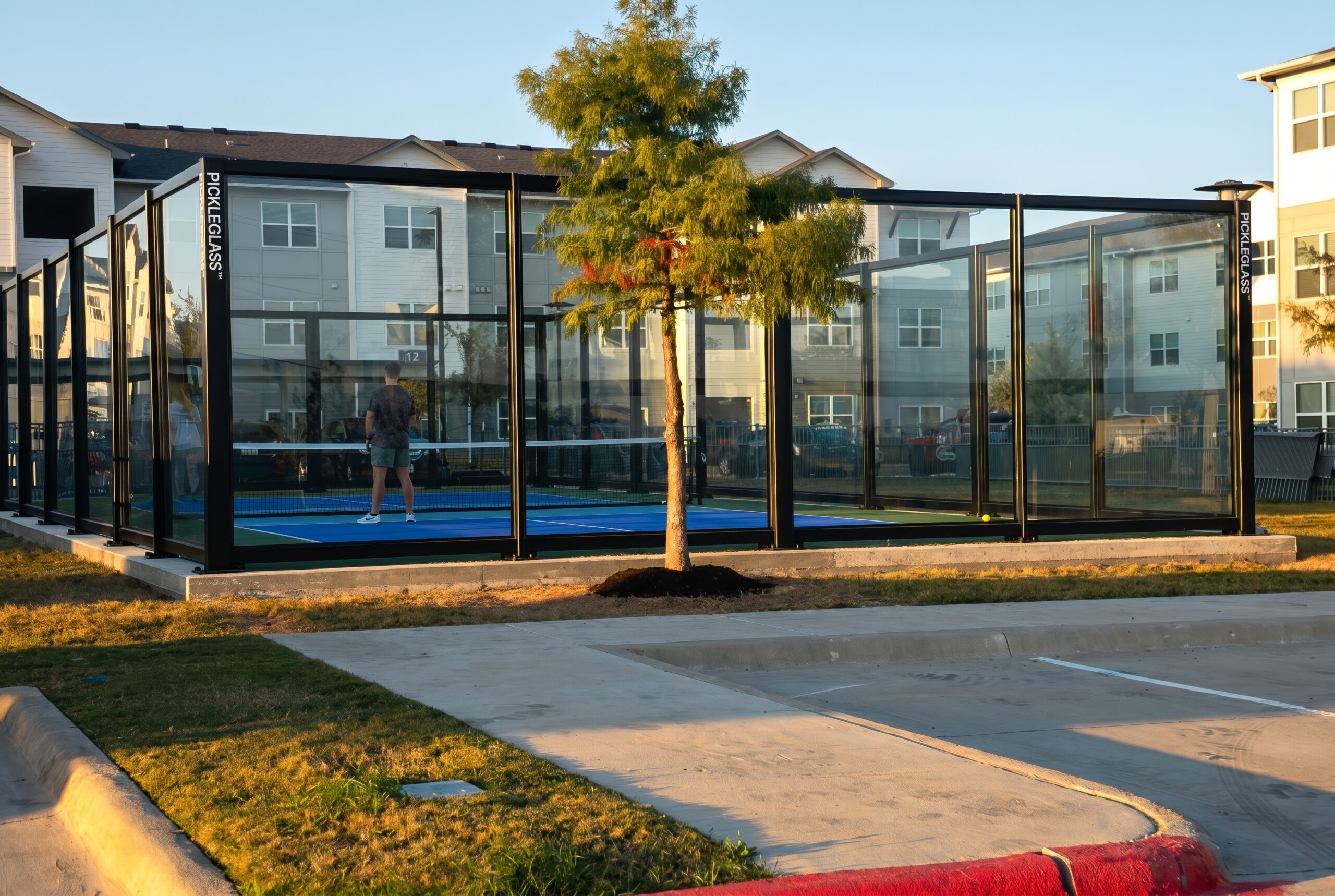
These are the questions that determine which PICKLETILE™ systems are appropriate for the project and what the right specification looks like. A two-court installation at a 30-foot setback in a high-density urban setting in Austin has a different acoustic and structural requirement than a four-court installation at a 100-foot setback in a suburban Florida community.
You do not need a finished site plan to answer these questions. A preliminary project description and an approximate court location are enough to have a productive first conversation.
The noise and acoustic exposure assessment
If your project involves courts within residential proximity, the scoping conversation will include a quick acoustic exposure assessment. This is not a formal acoustic study. It is a practical evaluation of whether the project site creates noise risk that needs to be addressed in the specification, and what the right enclosure height and configuration looks like given the setback distances and surrounding unit layout.
Most developers who have not yet addressed this question are carrying a specification gap they do not fully see yet. The scoping conversation surfaces it early, when it is a design decision rather than a retrofit problem.
Product selection: what your project actually needs
The scoping conversation covers which PICKLETILE™ products are appropriate for your project, in plain terms.
Does your site require a full-height perimeter PICKLEGLASS™ enclosure for acoustic performance? Almost certainly, if courts are within 100 feet of occupied units. Does your multi-court layout benefit from interior 4-foot glass dividers for ball containment and visual separation? Likely, if you are planning two or more courts in the same facility. Do you need AUTONOMOUS access control integrated into the facility? Strongly recommended if you want to run the courts as a managed amenity with booking capability and usage tracking rather than an open recreational space.
These are not sales questions. They are specification decisions with real consequences for how the facility performs. The scoping conversation is where they get answered with actual information rather than assumptions.
Timeline alignment
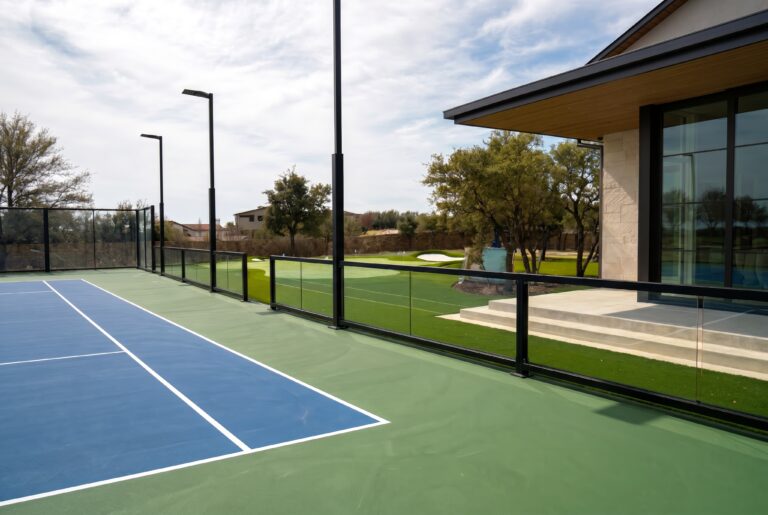
A court infrastructure project from initial engagement to installation completion runs approximately 12 to 17 weeks. The engineering and design phases occupy the first several weeks. Fabrication follows. Installation is the final phase.
The scoping conversation is where PICKLETILE™ maps that timeline against your construction schedule, identifies the critical path decisions, and flags if there are timing constraints that require moving faster in the design phase. Developers who engage at the amenity design phase have maximum schedule flexibility. Developers who engage after their GC has already started permitting have a tighter window.
Knowing where you sit on that timeline, and what it means for your project, takes five minutes of the conversation.

What you leave with
At the end of a 20-minute scoping conversation, you will have a clear product recommendation for your project, a preliminary understanding of the right scope and configuration, a timeline that maps against your construction schedule, and a quote that reflects your actual project parameters rather than a generic price range.
You will also have enough information to make the court scope decision with confidence rather than sitting on it while the amenity design phase passes.
This is not a sales presentation. It is a working conversation between a developer and an infrastructure partner, focused on your specific project. It takes 20 minutes. The only thing it requires from you is a general description of your project and an idea of where the courts are going on your site.
Request a quote now. We will get the conversation on the calendar and get you the information you need to move the court scope forward.
About PICKLETILE™
PICKLETILE™ is the leading design-build firm for premium pickleball court construction and the Official Court Builder of USA Pickleball.
Headquartered in Austin, Texas, PICKLETILE™ simplifies the complex construction process by offering turnkey solutions for residential, commercial, and club-level projects. The company is also the creator of PICKLEGLASS™, a patented soundproof glass wall system engineered to reduce noise by 50% while offering panoramic views and wind protection. For more information, visit www.pickletile.com.
