
The most common reason club leadership delays a racquet facility decision is a version of this: “We want to understand our member demand before we commit to a scope.” It is a reasonable instinct. Capital projects at private clubs require board buy-in, and board buy-in requires evidence.
But the evidence is almost always already there, sitting in the systems and dynamics of the club’s day-to-day operations. You do not need a survey, a consultant, or a formal demand study to understand whether your club has a pickleball problem worth solving. The signals are visible, and this article walks through how to read them.
The scheduling friction signal
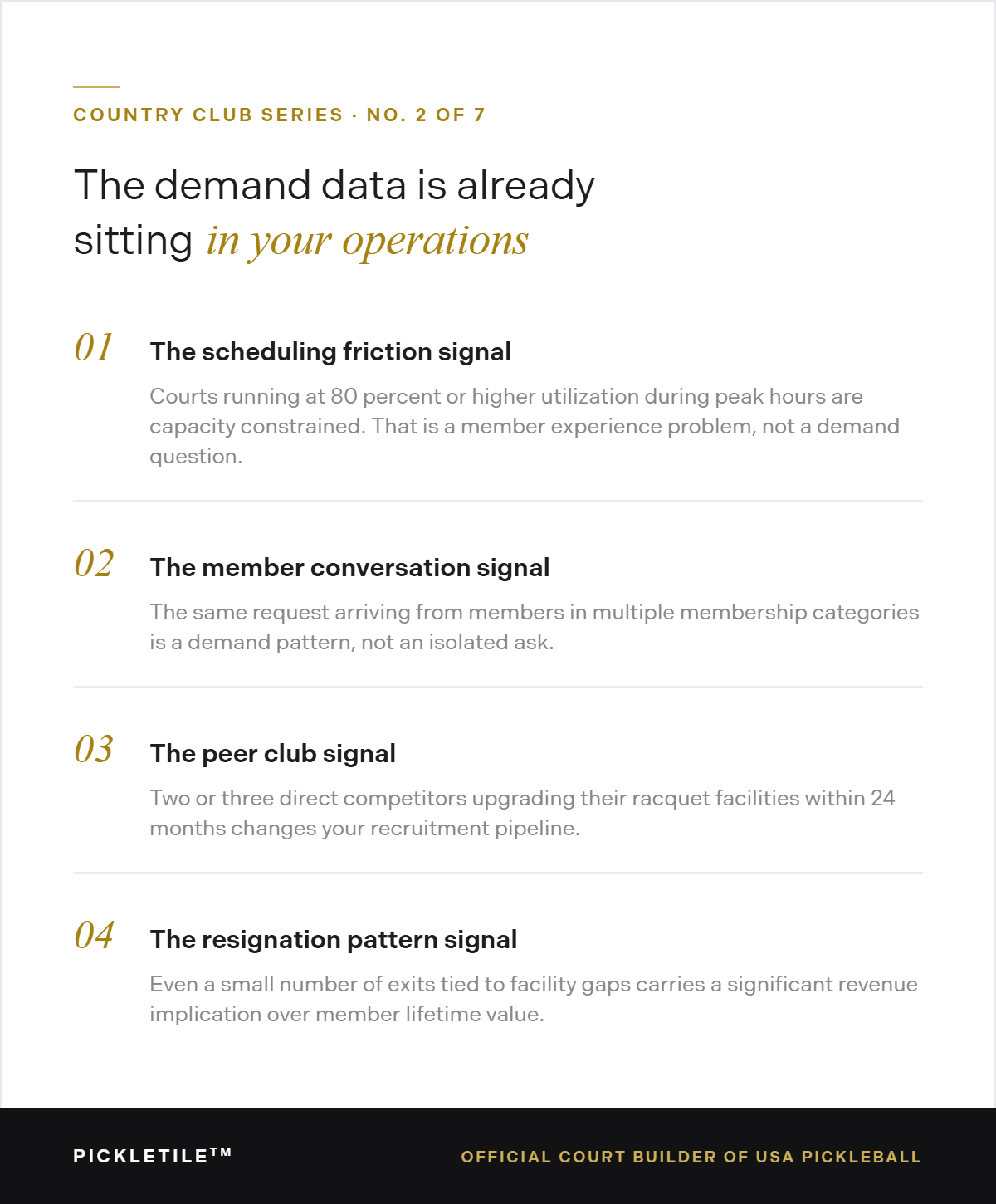
The most reliable indicator of unmet demand at a club is not what members say. It is what the booking system shows.
If your club has any pickleball courts, or any courts that have been converted to serve pickleball, pull the court utilization data for the past three months. Look for two things: peak hour booking rates and the frequency of scheduling conflicts or waitlist activity.
Courts that are running at 80 percent or higher utilization during peak hours are already capacity-constrained. That is not a demand question. That is a facilities capacity problem that is manifesting as a member experience problem every time a member cannot get a court at the time they want to play.
If your club does not have a formal booking system for pickleball courts, or if courts are managed informally, that itself is a signal. Demand that outpaces a club’s ability to manage it systematically tends to produce the informal workarounds, sign-up sheets, member friction, and staff involvement that everyone finds unsatisfying but nobody has formally addressed.
For the Director of Tennis/Racquets: The scheduling friction signal is usually most visible at the operations level before it surfaces in membership feedback. If the racquets staff is managing court conflicts, fielding requests for additional court time, or navigating tension between tennis and pickleball programming, those operational pressures are quantifiable. Documenting them in terms of staff hours spent on conflict resolution and the number of programming requests that could not be accommodated builds a concrete internal case for the capital conversation.
The member conversation signal
Member feedback about pickleball does not always arrive through formal channels. It often arrives through direct conversations with the GM, comments at the bar, or through the Director of Tennis/Racquets hearing the same requests repeatedly.
This qualitative signal is worth taking seriously as a leading indicator. Members who are actively raising the pickleball conversation are not a fringe group in 2026. They are representative of a broader segment of the membership that is thinking the same thing but has not said it yet. The members who say nothing but quietly begin evaluating other clubs are harder to count but no less real.
The question worth answering before the board conversation is: in the past 12 months, how often has the pickleball question come up from members, and who raised it? If the answer is multiple times, from members in multiple membership categories, that is a demand pattern, not an isolated request.
The peer club signal
Club leadership consistently underestimates how much their own members pay attention to what peer clubs are doing. Members who belong to multiple clubs, or who have friends at nearby clubs, will notice when a competitor completes a facility upgrade. They will mention it. And if the gap between your facility and the peer club’s facility becomes visible enough, it enters the membership evaluation conversation.
Tracking what peer clubs in your market have done or announced on the racquet facility front is straightforward. Golf and tennis club industry publications, local real estate and lifestyle coverage, and direct awareness of clubs in your competitive set provide most of what you need. If two or three of your direct competitors have added or upgraded pickleball facilities in the past 24 months, that is a competitive signal with direct implications for your recruitment pipeline.
The resignation pattern signal
Member resignation data is the most lagging signal on this list, but it is also the most concrete. If your club tracks exit interview data or exit surveys, review the past 12 months for any resignation reasons that reference amenities, racquet sports, or pickleball specifically. Even a small number of resignations attributable to facility gaps represents a significant revenue implication over the lifetime value of a member relationship.
For clubs that do not collect formal exit data, the question to ask your membership team is simple: in the past year, have you heard pickleball or racquet facilities come up when you were trying to retain a member who was considering leaving? If the answer is yes even once, the conversation is worth having.
What to do with what you find
The signals above are not definitive ROI calculations. They are the inputs to a strategic conversation about whether the racquet facility represents a meaningful gap in your club’s competitive position. In most cases, the answer that emerges from looking at these signals honestly is yes, and the next question is what to do about it.
That is exactly what PICKLETILE™’s scoping conversation is designed to address. We will look at your facility’s current state, your demand signals, and your competitive environment, and show you what the right infrastructure upgrade looks like for your club. Request a quote and we will get the conversation scheduled.
The demand data is usually already sitting in your operations. Let’s look at what it says about your facility and what the right response is.
