
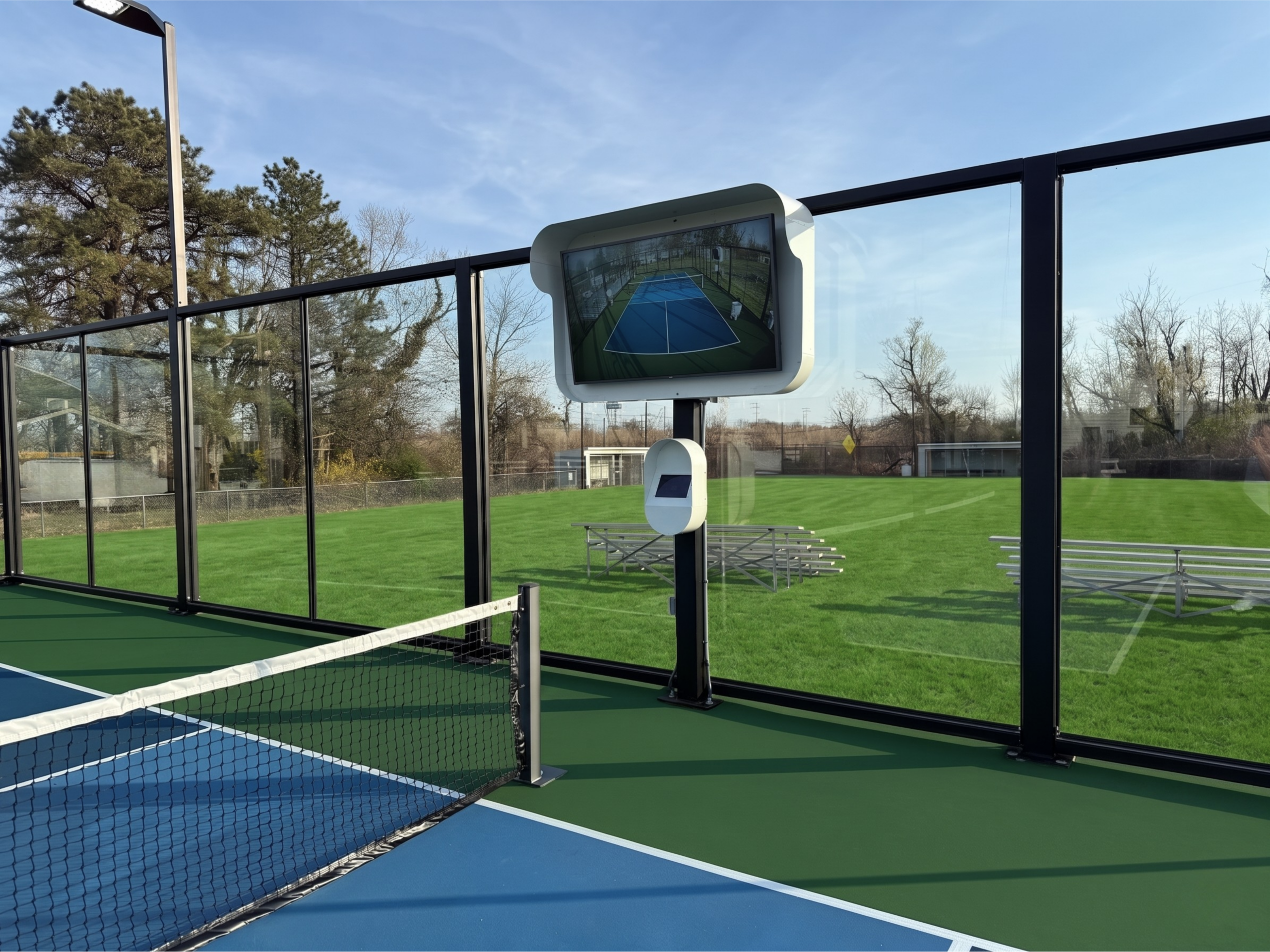
This covers what’s actually specified in a court facility designed for heavy daily use in a multifamily environment.
AUSTIN, Texas – Apr. 10, 2026 – From a distance, most court facilities look the same: a flat surface, some kind of perimeter, lights, nets. The visible differences between a $50,000 installation and a $200,000 facility are subtle. The engineering differences are not.
For a PM evaluating what the scope actually includes (and what justifies the investment compared to basic construction), here’s a component-by-component breakdown of what’s engineered into a court facility designed for 15 to 20+ years of heavy daily use.
Foundation: post-tensioned concrete
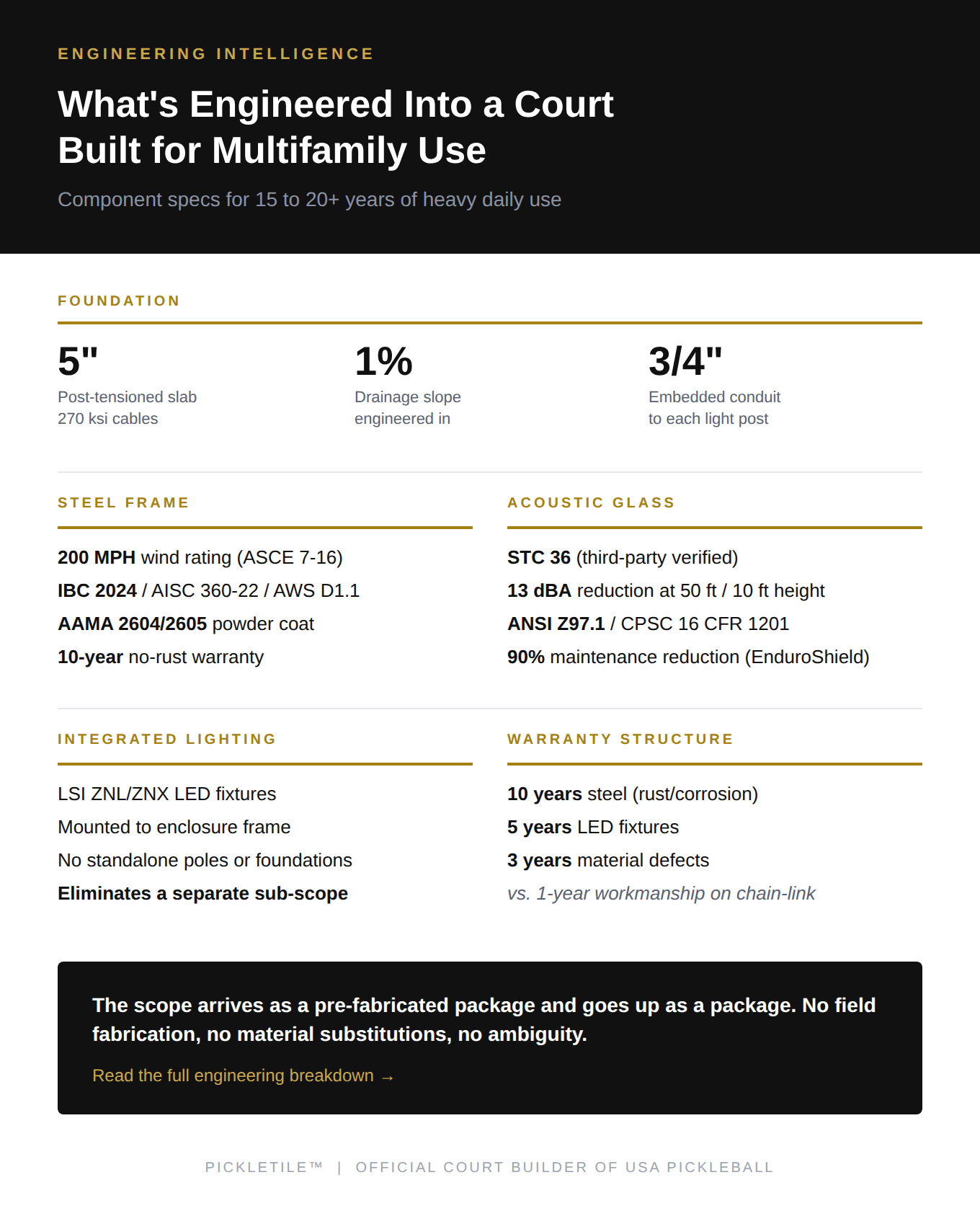
The slab is 5 inches thick with post-tensioned steel cables (1/2 inch, 270 ksi) at 30 to 42 inch spacing. Post-tensioning compresses the concrete after curing, which prevents the cracking that develops in standard reinforced slabs over time, particularly in climates with significant temperature variation.
Why it matters for the PM: a cracked slab means a cracked court surface, which means maintenance callbacks, resident complaints, and eventual resurfacing on an accelerated timeline. Post-tensioning costs more upfront but eliminates the most common long-term failure mode in court construction.
Additional slab elements: 1% continuous drainage slope, anchor bolts at each post location (4 per post, 3/4 inch ASTM F1554 Grade 55), and underground 3/4 inch conduit routing to each light post junction box. All specified before the pour and incorporated into the civil engineer’s slab design.
Steel frame: structural-grade, code-compliant
The enclosure frame is HSS ASTM A500 Grade B steel: 6 inch square posts on 12×12 inch base plates, 4×4 inch crossbeams. Engineered to IBC 2024, AISC 360-22, and AWS D1.1. Wind load calculations follow ASCE 7-16, with systems rated for 125 to 200 MPH depending on the project’s exposure category.
For PMs in coastal or high-wind regions: this isn’t overspec. It’s code compliance for a structural system in those environments. The engineering package documents the specific wind load calculation for your site’s geographic and exposure conditions.
The finish is architectural-grade super-durable polyester powder coat, certified to AAMA 2604/2605. This is the same coating standard used on commercial building facades and storefronts, not the vinyl dip coating used on chain-link fencing. It’s backed by a 10-year warranty against rust and corrosion, the primary failure mode for outdoor steel structures.
Glass: tempered, safety-rated, coated
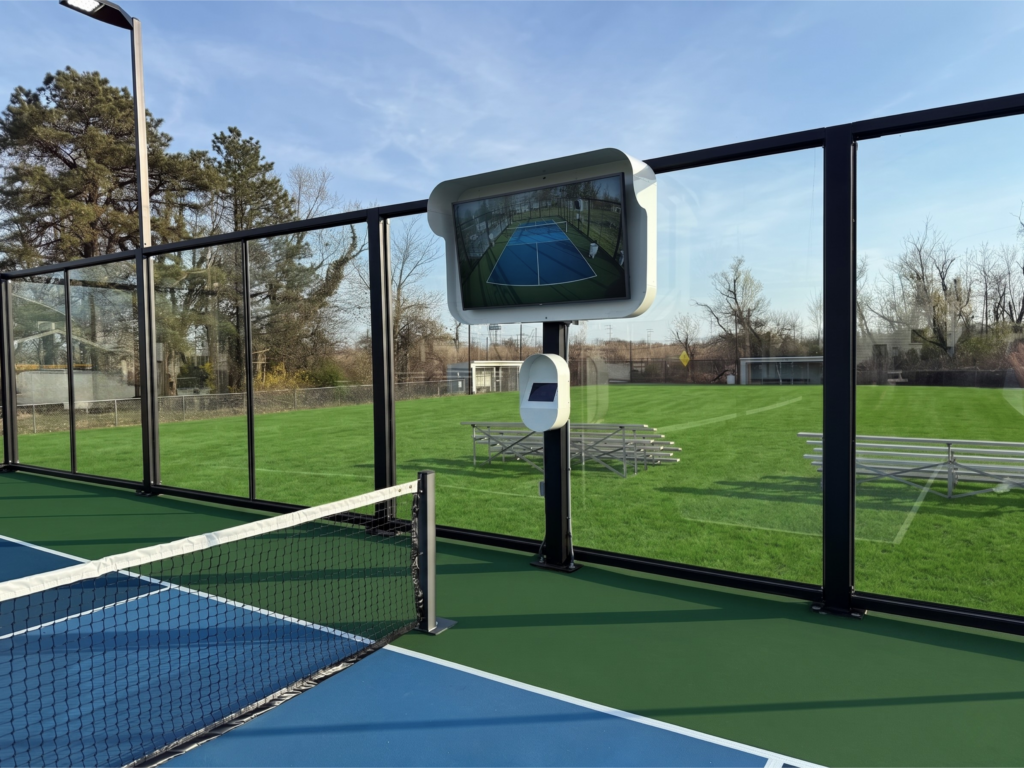
Panels are 1/2 to 3/4 inch tempered glass, with thickness determined by the site’s wind environment. Safety ratings: ANSI Z97.1 (safety glazing) and CPSC 16 CFR 1201 (architectural glazing safety). These are the same certifications required for glass in commercial buildings.
Panels are joined using 3M clear adhesive tape rather than metal framing between panels. This serves two functions: it maintains acoustic continuity across the enclosure wall (gaps reduce sound attenuation), and it creates a clean visual without the bulk of traditional mullion framing.
Acoustic performance: STC 36, verified by third-party testing (Trinity Consultants / Cerami Longman Lindsey). At a 10-foot height, this provides 13 dBA of noise reduction at 50 feet, which is the critical specification for courts placed near residential units.
Every panel is coated with EnduroShield, a polysiloxane surface treatment that bonds at the molecular level to the glass. It repels water, oils, dirt, and environmental contaminants, reducing maintenance by up to 90%. In practical terms for the property management team that inherits the facility: the glass stays clear without manual cleaning. Rain does most of the work.
Lighting: integrated into the structural frame
LED fixtures (LSI ZNL or ZNX, Official Lights of USA Pickleball) mount to the enclosure’s steel frame on HSS 3.5×3.5 posts. Electrical conduit runs underground through the slab to junction boxes at each post base. No standalone pole foundations, no exposed wiring runs, no separate lighting infrastructure to coordinate.
For the PM: this eliminates an entire sub-scope. There’s no lighting vendor to coordinate separately. The light fixtures, posts, and conduit are all part of the enclosure scope, engineered and installed by the same team. The only external electrical work is the final connection from junction boxes to the building’s electrical panel, which is a straightforward task for the project’s existing electrical sub.
Warranty: 5 years on LED fixtures.
Warranty structure
The tiered warranty covers the primary failure modes for each component: 10 years on steel against rust and corrosion, 5 years on LED light fixtures, 3 years on material defects.
For comparison: a typical chain-link installation carries a 1-year workmanship warranty with no material performance warranty. Vinyl coating degradation, rust, and fabric stretching are considered normal wear. The 10-year rust warranty on the steel frame alone exceeds the expected replacement cycle of most chain-link installations.
What the GC should take away:
The court facility arrives on-site as a fully engineered, pre-fabricated system. Steel is cut and welded to shop drawing specifications. Glass panels are sized to the exact opening dimensions. Light fixtures are specified for the exact mounting locations. The installation crew arrives with a sequenced plan and all materials accounted for.
For the GC, this means: no field fabrication, no field engineering, no material substitutions, and no ambiguity about what’s being installed. The scope arrives as a package and goes up as a package. That’s a different experience from coordinating five separate trades, each doing their piece independently.
If you’d like to see how these specifications apply to your specific site conditions and wind environment, or walk through the documentation package with your GC, that’s what the scoping call covers. Call us to set something up.
About PICKLETILE™
PICKLETILE™ is the leading design-build firm for premium pickleball court construction and the Official Court Builder of USA Pickleball.
Headquartered in Austin, Texas, PICKLETILE™ simplifies the complex construction process by offering turnkey solutions for residential, commercial, and club-level projects. The company is also the creator of PICKLEGLASS™, a patented soundproof glass wall system engineered to reduce noise by 50% while offering panoramic views and wind protection. For more information, visit www.pickletile.com.
