
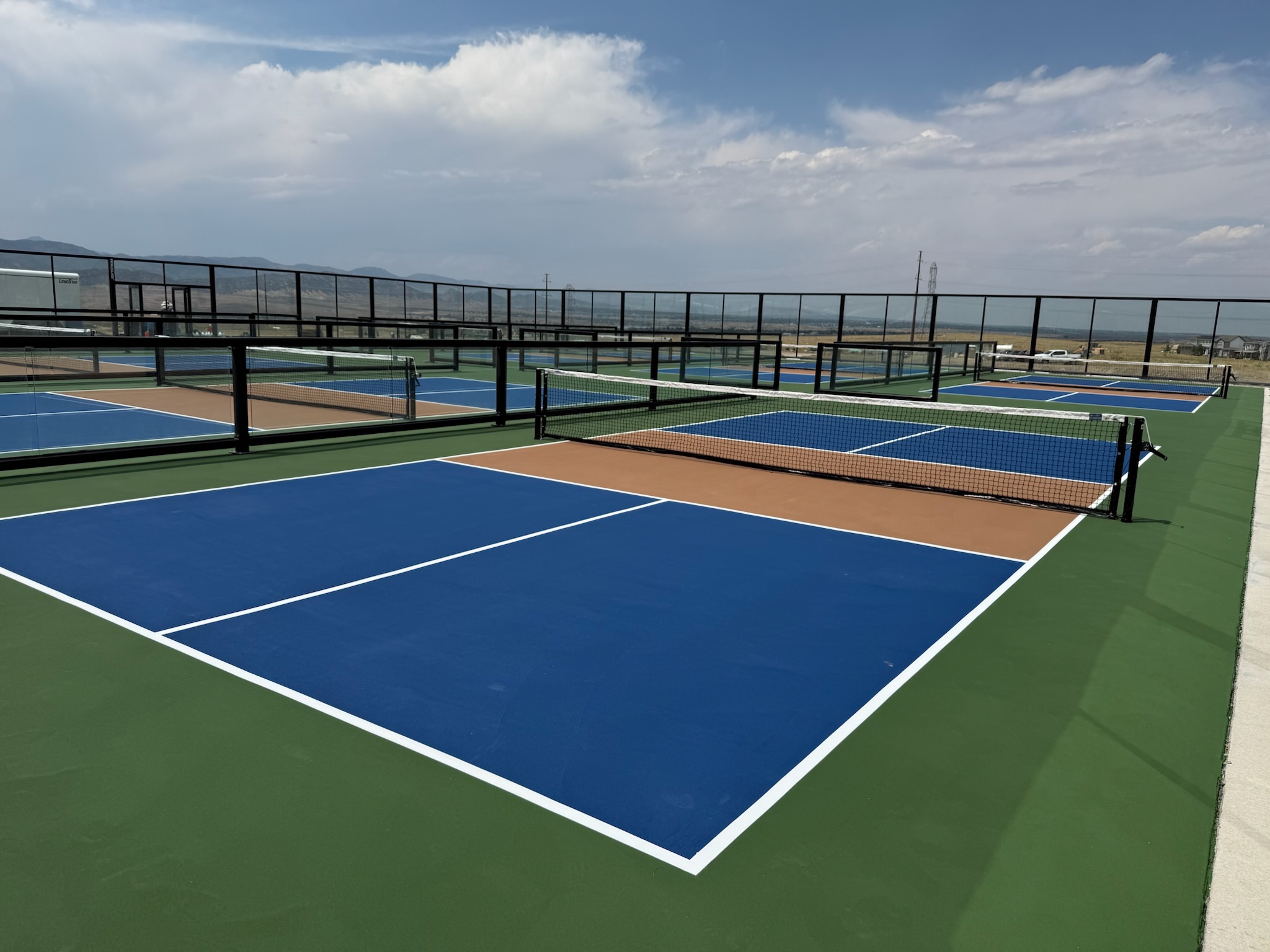
Probably the most practically important and the cheapest thing you can add during slab work… (BUT the most expensive to add later)
AUSTIN, Texas – Apr. 10, 2026 – There’s one decision on a court facility project that has the most extreme cost asymmetry of any item in the scope, and it comes down to timing.
If your court facility includes integrated lighting (which most multifamily projects do), electrical conduit needs to be routed from the power source to junction boxes at each light post location. The conduit runs underground, through the slab.
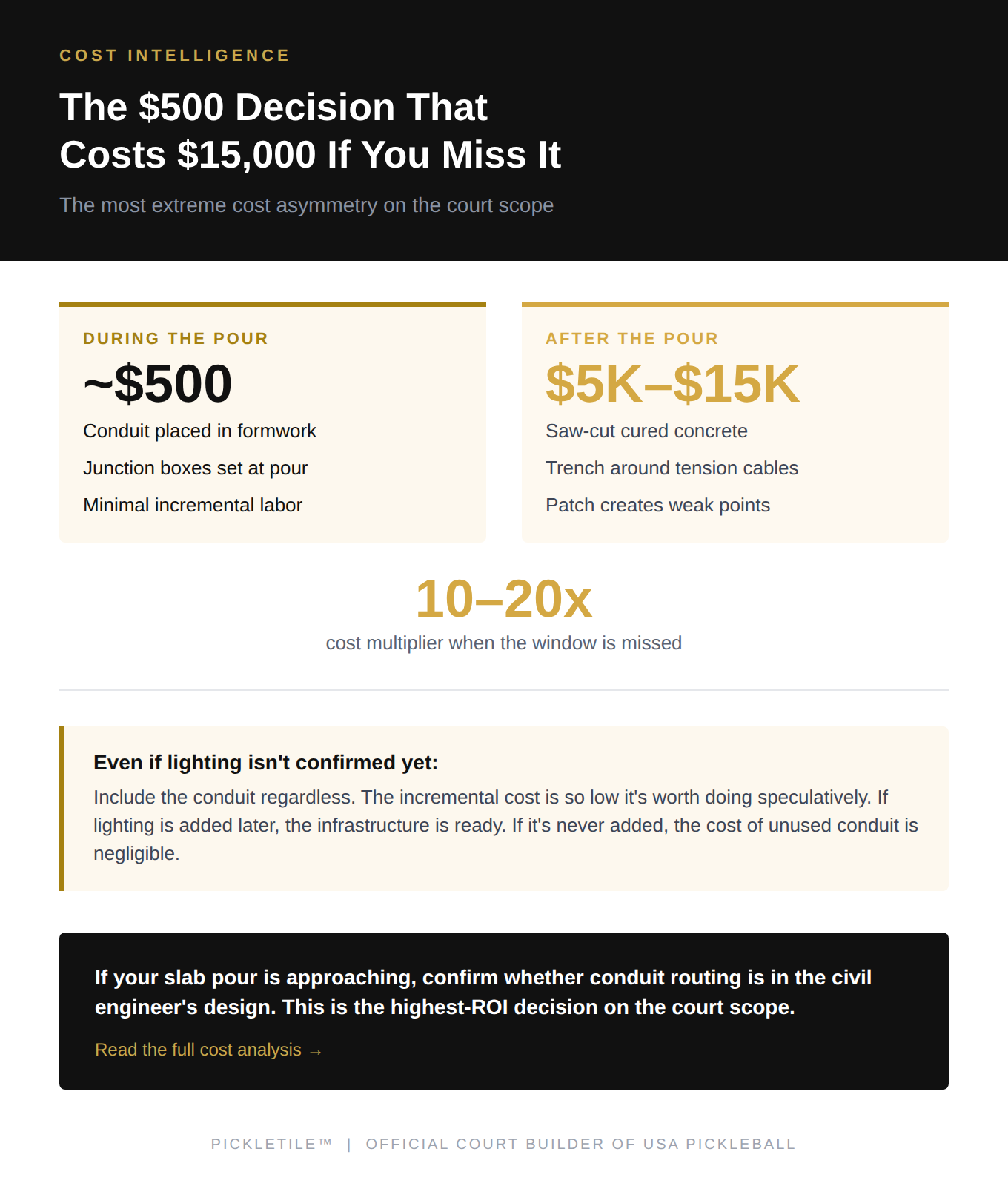
If you route the conduit during the slab pour:
The conduit is placed in the formwork before the concrete is poured, the same way any other embedded utility would be. The incremental cost is minimal: the conduit itself, the junction boxes, and a small amount of additional labor during the pour. On most projects, this adds a few hundred dollars to the slab scope.
If you miss the window and need to add conduit after the slab is cured:
The process becomes: saw-cut the cured concrete along the conduit path, trench to the required depth, place the conduit, backfill, and patch the concrete. On a post-tensioned slab, the saw-cutting must carefully avoid the tension cables, which adds complexity and risk. The patched areas create potential weak points in the slab surface. And the cost is typically 10 to 20x what it would have been during the original pour.
The exact numbers vary by project, but the pattern is consistent: a few hundred dollars during the pour becomes $5,000 to $15,000 (or more) after the pour.
Why this matters even if lighting isn’t confirmed yet:
Some PMs are in a situation where the court scope is likely but not confirmed, or where lighting is being considered but hasn’t been decided. The recommendation in that situation is straightforward: include the conduit in the slab pour regardless. The incremental cost of routing conduit during the pour is so low that it’s worth doing speculatively. If lighting is ultimately included, the infrastructure is ready. If lighting is deferred to a future phase, the conduit is in place and the future installation is simple and inexpensive. If lighting is never added, the cost of the unused conduit is negligible.
The only scenario where this doesn’t apply is if there is zero possibility of ever adding lighting to the facility. On a multifamily development where the courts will be used by hundreds of residents, that scenario is rare.
The PM’s action item:
If your slab pour for the court area is approaching, confirm whether conduit routing is included in the civil engineer’s slab design. If it’s not, and there’s any possibility of lighting (now or in the future), adding it before the pour is the highest-ROI decision you’ll make on the court scope. After the pour, the window closes and the cost structure changes dramatically.
This is one of the specific items we address in the scoping conversation: what needs to be in the slab specification and when. If your slab design is in progress, it’s worth a quick call to make sure the court specifications are included before the pour. Call us.
About PICKLETILE™
PICKLETILE™ is the leading design-build firm for premium pickleball court construction and the Official Court Builder of USA Pickleball.
Headquartered in Austin, Texas, PICKLETILE™ simplifies the complex construction process by offering turnkey solutions for residential, commercial, and club-level projects. The company is also the creator of PICKLEGLASS™, a patented soundproof glass wall system engineered to reduce noise by 50% while offering panoramic views and wind protection. For more information, visit www.pickletile.com.
