
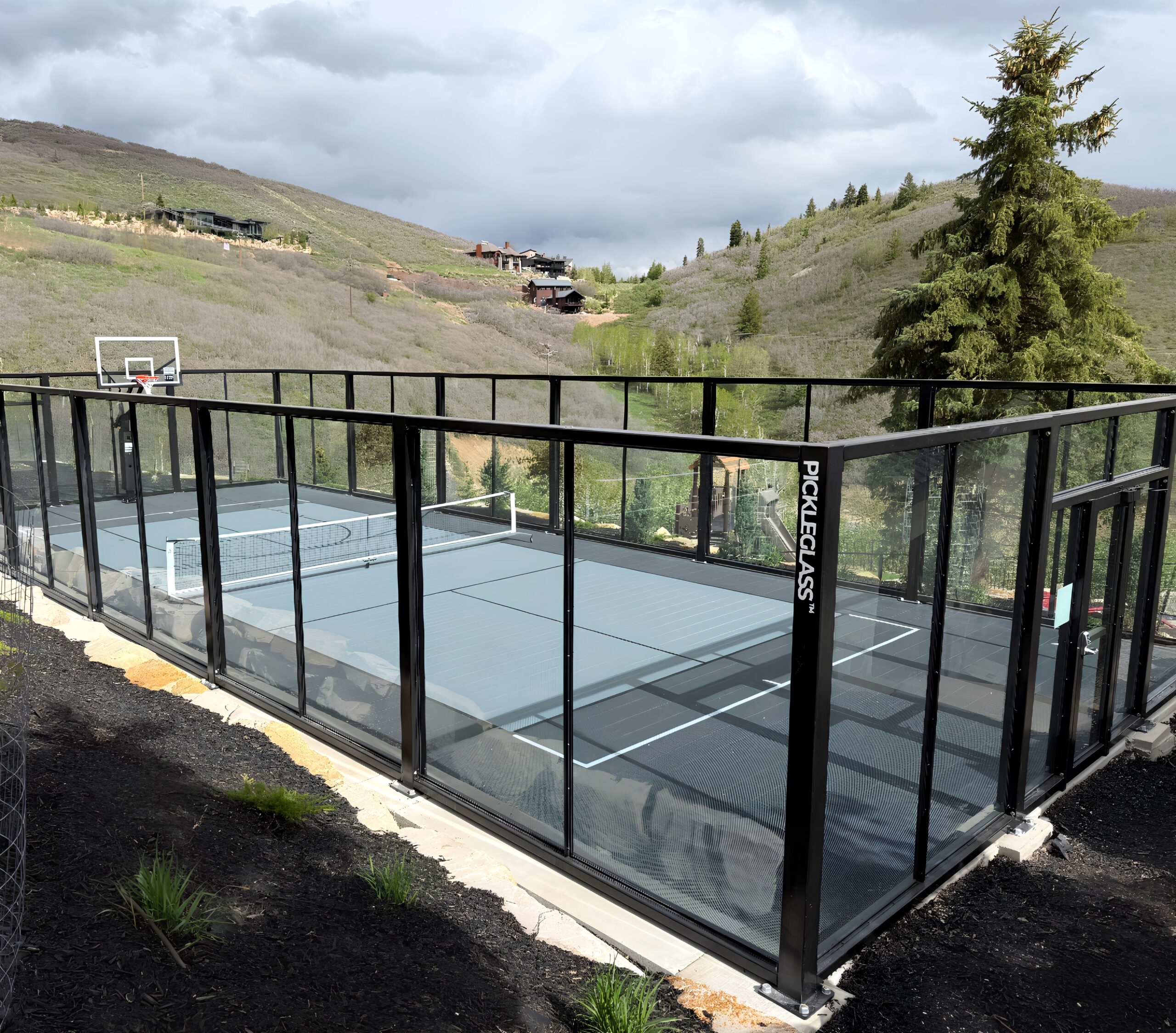
Glass on a construction site: what your risk team needs to see.
AUSTIN, Texas – Apr. 24, 2026 –
At some point during a court facility project, someone on the development team will ask: “Is glass safe in an outdoor sports environment?”
The question usually comes from different directions depending on which side of the team you’re on. The principal or managing partner hears it from their insurance carrier, their lender’s risk department, or a concerned equity partner who pictures glass breaking during a game. The PM or director of construction hears it from the building official reviewing the permit application, or from the GC’s safety manager evaluating the installation scope.
Both versions of the question deserve a specific, data-backed answer. Here’s the safety profile of structural glass court enclosures, the codes they comply with, and how the risk framework compares to traditional enclosure materials.
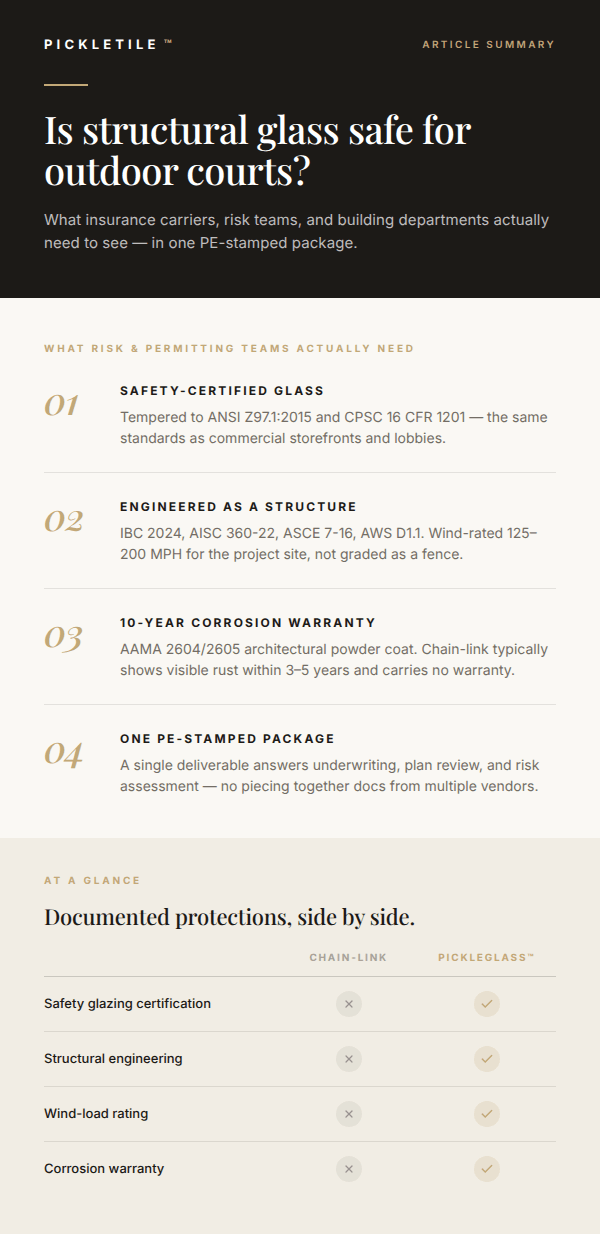
Glass safety certifications
The glass panels in a PICKLEGLASS system are tempered glass, the same category of safety glass used in commercial storefronts, building facades, automotive windshields, and shower enclosures. Tempering is a heat treatment process that significantly increases the glass’s strength and changes its failure behavior.
Standard (annealed) glass breaks into large, sharp shards that create laceration hazards. Tempered glass, when broken, fragments into small, blunt granular pieces that are dramatically less likely to cause serious injury. This failure characteristic is the entire basis for safety glazing standards in building codes.
The glass conforms to two applicable safety standards:
ANSI Z97.1:2015 (Safety Performance Specifications for Glazing Materials Used in Buildings). This is the American National Standard for safety glazing in architectural applications.
CPSC 16 CFR 1201 (Safety Standard for Architectural Glazing Materials). This is the federal Consumer Product Safety Commission standard for glass in locations where human impact is possible.
Both certifications require the glass to meet specific impact resistance thresholds and to exhibit the safe-break pattern (small fragments, not sharp shards) when failure does occur.
What the ownership group should know: these are the same safety certifications that the glass in your building’s lobby, storefronts, and common areas carries. If your insurance carrier or lender’s risk team asks about the court enclosure glass, the answer is: it’s certified to the same federal and national safety standards as the architectural glazing throughout the rest of the development. The certifications are documented and can be provided to any underwriter or risk assessor upon request.
What the construction team should know: these certifications are what the building department reviews during the permit process. The glass specification (including the ANSI and CPSC certifications) is documented in the engineering package and the PE-stamped drawings. If the building official has questions about the glazing safety during plan review, the documentation addresses them directly. The PM doesn’t need to source a separate safety analysis or engage a glazing consultant. The certifications are part of the standard deliverable package.
Structural code compliance
The enclosure system as a whole (steel frame, glass panels, connections, and foundations) is engineered to meet:
IBC 2024 (International Building Code). The enclosure is treated as a structural system subject to the same code requirements as building components, not as a fence or recreational accessory.
AISC 360-22 (Specification for Structural Steel Buildings). The steel frame design follows the same structural steel standards used for commercial building construction.
ASCE 7-16 (Minimum Design Loads). Wind load calculations are performed for the specific project site, accounting for geographic wind speed, exposure category, and enclosure height. Systems are rated for 125 to 200 MPH depending on the site.
AWS D1.1 (Structural Welding Code). All welded connections meet the American Welding Society’s structural welding standard.
What the ownership group should know: the enclosure is engineered to the same structural codes as the buildings on your development, not to recreational or residential fence standards. When PE-stamped, the structural calculations and drawings document compliance with all applicable codes. These documents can be submitted to your building department for permits, provided to your insurance underwriter for the asset’s risk profile, and filed as part of the property’s permanent structural documentation.
For the principal evaluating long-term liability: the code-compliant engineering, combined with the documented wind load rating and safety glazing certifications, creates a defensible position if any structural or safety question ever arises during the life of the asset. A chain-link installation without structural engineering or documented code compliance does not provide the same documentation trail.
What the construction team should know: the structural engineering package is produced during the design phase and is ready for permit submission when the PM needs it. The PM doesn’t hire a separate structural engineer, commission a separate wind study, or assemble the code compliance documentation from multiple sources. It arrives as a unified package: structural calculations, shop drawings, material certifications, and (if required) PE-stamped documents.
For the PM managing the permit process: if the building department has questions during plan review, the engineering package is the single document that addresses structural, wind, glazing, and connection code compliance. Most plan reviews for court enclosures proceed smoothly when the PE-stamped package is submitted with the initial application because the documentation preemptively answers the questions the reviewer would otherwise raise.
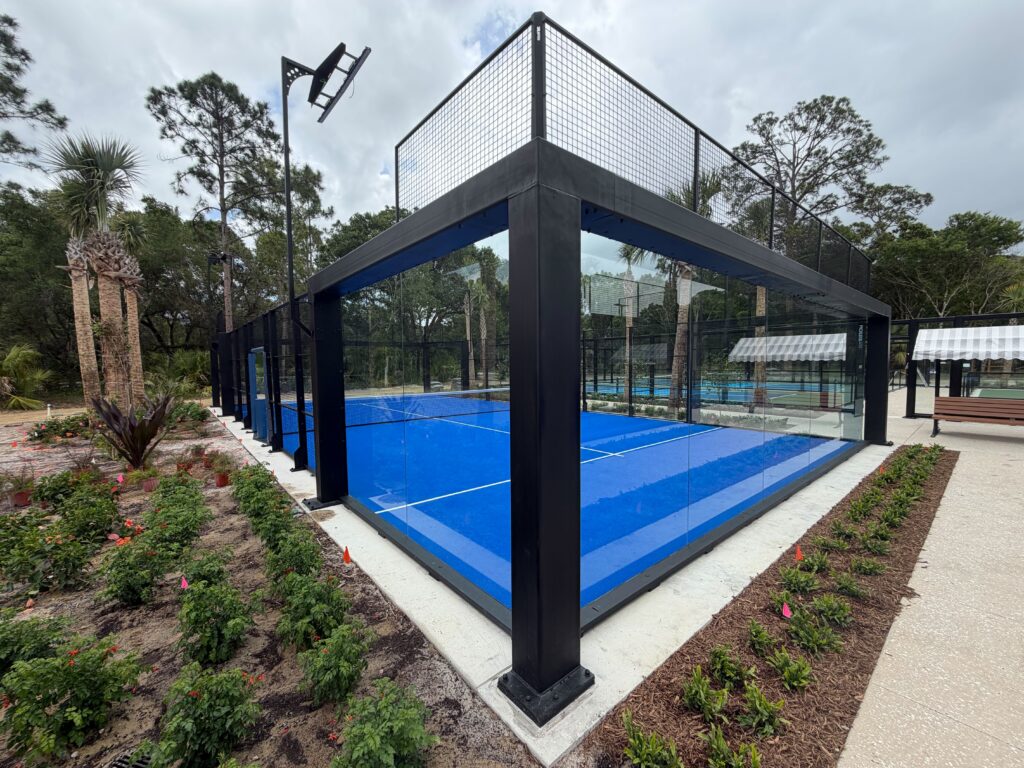
Comparison to traditional enclosure materials
Chain-link fencing has no applicable safety glazing certification (because there’s no glazing). However, chain-link introduces its own safety and liability considerations that are rarely documented:
Wire ends and connection points create potential laceration hazards, particularly as the material ages, connections loosen, and the vinyl coating deteriorates. Windscreen fabrics degrade under UV exposure and can create tripping hazards when they detach from the fence. Post-mounted chain-link fencing does not carry structural certifications for wind load resistance in most standard installations. There is no industry standard for acoustic performance of chain-link systems. And there is no standard corrosion warranty.
What the ownership group should understand about the liability comparison: a structural glass system has a documented safety, structural, and durability profile (safety glazing certifications, structural code compliance, PE-stamped engineering, 10-year corrosion warranty). A chain-link system has none of these documented protections. If a safety or structural incident occurs with chain-link (a wire laceration, a post failure in high wind, a windscreen detachment), there’s no engineering documentation to reference because none was produced. The liability exposure is undocumented and unmitigated.
This doesn’t mean chain-link is inherently dangerous. It means the risk profile isn’t documented or engineered, which is a meaningful distinction for an insurance underwriter evaluating the asset and for the ownership group evaluating long-term liability exposure.
What the construction team should understand: from a building department and permitting perspective, chain-link fencing is typically classified as a fence (not a structure) and may not require structural engineering or a building permit in many jurisdictions. A structural glass enclosure IS classified as a structure and requires both. This means the glass enclosure goes through a more rigorous review process upfront, but it also means the glass enclosure has documented engineering and code compliance on file for the life of the property. For the PM, the permitting path for glass is slightly more involved but produces documentation that the chain-link path never generates.
Corrosion and long-term durability
Outdoor steel structures in humid, coastal, or high-precipitation environments face corrosion as their primary long-term risk.
What the ownership group should know: the PICKLEGLASS steel frame uses architectural-grade powder coat finish certified to AAMA 2604/2605 (the same standard used for commercial building exterior metals) and carries a 10-year warranty against rust and corrosion. Chain-link fencing uses vinyl dip coating that degrades under UV exposure, with visible rust typically appearing within 3 to 5 years in demanding environments. There is no industry-standard corrosion warranty for chain-link systems.
For the principal’s long-term planning: the 10-year corrosion warranty means no structural steel maintenance or replacement costs during the first decade of ownership. This is a quantifiable operating cost advantage that belongs in the pro forma comparison. If the property is sold during the warranty period, the remaining coverage transfers to the buyer, which is a tangible asset for disposition.
What the construction team should know: the AAMA 2604/2605 coating specification and the 10-year corrosion warranty are documented in the closeout package at project turnover. If the PM or the property management team observes a corrosion issue during the warranty period, the claim goes to one vendor (PICKLETILE) with documented coverage terms. On a chain-link installation, corrosion is not warrantied, so the cost of rust treatment and eventual replacement falls entirely on the developer’s operating budget with no recourse.
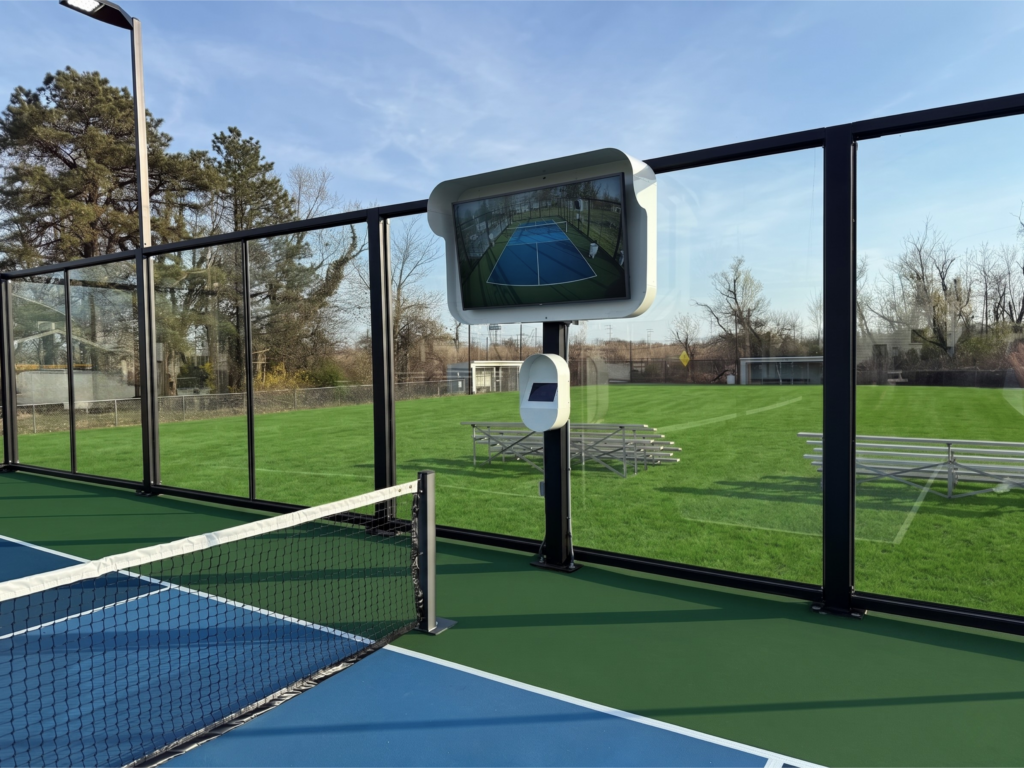
Glass impact resistance
A question that frequently comes up from both groups: what happens if a ball hits the glass?
Tempered glass at the specified thickness (1/2 to 3/4 inch) is designed to absorb repeated impact from pickleball and tennis play without damage. The glass is significantly stronger than the forces generated by ball impacts in racquet sports. This isn’t a theoretical claim. It’s the daily operating reality on every installed PICKLEGLASS facility.
What about intentional or accidental human impact? Tempered glass at these thicknesses is classified as safety glazing specifically because it resists casual or accidental human impact. It requires significantly more force to break than standard glass, and when it does break, the failure mode (small blunt fragments) minimizes injury risk. This is why the same glass category is used in commercial storefronts, building lobbies, and other locations where human contact is expected.
What to provide when the question comes up
The documentation package for the enclosure includes: glass safety certifications (ANSI Z97.1, CPSC 16 CFR 1201), structural engineering calculations documenting code compliance (IBC, AISC, ASCE, AWS), PE-stamped drawings if required by jurisdiction, material specifications for steel and coatings, and warranty documentation (10-year rust, 5-year lighting, 3-year materials).
For the ownership group: this package is typically sufficient for insurance underwriting and property risk assessments. It demonstrates that the enclosure is a code-compliant, documented structural system with certified safety glazing, not an ad hoc installation of commodity materials.
For the construction team: this same package addresses building department plan review, GC safety assessments, and any third-party quality review. The PM receives it as a single deliverable during the design phase, not as scattered certifications assembled from multiple vendors.
If your insurance carrier, risk team, or building department has questions about the court enclosure, we can provide the relevant certifications and engineering documents directly. Happy to facilitate that conversation with whichever group on your team needs the information.
About PICKLETILE™
PICKLETILE™ is the leading design-build firm for premium pickleball court construction and the Official Court Builder of USA Pickleball.
Headquartered in Austin, Texas, PICKLETILE™ simplifies the complex construction process by offering turnkey solutions for residential, commercial, and club-level projects. The company is also the creator of PICKLEGLASS™, a patented soundproof glass wall system engineered to reduce noise by 50% while offering panoramic views and wind protection. For more information, visit www.pickletile.com.
