
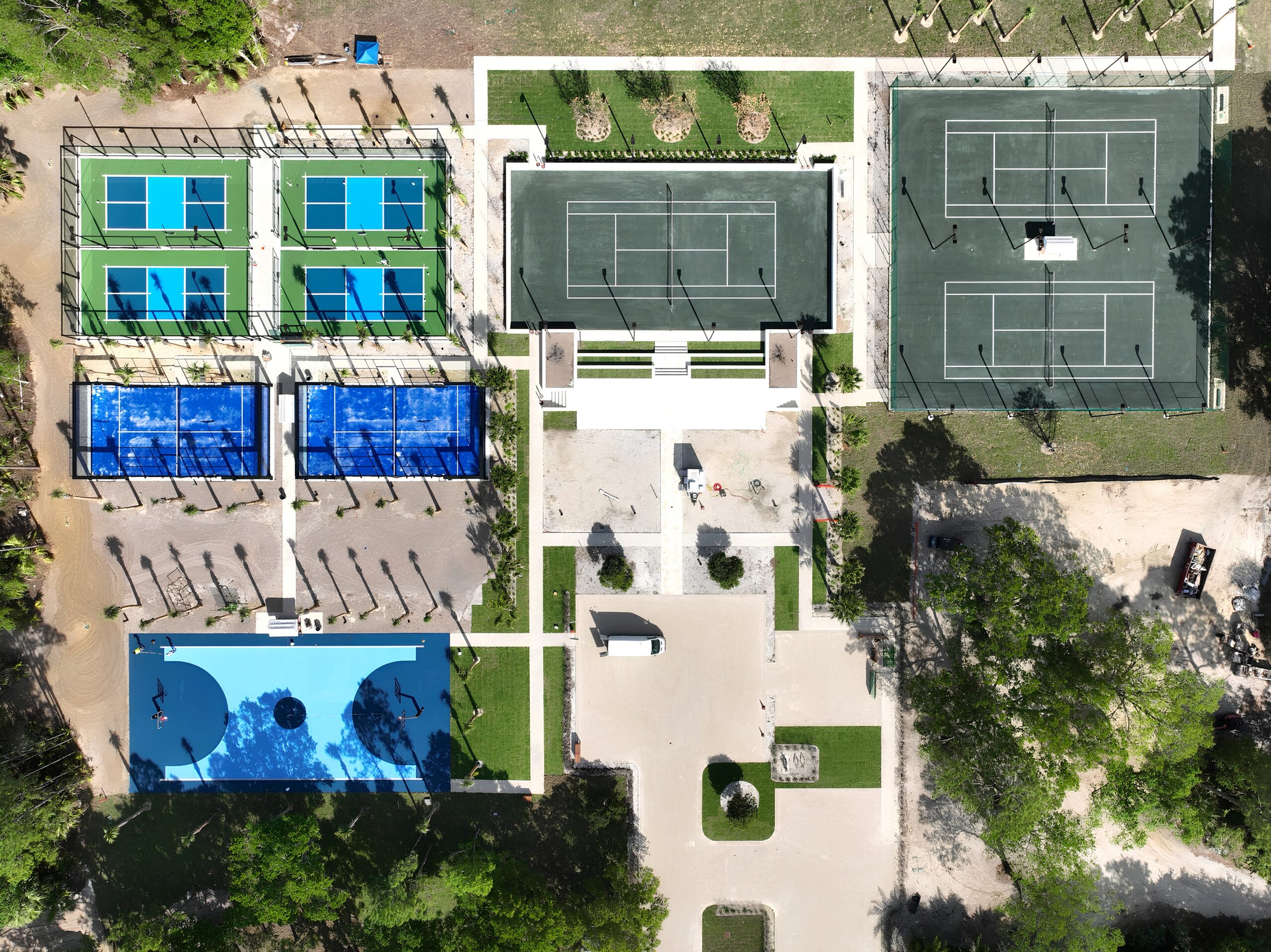
A board-meeting structure that approves the capital allocation in one vote — and keeps design decisions where they belong.
AUSTIN, Texas – May 6, 2026 – Board approval is a common gating factor for court projects at private clubs, and for good reason. These are significant capital investments that affect the club’s facilities, finances, and member experience. The board should be involved.
But there’s a meaningful difference between board involvement that moves the project forward and board involvement that stalls it. The difference comes down to what the President or GM asks the board to approve, and how prepared they are to answer the questions that come up in the meeting. Most of the answers the board will want come from the operational side of the racquets program — which means the Director of Racquets has a critical role in the approval process, even though they’re not the one running the meeting.
The mistake: presenting every detail to the board
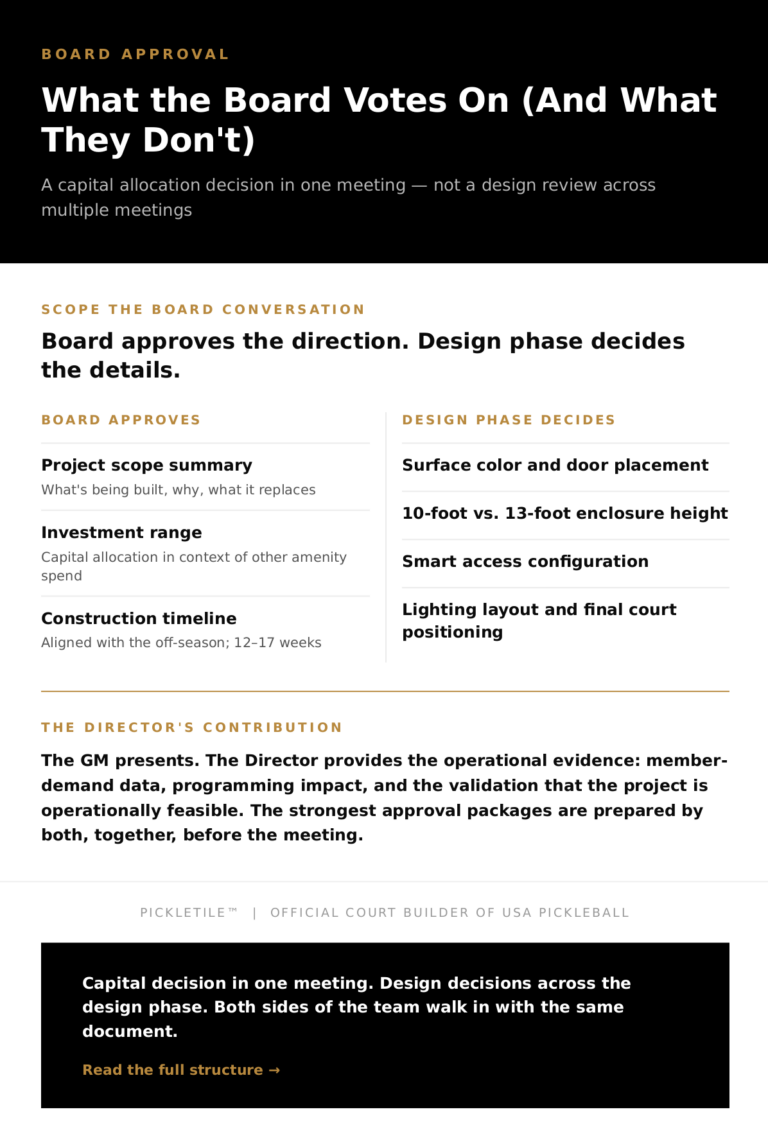
When the President or GM brings a detailed court proposal to the board — complete with surface color options, door placement alternatives, enclosure height comparisons, smart access configurations, and lighting layout options — the board meeting turns into a design review session. Board members start debating whether the surface should be blue or green, whether the doors should be centered or off-center, and whether 10 feet or 13 feet is the right enclosure height.
These are legitimate discussions. They’re not board-level decisions. They’re design decisions that the GM, the Director, and the project’s engineering team are better positioned to make collaboratively during the design phase, after 3D models and shop drawings are available to inform each choice.
When the board weighs in on design details, two things happen. First, the approval takes longer because there are more questions, more opinions, and more requests for additional information at each meeting. Second, the board begins functioning as a design committee, which is a role they’re not equipped for and didn’t sign up for.
The better approach: present the board with a capital allocation decision
The board’s role is to approve the capital investment and the general project direction. That means the GM should present three things:
The project scope summary. What’s being built (X courts with a structural glass enclosure, integrated lighting, professional surfacing, and accessories), why it’s being built (member demand, competitive positioning, facility quality standards), and what it replaces or improves (current facility condition, limitations being addressed).
The investment range. The capital allocation the project requires, positioned in context: comparable to other amenity investments the club has made (pool renovation, clubhouse upgrade), and evaluated against the lifecycle cost picture (total cost of ownership over 15 to 20 years, not just the upfront number).
The timeline. When construction would happen (aligned with the off-season), how long it takes (12 to 17 weeks), and when the facility would be available for members.
That’s the board vote: do we allocate this capital for this project on this timeline? Yes or no.
What the Director of Racquets contributes to the approval
The GM is the one presenting to the board, but most of the persuasive evidence in the presentation comes from the Director’s day-to-day visibility into the racquets program. Boards approve capital allocations more readily when the case is grounded in operational data, not assumptions. The Director is the source of that data, and the strongest approval packages we see at clubs are the ones where the GM and the Director have prepared the operational case together before the meeting.
The Director’s contribution typically includes:
Member demand evidence. Current waitlist length for popular leagues and clinics. Peak-hour utilization (how often courts are at 100% during the 5 to 8 PM weekday window). Member survey responses or informal feedback about the racquets program. Number of members who’ve asked about pickleball specifically, and the demographic mix of those members. Lost programming opportunities — events, tournaments, and clinics the club couldn’t host because of court limitations. This is the data that turns “we need a better facility” from an opinion into a documented business case.
The programming impact assessment. What new programs become possible after the build that aren’t possible now. How many additional members the racquets program can engage at the new capacity. The shift from a zero-sum schedule (adding one program means cutting another) to parallel programming (multiple programs running simultaneously). The retention implications for working-age members who currently can’t get court time during the hours they’re available. This translates the capital investment into the engagement metrics the board cares about.
Operational validation that the project is feasible. A board member may ask whether the racquets staff can absorb this expansion, whether the operating budget supports the maintenance profile, whether the programming plan is realistic for the membership’s actual demand. The Director’s validation that the operational picture works — confirmed before the meeting, ready as talking points the GM can reference — removes a category of “let me get back to you” delays that push approval to the next meeting.
The pattern at clubs that move through approval efficiently: the GM and the Director sit down together before the board meeting. The Director provides the operational data and the programming impact narrative. The GM incorporates those into the capital allocation case. By the time the GM is in front of the board, every operational question the board could ask has an answer ready, sourced from the Director.
Everything else happens after the vote
Once the board approves the capital allocation and project direction, the GM and Director work with the engineering team during the design phase to make all the detail decisions: surface colors, door placement, enclosure height optimization, lighting layout, smart access configuration, and layout refinement. The board can receive updates on design progress if the GM wants to keep them informed, but those decisions don’t come back to the board for approval unless the GM chooses to include them. The board approved the investment. The GM manages the execution. The Director shapes the operational details.
This division matters for both sides of the team. For the GM, it means the board conversation is about a capital decision that fits in one meeting, not a design conversation that drifts across multiple meetings. For the Director, it means the layout, programming integration, and configuration decisions stay in the hands of the people who’ll actually operate the facility — not a board committee that won’t be present when the courts open.
How to structure the board presentation
Based on what we’ve seen work at clubs that move through the approval process efficiently:
Open with the member demand. Scheduling data, member survey results, utilization numbers, informal feedback. Let the board see the problem before the solution. This is where the Director’s data leads — the GM presents it, but it comes from the Director’s operational visibility.
Present the scope as a racquet facility investment, not a pickleball project. Frame it around all racquet sports members and the broader programming impact, not as a single-sport upgrade. The Director’s input on which programs benefit and which member segments are affected helps make the framing concrete.
Show the comparison to conventional construction. The 10-point bid comparison framework helps the board understand why the investment level is what it is and what it includes that cheaper alternatives don’t. The GM owns this part of the presentation, since it’s primarily a procurement and risk discussion.
Present the lifecycle cost picture. The 15-year cost of ownership comparison (chain-link vs. engineered glass) is often the data point that moves board members who are focused on financial responsibility. The upfront cost is higher. The long-term cost is lower. The quality gap never closes.
Include the programming impact summary. This is where the Director’s contribution lands most directly. A short section — three or four bullets — that translates the capital investment into specific programming gains: additional court-hours per week, programs that become possible, member capacity in evening leagues, tournament hosting capability. This connects the dollar figure to what members will actually experience.
Ask for the capital allocation. A specific dollar range for a specific project scope on a specific timeline. The more specific the ask, the easier it is for the board to vote on it.
The timeline benefit of this approach
When the board is asked to approve a capital allocation, the vote can happen in one meeting. When the board is asked to approve a detailed design, the vote often takes multiple meetings because new questions and opinions emerge each time.
Clubs that structure the board conversation as a capital decision rather than a design review consistently report faster approvals and less friction in the process. The clubs that get there in one meeting are usually the ones where the GM walks in with the operational case fully prepared — which is the part of the presentation the Director makes possible.
If your team is preparing for a board presentation and wants help structuring the scope summary, investment framing, lifecycle comparison, or programming impact section in a format optimized for a capital allocation vote, happy to help put it together. The most effective approach is for the GM and the Director to walk into the meeting with one unified document, where the operational evidence and the financial case are aligned. The goal is to make the board conversation as focused and efficient as possible — and to give both sides of your team confidence that what’s being voted on is what each of you is actually trying to build.
About PICKLETILE™
PICKLETILE™ is the leading design-build firm for premium pickleball court construction and the Official Court Builder of USA Pickleball.
Headquartered in Austin, Texas, PICKLETILE™ simplifies the complex construction process by offering turnkey solutions for residential, commercial, and club-level projects. The company is also the creator of PICKLEGLASS™, a patented soundproof glass wall system engineered to reduce noise by 50% while offering panoramic views and wind protection. For more information, visit www.pickletile.com.
