
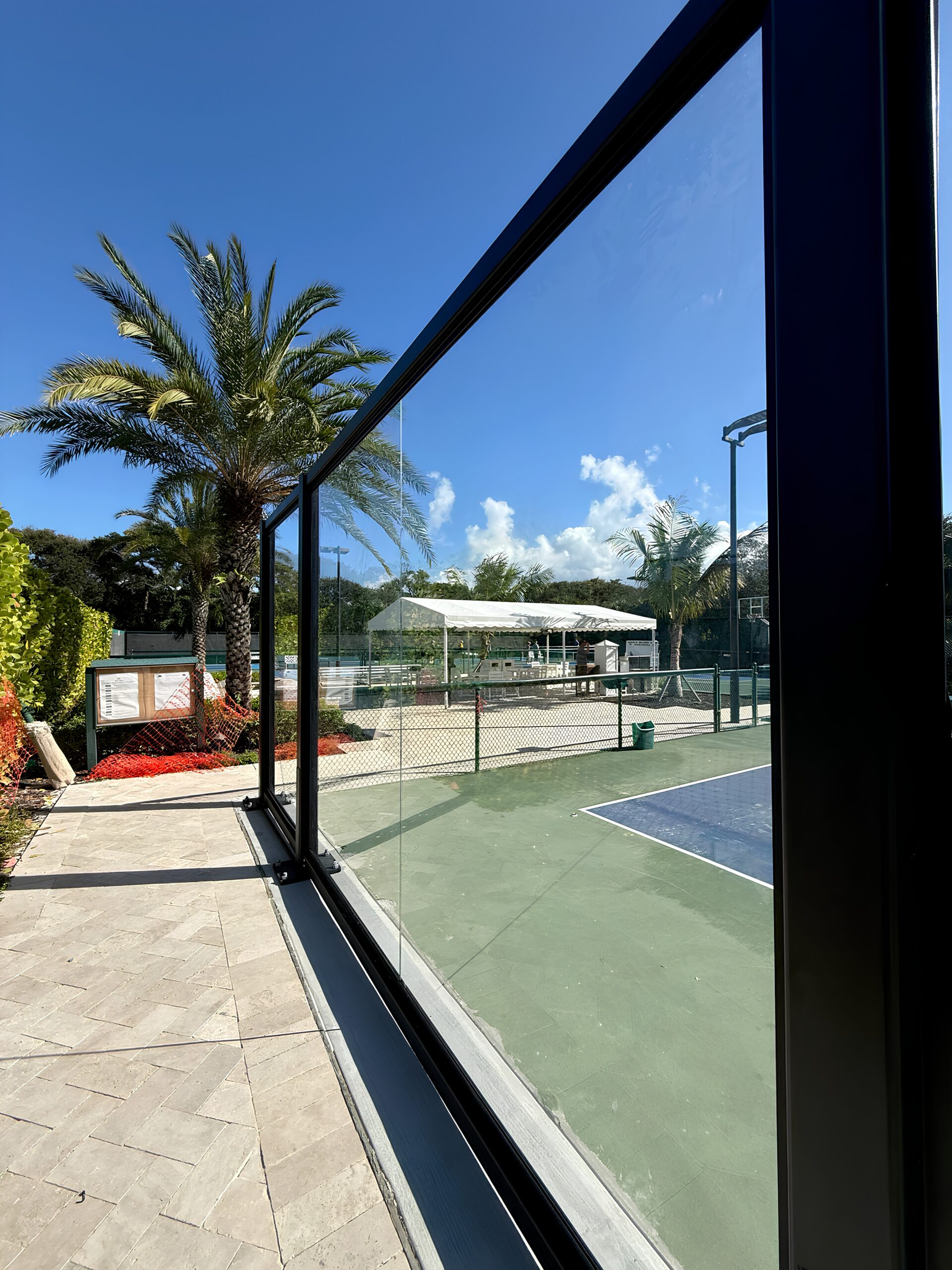
A six-step playbook for the chain-link comparison question — what the GM says, what the Director prepares.
AUSTIN, Texas – May 7, 2026 – It happens in almost every board meeting where a court project is being discussed. A board member, usually someone with a business background who values cost discipline, has done their own research. They’ve found a chain-link fencing contractor who quoted $30,000 to $50,000 for a court enclosure. The estimate the GM is presenting is several times that amount. The board member asks: “Why are we paying this much when I found it for a fraction of the price?”
This is not a hostile question. It’s a responsible one. The board member is doing their job by questioning a significant expenditure. But the question compares two fundamentally different things, and if the GM isn’t prepared with a clear, factual response, the board conversation can spiral into a cost-cutting exercise that undermines the project.
The GM is the person in the room who has to handle the question. But most of the strongest material in the response comes from the Director’s day-to-day operational visibility. Knowing what the noise complaint cycle actually looks like, why ball retention matters, what windscreen replacement actually costs the club year over year — these are facts the GM needs to have ready, and they come from the Director’s experience, not from a spec sheet.
The clubs that handle this moment well are almost always the ones where the GM and the Director sat down before the meeting, walked through the chain-link comparison together, and made sure the GM had the operational evidence ready to use. Here’s how that conversation plays out at the board meeting when both sides have prepared for it.
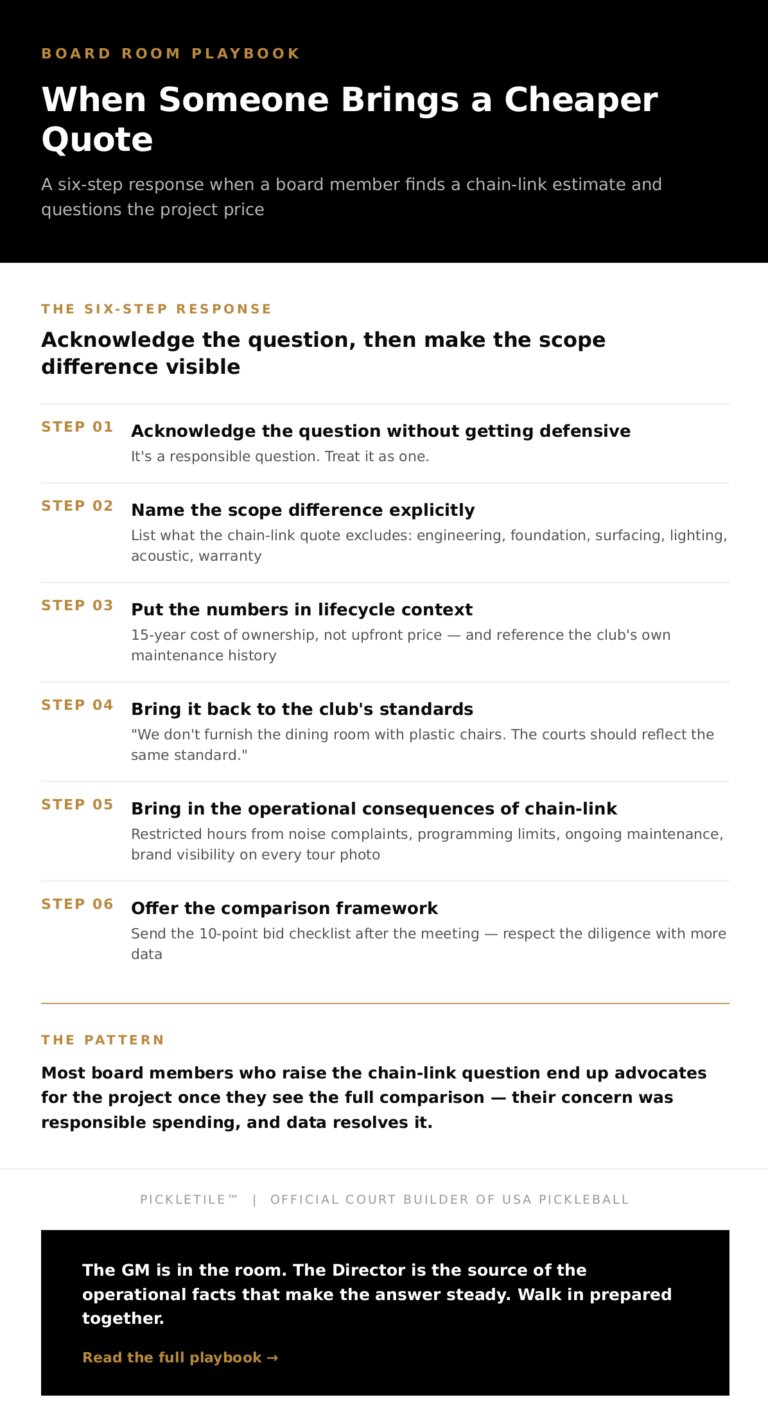
Step 1: Acknowledge the question without getting defensive
The worst response is to dismiss the board member or act as if the question is uninformed. They did research. They brought data. Acknowledge it: “That’s a fair question, and it’s the right one to ask. The price difference is significant, and it deserves a clear explanation.”
This is the GM’s moment, but the tone is set by the GM and the Director’s shared confidence in the answer. If the GM is uncertain, the board feels it. If the GM walks in knowing the Director has already validated every operational claim in the response, the answer comes out steady.
Step 2: Name the scope difference explicitly
The chain-link quote and the integrated facility estimate are not different prices for the same thing. They’re different scopes entirely. The GM should make the difference visible — and this is where the prep work with the Director pays off, because every item on the list connects to something the Director has lived with or been protected from in their daily work:
“The $40,000 quote includes chain-link fencing, windscreen, and basic installation. Here’s what it does NOT include:
- Acoustic engineering (STC 0, no sound reduction whatsoever)
- Structural engineering (no PE-stamped calculations, no wind load analysis)
- Post-tensioned concrete foundation (the chain-link quote assumes the club provides a finished slab)
- Professional court surfacing (surfacing is a separate contractor, separate bid, separate scope)
- Integrated lighting (lighting requires a separate vendor, separate poles, separate electrical scope)
- A 10-year corrosion warranty (chain-link typically carries a 1-year workmanship warranty)
- Maintenance reduction (chain-link requires ongoing windscreen replacement, rust treatment, and fabric repair)
- Single-source delivery (the club coordinates 3 to 5 separate contractors rather than one)
Our estimate includes ALL of those items. The price difference is the sum of everything the chain-link quote excludes.”
Step 3: Put the numbers in lifecycle context
“If we build chain-link today, we’ll spend the $40,000 upfront. Over the next 15 years, we’ll also spend on windscreen replacement every 3 to 5 years, rust repair and fence section replacement, a separate lighting installation if we decide we need evening play, and potentially an acoustic retrofit if noise complaints arise from our neighbors or members. The total 15-year cost of chain-link ownership is significantly higher than the upfront savings suggest.
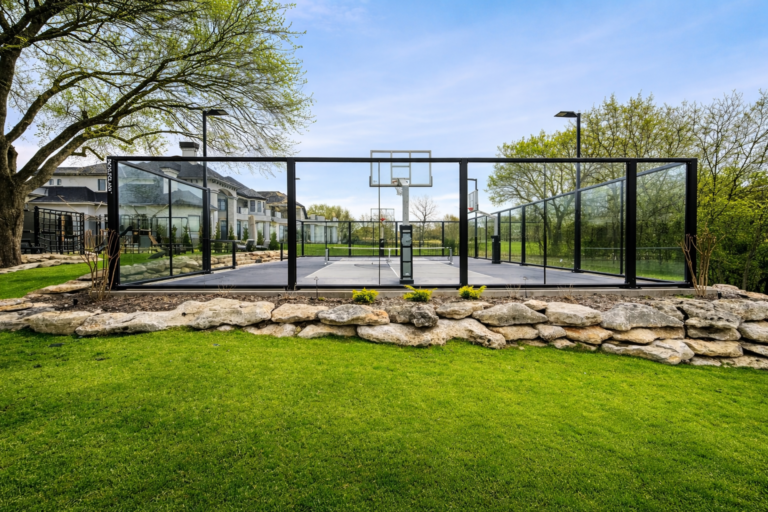
The glass enclosure system carries a 10-year warranty on the steel, self-cleaning glass that requires almost no maintenance, integrated lighting that’s included in the scope, and acoustic performance that prevents the noise complaints that restrict playing hours. Over a 15-year hold, the total cost of ownership is much closer to the glass system than the upfront numbers suggest.”
The Director’s contribution to this part of the response, prepared in advance: a realistic estimate of the maintenance the club has actually been doing on the existing chain-link or older facility. If the racquets staff has been replacing windscreens, treating rust, and managing fence repairs, the Director knows the rough cadence and the rough cost. That data is far more credible than industry averages, because it’s the club’s own history. When the GM can say “our racquets team replaces windscreens roughly every four years, and that’s already a recurring line in our maintenance budget,” the lifecycle argument lands as fact, not theory.
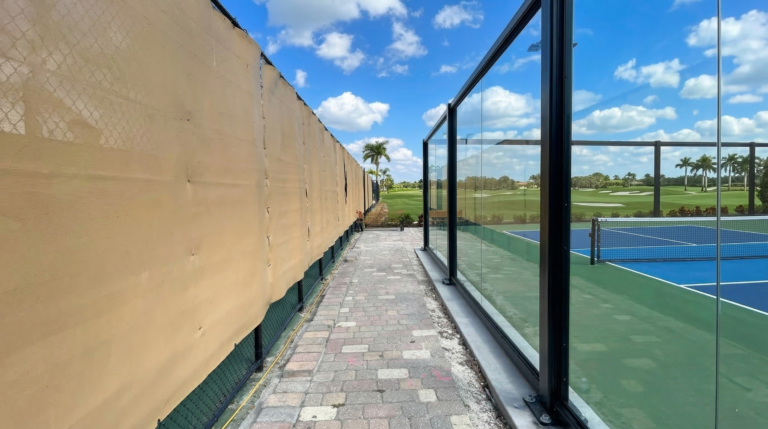
Step 4: Bring it back to the club’s standards
This is the strongest closing point, and it should come from the GM, not from a spec sheet:
“This club doesn’t build its pool with the cheapest liner. We don’t furnish our dining room with plastic chairs. We don’t maintain our golf course at a municipal standard. Our racquet facility should reflect the same standards we apply to every other amenity at this club. The question isn’t whether glass costs more than chain-link. It’s whether our courts should be built to the same standard as the rest of our facilities.”
The Director’s role in this argument is to make sure the GM knows what the comparison should be — which other amenities the racquet facility sits next to in the member’s experience, which peer clubs the membership compares this club to, and what the actual member feedback has been on the current facility. That context turns “the same standard as the rest of our facilities” from a slogan into a specific, defensible position.
Step 5: Bring in the operational consequences of chain-link
This is the section the original GM-only playbook tends to skip, and it’s often the one that closes the conversation. The board member with the cheaper quote is making a financial argument. The strongest counter is a financial argument grounded in operational reality — and the Director is the source.
Before the meeting, the GM and the Director should walk through the practical consequences of chain-link as a board-meeting talking point, not just a maintenance footnote:
Restricted playing hours. Chain-link provides no acoustic protection. If our courts are within 100 feet of any residential property, including member residences, we will absorb noise complaints. The property’s response will be to restrict playing hours. The hours that get cut are the prime member-availability hours — early morning and evening. We will be removing court access from exactly the members whose dues structure assumes they’ll have full use of the facility.
Programming limitations. Without acoustic separation between courts, we cannot run a clinic next to a competitive match without sound interference. The Director schedules around this constraint by leaving courts empty as buffers, which means we deliver less programming on more capital. This is the difference between a facility members brag about and one they tolerate.
Maintenance burden. The racquets team currently absorbs windscreen replacement, rust treatment, and chain-link repair as recurring tasks. With a glass enclosure, the staff time and the maintenance line both go to zero for the warranty period. That’s not a minor improvement. It’s a structural change in how the racquets program operates.
Member-experience visibility. The court facility appears in every aerial photo, every drone shot, every tour with prospective members. Chain-link photographs as utility infrastructure. Glass photographs as a designed amenity. The Director sees this in tour conversations. The GM sees it in marketing assets and member communications. The board should see it as a brand decision.
When the GM can deliver these points with the Director’s specific data behind them — actual hours of restricted play observed at peer clubs, actual maintenance costs from the club’s own history, actual member feedback from tours — the financial argument shifts. The cheaper quote is no longer a savings. It’s a deferral of costs that lands somewhere else, and somewhere visible.
Step 6: Offer the comparison framework if the board wants it
If the board member wants to see the comparison in writing, the 10-point bid evaluation checklist (which your rep can provide) lays out every scope difference in a side-by-side format. Offer to share it after the meeting so the board member can review it at their own pace.
This works because it respects the board member’s diligence. They asked a real question. The GM is offering them more information, not less. Most board members who raise the chain-link question end up advocates for the project once they see the full comparison, because their underlying concern — that the club is spending responsibly — is satisfied by data, not deflection.
What NOT to do
Don’t argue about the chain-link contractor’s quality or reputation. The issue isn’t that the chain-link bid is bad. It’s that it’s a different scope. Going after the contractor turns the conversation personal and defensive.
Don’t get into a detailed technical defense of every specification. The board doesn’t need to know the ASTM number for the anchor bolts. They need to understand the category difference.
Don’t let the conversation become adversarial. The board member who raised the question is an ally if you respond with facts and respect. They become an opponent if you respond with defensiveness.
Don’t show up without the Director’s preparation. This is the most common failure mode. The GM walks into the meeting with the financial case ready but no operational evidence behind it. When the chain-link question comes, the GM has the dollars but not the daily reality. The board member’s quote has more weight than it should because the response is generic. Walking in with the Director’s preparation — actual maintenance cadence, actual member feedback, actual programming consequences — is the difference between a strong response and one that lets the cheaper quote linger.
The pattern
Clubs that get through this moment well usually share one thing: the GM and the Director treated the board meeting as a shared event, not a GM-only event. The Director may not be at the table, but their preparation is in every part of the GM’s response. The GM walks in with a financial case grounded in operational facts, an operational case grounded in financial discipline, and the confidence that comes from knowing the answer is the same whether the question is asked from the President’s chair or the Director’s office.
If your team needs the one-page bid comparison or any supporting materials for the board meeting, let us know. We can prepare what the GM needs to walk in ready for this exact question, and we can help structure the Director’s pre-meeting briefing so the operational evidence is sharp and specific to your club. This is one of the most common board dynamics we help clubs navigate, and having the right materials — from both sides of the team — makes the conversation smooth rather than contentious.
About PICKLETILE™
PICKLETILE™ is the leading design-build firm for premium pickleball court construction and the Official Court Builder of USA Pickleball.
Headquartered in Austin, Texas, PICKLETILE™ simplifies the complex construction process by offering turnkey solutions for residential, commercial, and club-level projects. The company is also the creator of PICKLEGLASS™, a patented soundproof glass wall system engineered to reduce noise by 50% while offering panoramic views and wind protection. For more information, visit www.pickletile.com.
