
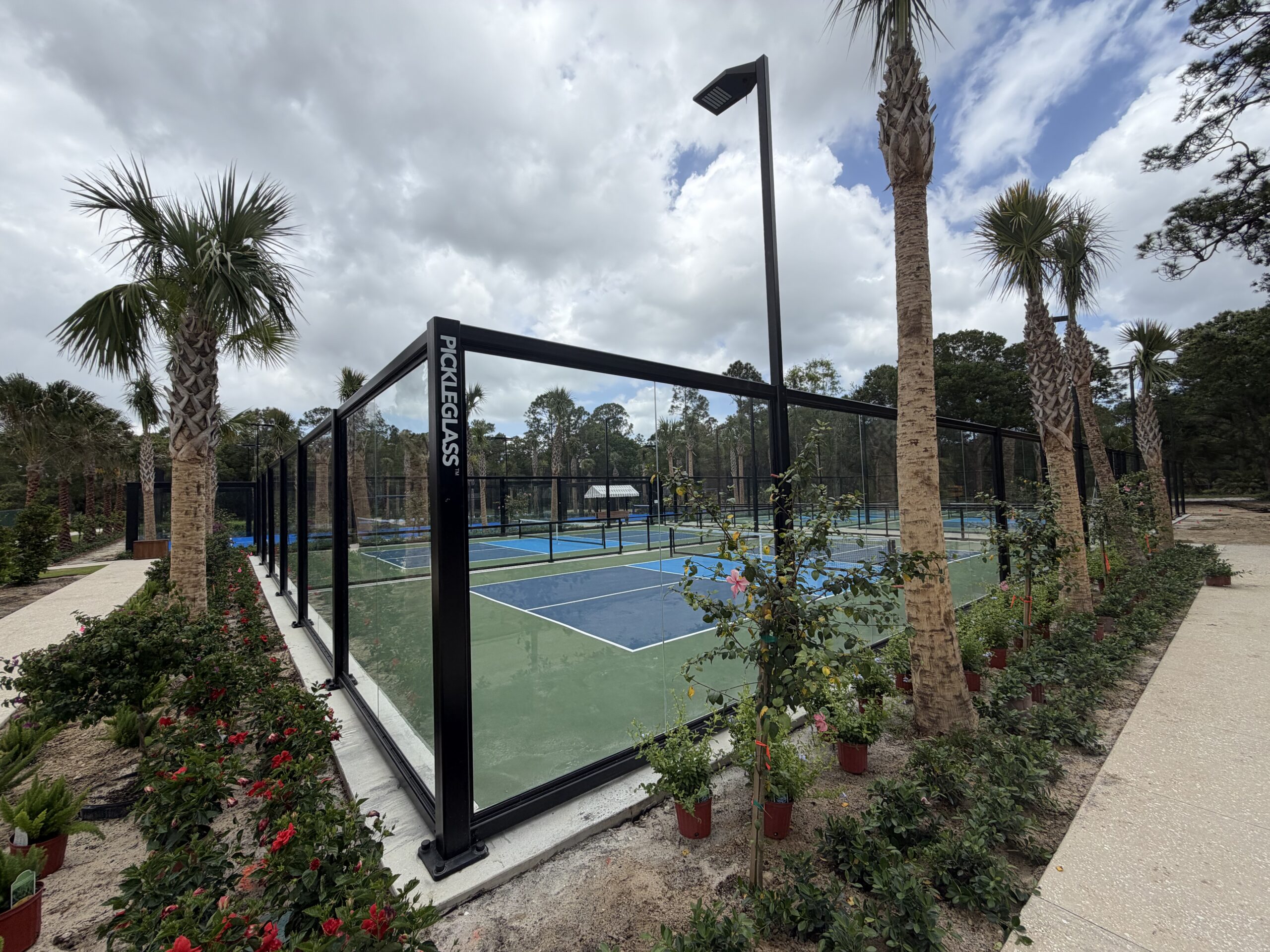
This covers what the court pad requires and why it’s different from a standard amenity slab.
AUSTIN, Texas – Apr. 10, 2026 – Most civil engineers designing multifamily site foundations have detailed specifications for building foundations, pool structures, parking areas, and utility infrastructure. What they rarely have, unless someone provides it, is a detailed specification for a court facility that includes a structural glass enclosure.
This creates a gap that shows up in one of two ways: either the court pad is designed as a generic flatwork slab (which may not meet the structural requirements of the enclosure system), or the civil engineer asks the PM for the court specification and the PM doesn’t have it yet because the court scope hasn’t been defined.
Both scenarios lead to the same outcome: rework, change orders, or field modifications during installation.
Here’s what a properly specified court slab actually requires, and why it differs from standard site concrete.
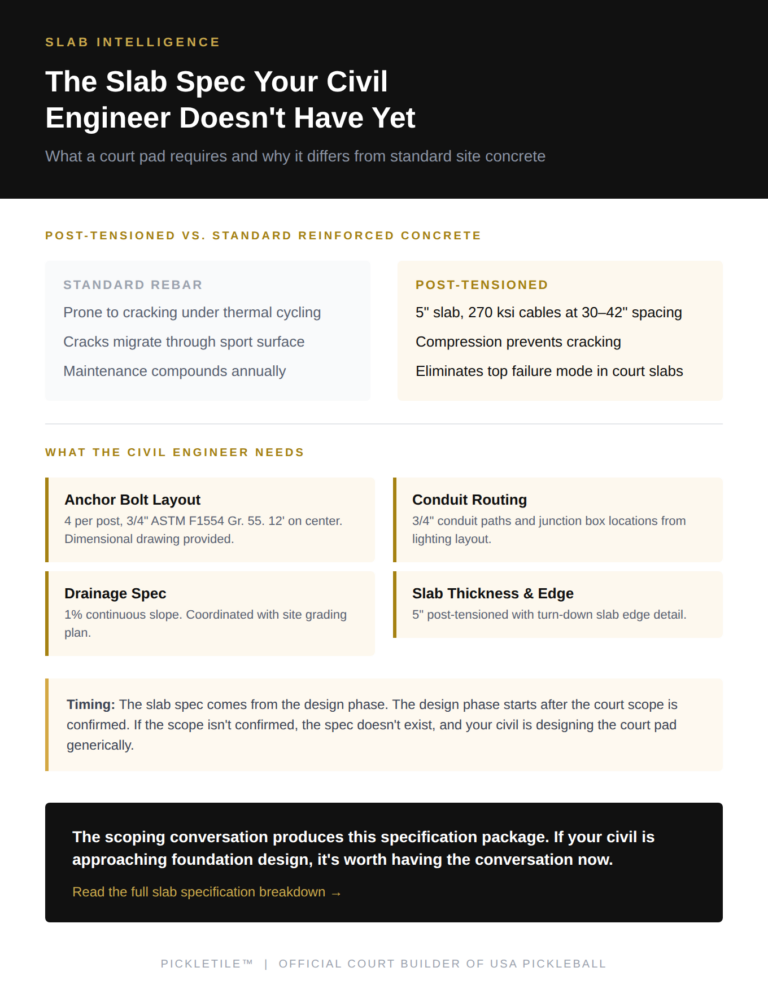
Post-tensioned concrete vs. standard reinforced concrete
A standard reinforced concrete slab uses rebar in a grid pattern to add tensile strength. This works for many applications, but for a court surface that will experience thermal cycling, heavy foot traffic, and point loads from structural steel posts, standard reinforcement is prone to cracking over the first several years. Those cracks migrate through the acrylic sport surface applied on top, creating maintenance issues that compound annually.
Post-tensioned concrete takes a different approach. High-strength steel cables (1/2 inch, 270 ksi) are placed throughout the slab at 30 to 42 inch spacing and tensioned after the concrete cures. This puts the entire slab in compression, which dramatically reduces cracking over the life of the facility. The standard specification is 5 inches thick with a turn-down slab edge.
For your civil engineer, the key difference is in the reinforcement design and the pour sequence. Post-tensioned slabs require the cables to be placed before the pour and tensioned after curing, which is a different workflow than standard rebar placement. Most commercial concrete contractors are familiar with post-tensioning, but your civil needs to specify it in the design documents.
Anchor bolt integration
The structural glass enclosure anchors to the slab through base plates at each post location. The anchor bolt specification is 4 per post, 3/4 inch diameter, ASTM F1554 Grade 55. The post spacing is typically 12 feet on center (the preferred dimension for panel width and court visibility), with 6 inch square post locations.
These anchor bolts need to be set in the slab during the pour, positioned to match the enclosure engineering. The bolt layout is produced during the design phase and provided directly to your civil engineer as a dimensional drawing they can incorporate into their slab plan.
If the anchor bolts aren’t set during the pour, the alternative is drilling into cured concrete and setting expansion anchors, which is a field modification that adds cost, introduces structural uncertainty, and delays installation.
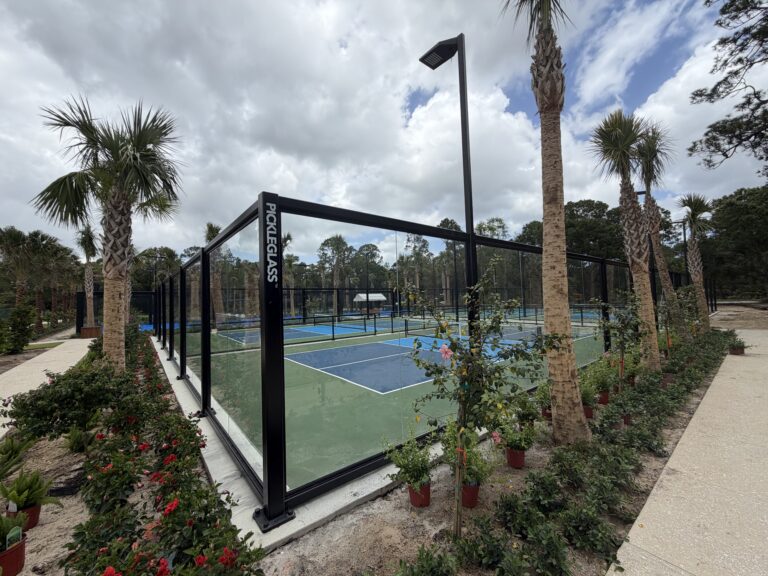
Conduit routing
If the facility includes integrated lighting, 3/4 inch electrical conduit is routed underground through the slab from the electrical source to junction boxes at the base of each light post. The conduit paths and junction box locations are determined by the lighting layout, which is part of the enclosure design.
This routing needs to be in the slab plan before the pour. Adding it afterward means saw-cutting cured concrete, trenching the conduit, and patching, which is expensive, disruptive, and produces an inferior result compared to conduit placed during the original pour.
Drainage specification
The slab requires a 1% continuous slope for drainage. This is enough to shed rainwater effectively without creating a perceptible slope during play. The drainage direction is determined by the site’s overall grading plan and needs to be coordinated with the surrounding site drainage.
What your civil engineer should receive:
A complete slab specification package that includes: slab thickness and reinforcement type (post-tensioned vs. standard, based on the specific project), anchor bolt layout with dimensional locations for each post, conduit routing plan with junction box locations, drainage slope requirement, and turn-down edge detail.
This package is produced during the court facility’s design phase and delivered directly to your civil engineer. The PM doesn’t need to translate or interpret the specification. It’s provided in a format your civil can incorporate directly into their slab design documents.
The timing issue:
The slab specification comes from the court facility’s design phase. The design phase starts after the court scope is confirmed. If the court scope hasn’t been confirmed yet, the specification doesn’t exist yet, which means your civil engineer is designing the site foundations without it.
The longer the court scope remains unconfirmed, the higher the probability that the slab in the court area gets designed generically, without the anchor bolts, conduit, or post-tensioning that the enclosure system requires. And the cost of correcting that after the pour is a multiple of what it costs to include it from the start.
The scoping conversation is what produces this specification package. If your civil engineer is approaching (or already in) the foundation design phase, it’s worth having the conversation now so the court slab can be specified correctly the first time. Contact us to walk through it together.
About PICKLETILE™
PICKLETILE™ is the leading design-build firm for premium pickleball court construction and the Official Court Builder of USA Pickleball.
Headquartered in Austin, Texas, PICKLETILE™ simplifies the complex construction process by offering turnkey solutions for residential, commercial, and club-level projects. The company is also the creator of PICKLEGLASS™, a patented soundproof glass wall system engineered to reduce noise by 50% while offering panoramic views and wind protection. For more information, visit www.pickletile.com.
