
Country club membership strategy typically focuses on three levers: programming quality, dining and social environment, and overall club prestige. Racquet facilities rarely appear on the list, even though for a meaningful and growing share of the membership demographic, they are a primary decision driver.
The clubs that are gaining ground on recruitment and retention right now are not necessarily doing everything better. In many cases, they have a comparable dining program, a comparable golf product, and a comparable social calendar. What they have that is visibly different is a racquet facility that communicates quality and intent from the first time a prospective member sees it.
This article covers how that advantage is being built and how it translates into measurable membership outcomes.
How the recruitment conversation has changed
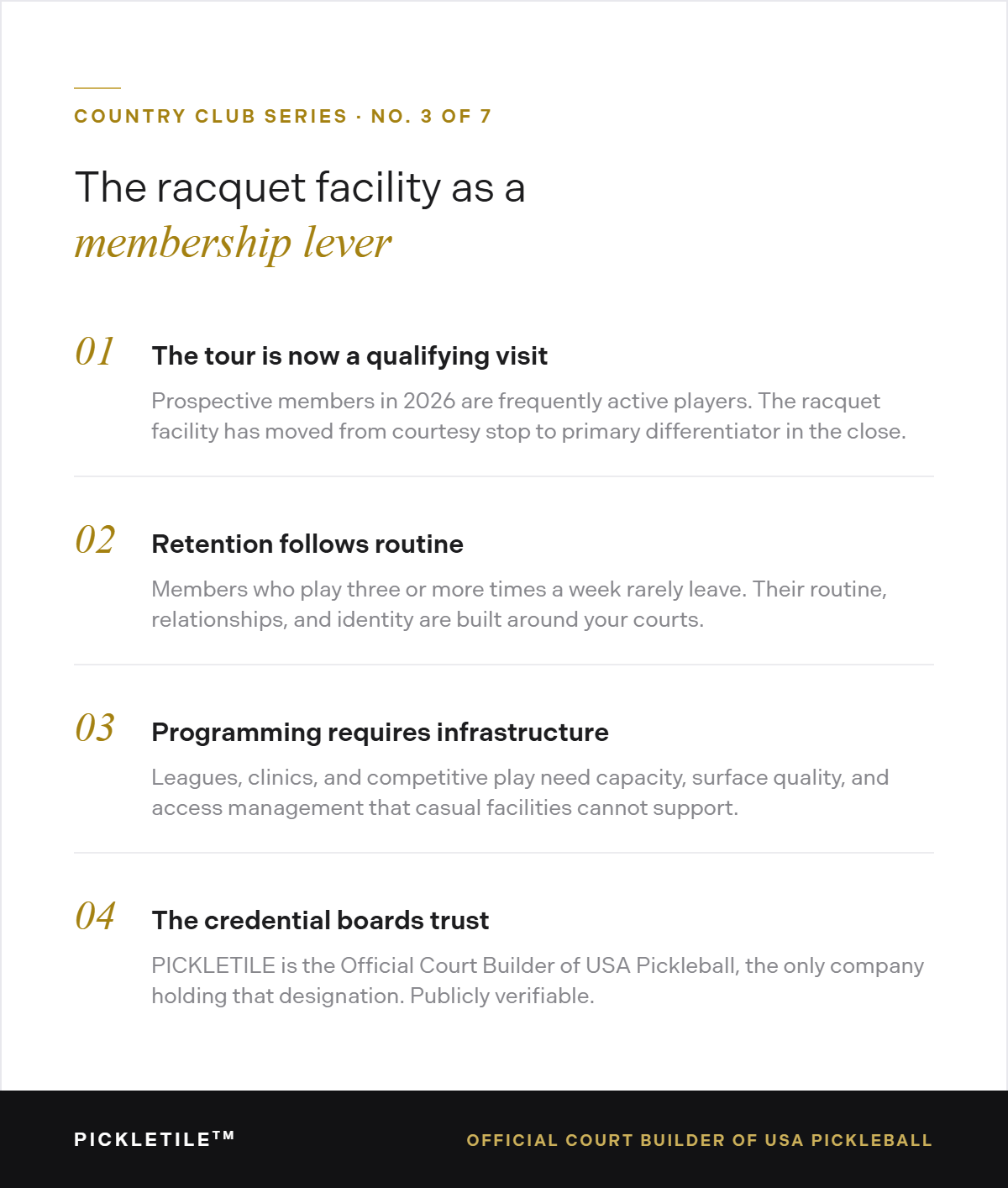
When a prospective member tours a private club in 2026, they are frequently a pickleball player. Not exclusively a pickleball player, but a person who plays the sport several times a week and whose daily routine is built around it. For that person, the racquet facility tour is not a courtesy stop. It is a qualifying visit.
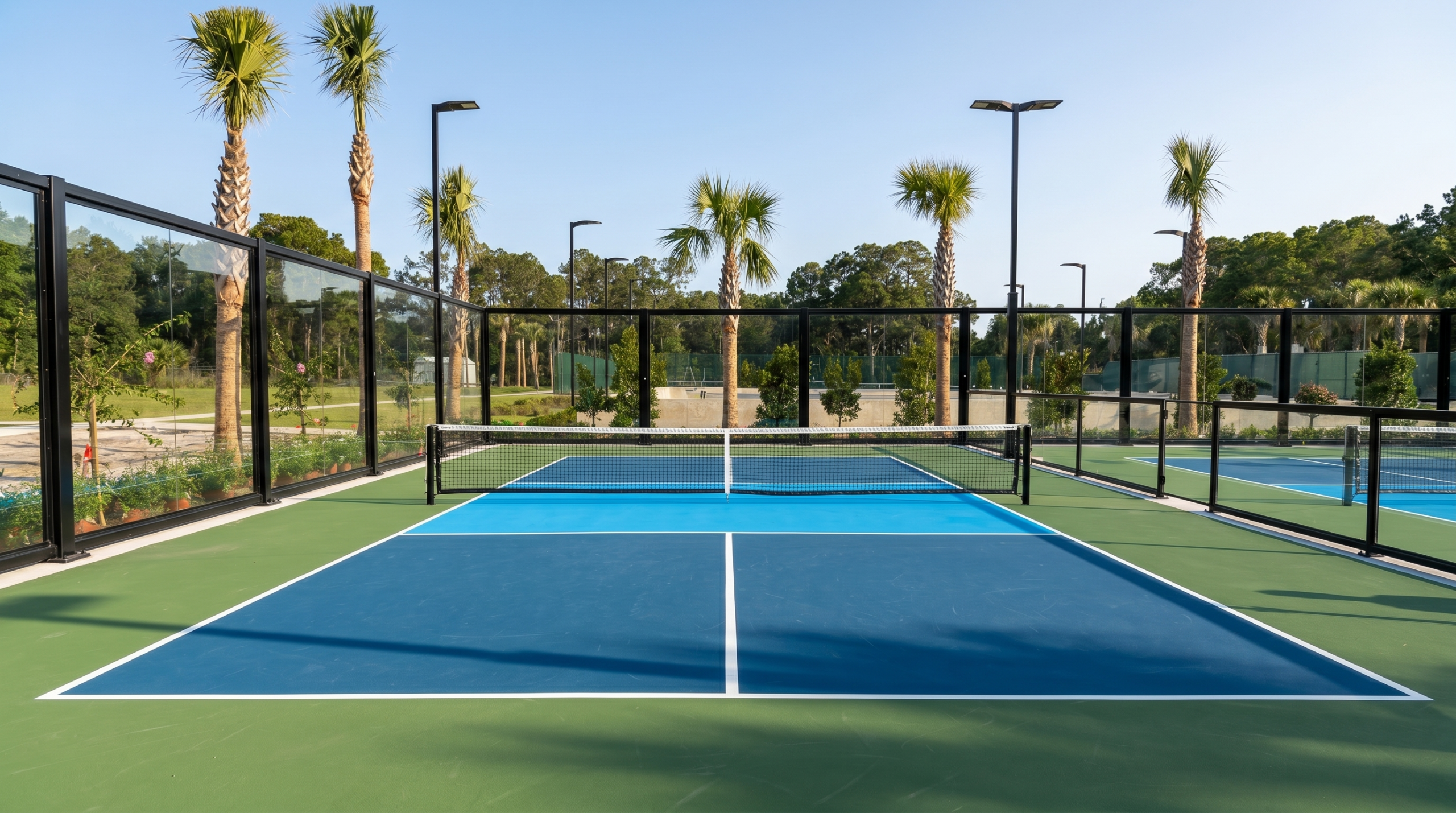
A facility that shows a premium structural glass enclosure, dedicated pickleball courts with proper proportions, evening lighting, and organized programming signals one thing: this club takes its racquet amenity seriously. A facility that shows a converted tennis court with painted pickleball lines and a chain-link perimeter signals something else entirely.
The prospective member does not describe it in those terms, but the decision reflects it. Clubs that have upgraded their facilities are consistently reporting that the racquet facility has moved from a supporting detail on the tour to a primary differentiator in the close.
The mechanism is straightforward: the membership prospect is evaluating your club against one or two alternatives. If one of those alternatives has a better racquet facility and yours does not, you are at a disadvantage in the portion of the prospect population that plays actively, and that portion is growing every year.
What retention looks like when the facility is right
Member retention at private clubs is driven by social integration: the degree to which a member’s routine, relationships, and identity are embedded in the club’s programming and environment. Members who participate actively in racquet sports programming are among the most socially integrated members any club has, because their sport is inherently social. They play with the same groups, join leagues, participate in clinics, and build relationships through the court in a way that translates directly into long-tenure membership.
The clubs that have built proper racquet facilities, with dedicated courts, organized league and clinic programming, and environments that draw members back consistently, are seeing this dynamic in their retention numbers. Members who play three or more times a week do not leave. The logistical and social cost of switching clubs is too high once someone has built their pickleball routine around your facility.
The inverse is also true. Members who want to play at that frequency but cannot, because your courts are over-subscribed, because the facility is not designed for the level of play they want, or because the experience does not match the dues they are paying, are in an ongoing evaluation of whether your club is the right one. Some of them will stay out of inertia. Others will make a quiet decision to change clubs before the next renewal cycle.
The programming capability question
A facility that enables serious programming is different from a facility that allows casual play. The distinction matters for recruitment and retention because the members you most want to retain are not casual players. They are the members who want leagues, clinics, round robins, and competitive play organized at a level that reflects the club’s standards.
That programming level requires courts that can hold organized events, surface quality that players associate with serious play, and enough capacity that programming and open play can coexist without constant scheduling friction. It also requires an access management system that allows courts to be reserved, blocked for programming, and managed without staff overhead.
Clubs that have built this infrastructure are running more racquet programming with less staff friction, and the programming quality is drawing members from peer clubs who are not getting the same experience at their current club.
The credential that gives club leadership a credible answer
When a club commits to a racquet facility upgrade and the board asks why PICKLETILE™, there is a clear answer: PICKLETILE is the Official Court Builder of USA Pickleball. It is the only company holding that designation from the sport’s governing body. Every facility PICKLETILE builds meets the engineering and construction standards defined by USA Pickleball, and that credential is publicly verifiable.
For club leadership presenting a capital recommendation to the board, that affiliation matters. It takes the vendor selection question off the table as a point of vulnerability and positions the investment as a deliberate choice of the category’s recognized infrastructure leader.
Request a quote and let’s build the business case for your club’s facility upgrade, starting with a scoping conversation.
The clubs that are ahead on recruitment and retention made this decision at the right moment in their capital cycle. Let’s understand what the right timing looks like for your club.
