
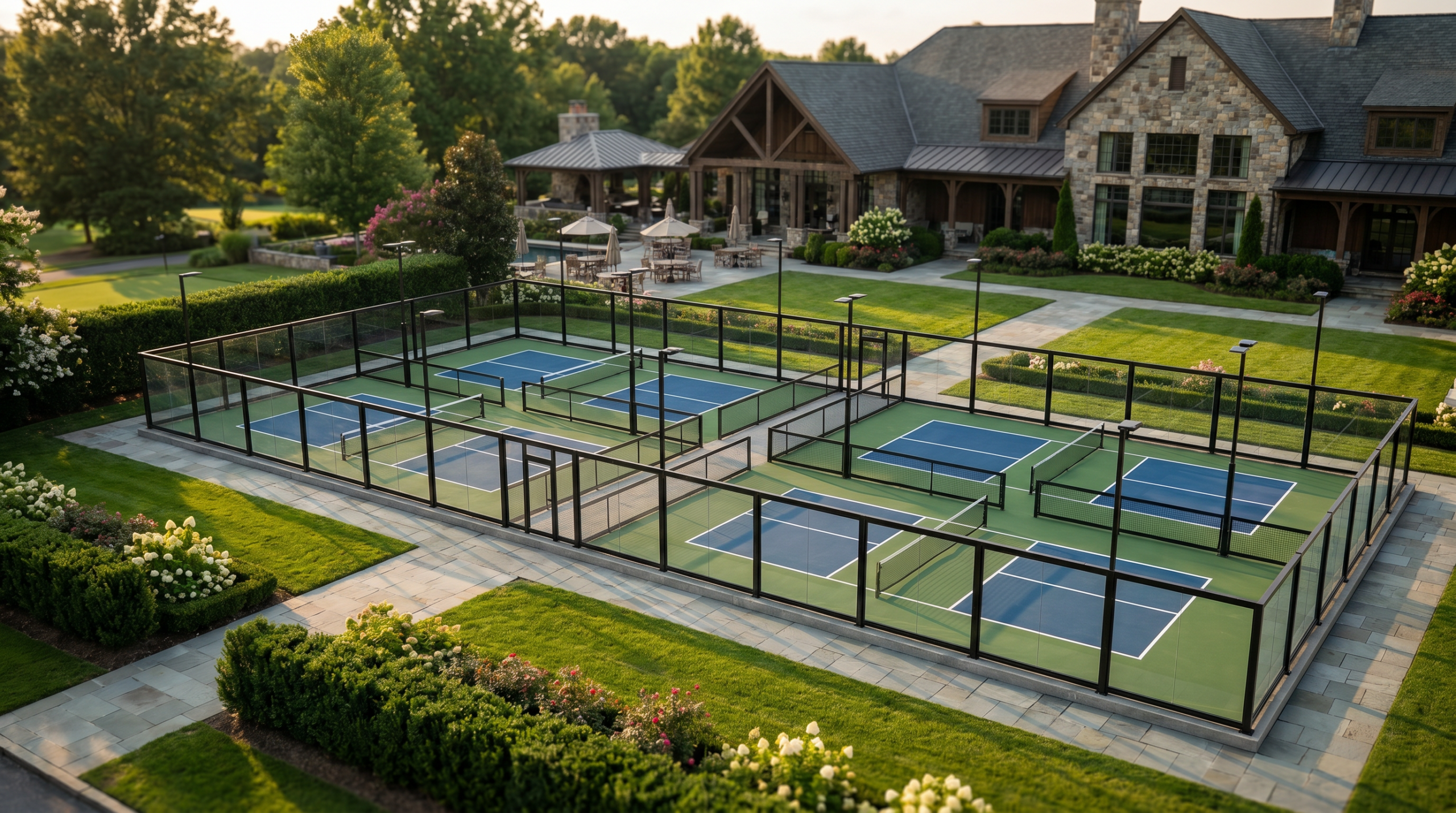
Why acoustic planning before construction is the only way to prevent pickleball noise from becoming a multifamily liability.
AUSTIN, Texas – June 4, 2026 – In 2026, pickleball noise has become one of the most consistently cited friction points in multifamily amenity development. Not because the sport is inherently incompatible with residential environments, but because developers who did not plan for the acoustic profile of the game are discovering the problem after the facility is already built.
This is a spec problem. And like most spec problems, it is far easier to solve before the drawings are finalized than after residents move in and start filing complaints.
Here is what is actually happening on the ground across the markets where PICKLETILE operates: developers who installed chain-link courts within 50 to 100 feet of occupied units are managing ongoing noise friction with their residents. Some are fielding formal complaints. Some are restricting court hours, which defeats the amenity’s purpose and creates resentment. A few are facing the significantly more expensive problem of retrofitting acoustic solutions onto a facility that was not designed to receive them.
The developers who are not having any of these conversations are the ones who specified the court infrastructure correctly before construction started.

What the acoustic reality of pickleball actually is
To understand the risk, you need to understand what makes pickleball noise different from other amenity noise.
The sport produces a high-frequency impact sound at the point of paddle contact. That frequency profile is more penetrating than the lower-frequency sounds generated by most outdoor recreation. It cuts through ambient noise more easily, travels farther relative to the decibel level at the source, and is subjectively perceived as more irritating by people in its path than comparably loud sounds at lower frequencies.
At the source, active pickleball play measures around 91 decibels at 15 feet. Without any barrier, that sound propagates across a residential setting in a way that is audible and disruptive at distances of 50, 75, even 100 feet from the court. At a typical multifamily setback, where occupied units may be 40 to 80 feet from the court perimeter, an unenclosed or poorly enclosed court is generating a noise exposure that a meaningful share of your residents will find disruptive.
The physics of this are not in dispute. The question is whether you are going to design around them or discover them later.
Why this is a spec decision, not a retrofit problem
The noise issue is solvable. Acoustic engineering for outdoor pickleball courts is a mature area now, with verified performance data from independent studies. Our PICKLEGLASS system, the Official Acoustic Solution of USA Pickleball, is engineered with a full-height perimeter enclosure that provides up to 13 decibels of attenuation at 50 feet for a standard 10-foot configuration. A 10-decibel reduction is generally perceived as cutting the noise in half.
That level of performance is achievable. But it requires building the acoustic solution into the design from the beginning.
What does not work: chain-link with windscreens. Windscreens are a visual barrier and a minor wind block. They have no meaningful acoustic value. All acoustic performance in an engineered court system comes from the full-height perimeter enclosure. This is a distinction worth understanding clearly before you lock your spec, because the market has no shortage of vendors who will blur it.
Retrofit solutions, which involve adding acoustic panels or barriers to an existing court after the fact, are structurally compromised compared to systems designed from the ground up. They are also significantly more expensive on a performance-per-dollar basis. And they require your residents to live through a construction disruption on a completed amenity, which generates its own operational friction.
The cost of getting this right at the spec phase is a fraction of the cost of addressing it post-completion.
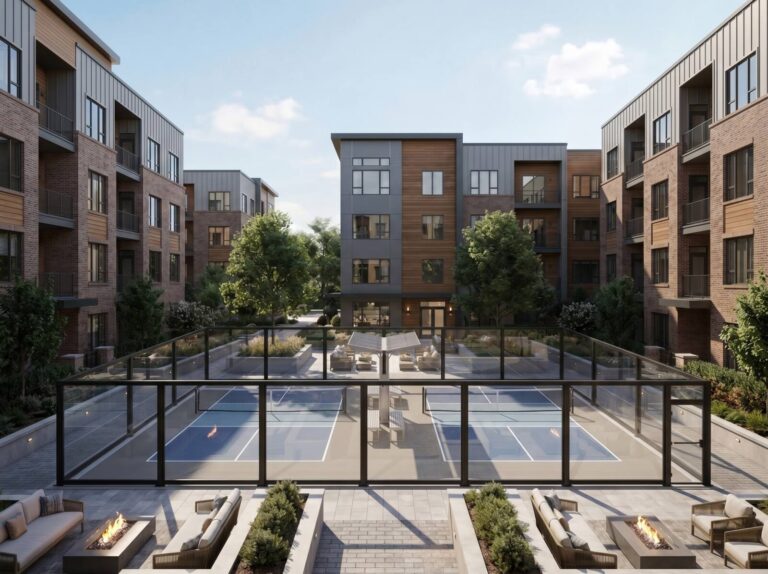
What this means for the construction and permitting process
For Directors of Construction and Project Managers reviewing court scope during the pre-construction phase, take extra note of this next section…
Beyond the resident relations risk, noise is increasingly a permitting and approval variable. Several municipalities across Texas, Florida, and California have begun applying noise ordinance scrutiny to outdoor recreation amenities that previously would have received routine approval. HOA communities adjacent to multifamily developments are more likely than they were three years ago to raise acoustic objections during the entitlement process.
If your project is in a jurisdiction that requires a noise analysis or is in a neighborhood with organized HOA presence, the question of how you’ve addressed court acoustics will come up. Having a documented, PE-stamped design with verified acoustic performance data puts you in a substantially stronger position in those conversations than a spec that relies on chain-link and windscreens.
What to look for in a court specification before it goes to permit:
Full-height perimeter enclosure with documented STC performance. Not a windscreen. Not a partial enclosure. A structural system with independent acoustic testing data behind the claim.
PE-stamped structural engineering on the enclosure system, consistent with IBC requirements for permanent structures. This is standard on PICKLETILE projects and should be a baseline requirement for any court infrastructure you are putting through a permit process.
Clear delineation between acoustic elements and non-acoustic elements in the scope. Interior dividers, for example, are not acoustic barriers. They serve a different function. Any vendor who represents them as acoustic solutions is presenting misleading specs.
Getting the engineering right at this stage does not add weeks to your schedule. It prevents weeks of rework and documentation scrambles that happen when a poorly specified court runs into permitting friction or post-occupancy complaints.
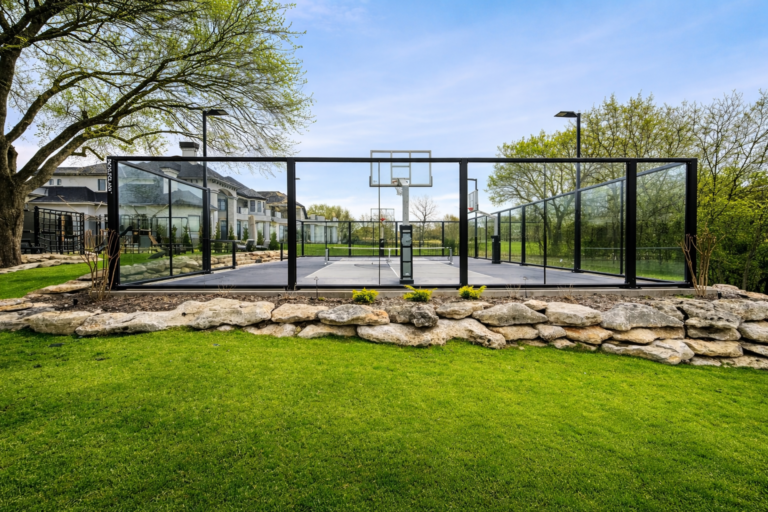
The conversation worth having before the amenity scope is locked
The developers who are consistently avoiding the noise problem are doing two things: they are specifying acoustic enclosure systems from the start, and they are having a scoping conversation with an infrastructure partner before the amenity design is finalized.
That conversation does not take long. PICKLETILE’s standard scoping process covers your site’s acoustic exposure, the right enclosure specification for your project environment, and what the engineered design looks like before you are committed to a budget number.
If you are at the amenity design phase on a current project, or planning a development where courts are part of the scope, request a quote now. The earlier in the design process we are engaged, the more value we can deliver on both the acoustic performance and the total project cost.
If noise risk is on your radar for a current project, the time to address it is before the amenity drawings are finalized. Request a quote and let’s take 20 minutes to walk through your site.
About PICKLETILE™
PICKLETILE™ is the leading design-build firm for premium pickleball court construction and the Official Court Builder of USA Pickleball.
Headquartered in Austin, Texas, PICKLETILE™ simplifies the complex construction process by offering turnkey solutions for residential, commercial, and club-level projects. The company is also the creator of PICKLEGLASS™, a patented soundproof glass wall system engineered to reduce noise by 50% while offering panoramic views and wind protection. For more information, visit www.pickletile.com.
