
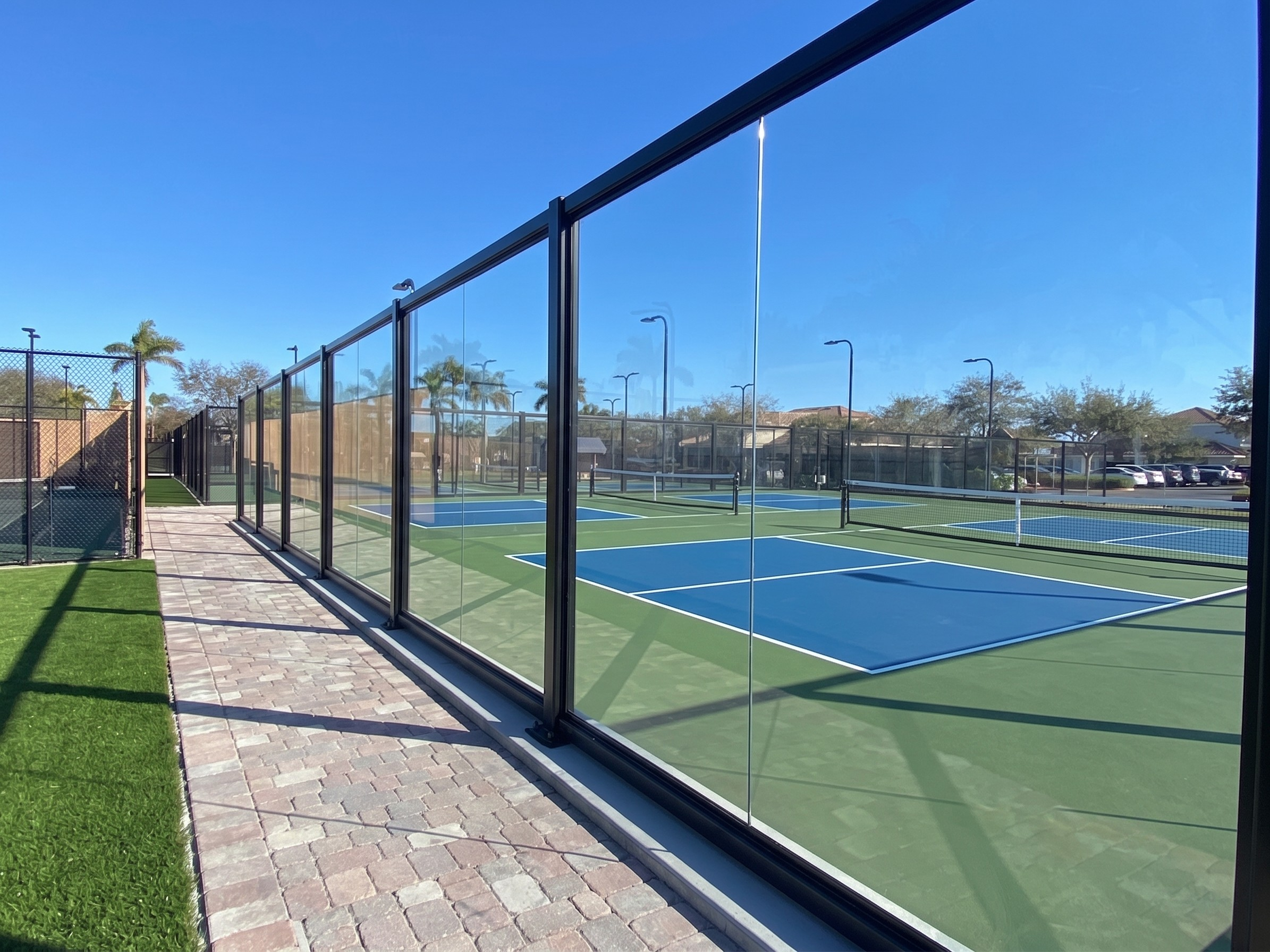
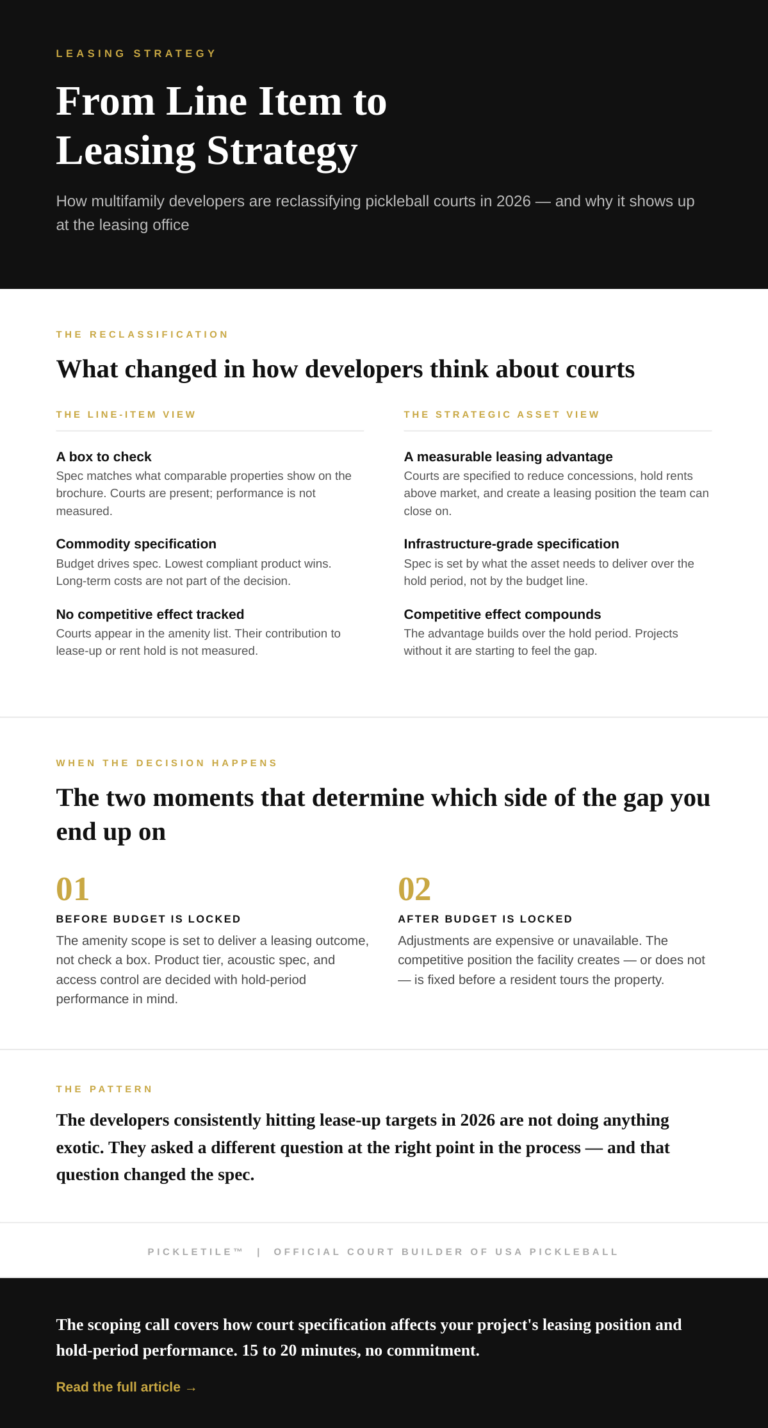
How top multifamily developers are reclassifying pickleball courts from amenity line items to leasing infrastructure.
AUSTIN, Texas – June 3, 2026 – For most of the past decade, pickleball courts in multifamily showed up in the amenity budget the same way a fire pit or dog run did. A line item. A box to check. Something the marketing team could photograph and put in the brochure.
That is changing, and it is changing fast.
In 2026, the developers who are consistently hitting lease-up targets, reducing concessions, and holding rents above their competitive set are treating court amenities as leasing infrastructure, not decoration. The distinction matters because it changes the budget conversation, the specification decision, and ultimately the return you get out of the investment.
A fire pit does not materially affect how a prospect decides between your property and the one down the street. A well-designed, fully enclosed pickleball facility with programming capability, access control, and architectural integration does. That difference is measurable. And the developers who have figured it out are building a durable competitive advantage into their projects at the design phase, not trying to retrofit it later.
Why pickleball courts outperform other amenity investments
Not every amenity delivers the same return. Pools are expected at premium price points and rarely differentiate. Fitness centers have become table stakes. Coworking spaces are increasingly standard. The amenities that actually move the needle for lease-up are the ones that (a) a specific and growing renter demographic actively seeks out, (b) require real capital to do well, which means your competition is less likely to match it, and (c) generate ongoing social activity that creates community and reduces churn.
Pickleball courts check all three boxes in a way almost no other amenity does right now.
The sport has added millions of players in the U.S. in the past four years, with the fastest growth concentrated in exactly the demographic that drives multifamily demand: renters between 25 and 45, with household incomes above the median, in Sun Belt markets. Texas, Florida, California, and Colorado are all seeing pickleball participation growth at rates that outpace the national average.
This is not a fad calculation. Fads do not produce 40 million players with organized leagues, national governing bodies, and television contracts. Pickleball has crossed the threshold from trend to sport. The rental prospects who play it are not going to stop playing it.
The developer who builds a serious court facility captures that demand signal at the front door. The developer who skips it, or builds something that looks like an afterthought, cedes that demand to whoever did it right.
The lease-up advantages developers are actually documenting
Let’s be specific about what a high-quality court amenity contributes to project performance, because this is where the line item framing breaks down and the leasing strategy framing takes over.
Prospect conversion. Properties with activated outdoor amenity programming, including pickleball, are consistently reporting that court visibility on tours drives tour-to-application conversion at higher rates than passive amenities. A prospect who plays pickleball three times a week and sees a premium enclosed court from the leasing office is doing math in their head during the tour. That math favors your property.
Rent premium support. Amenity differentiation is one of the few tools a developer has to justify a rent premium against a nearby competitor with a similar unit mix. When the comparison is between your property’s enclosed, architecturally integrated court facility and a competitor’s chain-link open court, the premium is defensible. When everything else is equal, the court becomes a genuine differentiating factor in the prospect’s decision.
Retention and reduced concession pressure. The residents who actively use a court amenity are among the highest-retention renters in any multifamily community. They have built their routine around your property. The cost of a concession cycle, a vacancy gap, and a re-lease is substantially higher than the cost of building a facility they want to stay for.
NOI protection over the asset hold period. This is the calculation that should matter most to you as the principal. Amenities that drive tenant loyalty reduce the vacancy drag and concession cycles that erode NOI over a 5- to 10-year hold. A court that was built right, with durable materials and a low maintenance footprint, continues contributing to that NOI protection without adding to your operating cost. A court that was built cheap has the opposite effect.
What separates a court that performs from one that doesn’t
The developers who are seeing the leasing and retention benefits described above are not seeing them because they added pickleball to their amenity checklist. They are seeing them because they built facilities that residents actually want to use, that photograph well for marketing, that function without management headaches, and that hold up aesthetically over years of use.
That outcome requires getting several things right.
Enclosure design. Open chain-link courts look like what they are: a low-cost installation. They do not communicate premium. They generate noise complaints from adjacent units. They require residents to coordinate their own gameplay without any access management. And they age poorly, which means they are working against your marketing materials within a few years of opening.
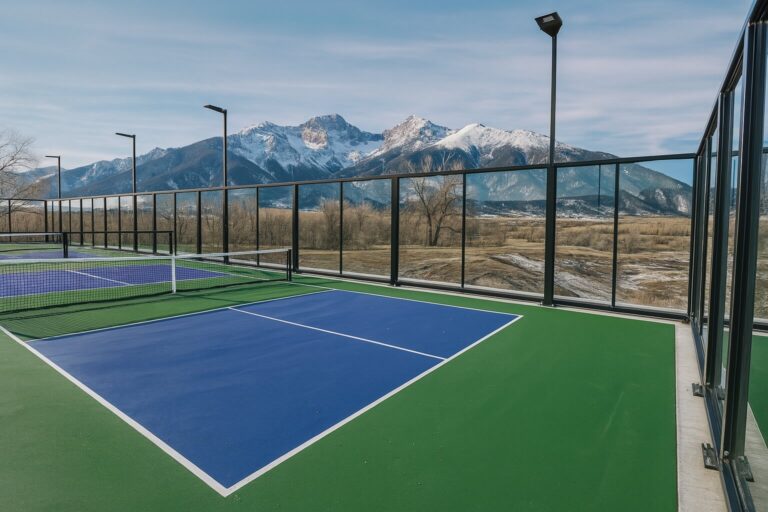
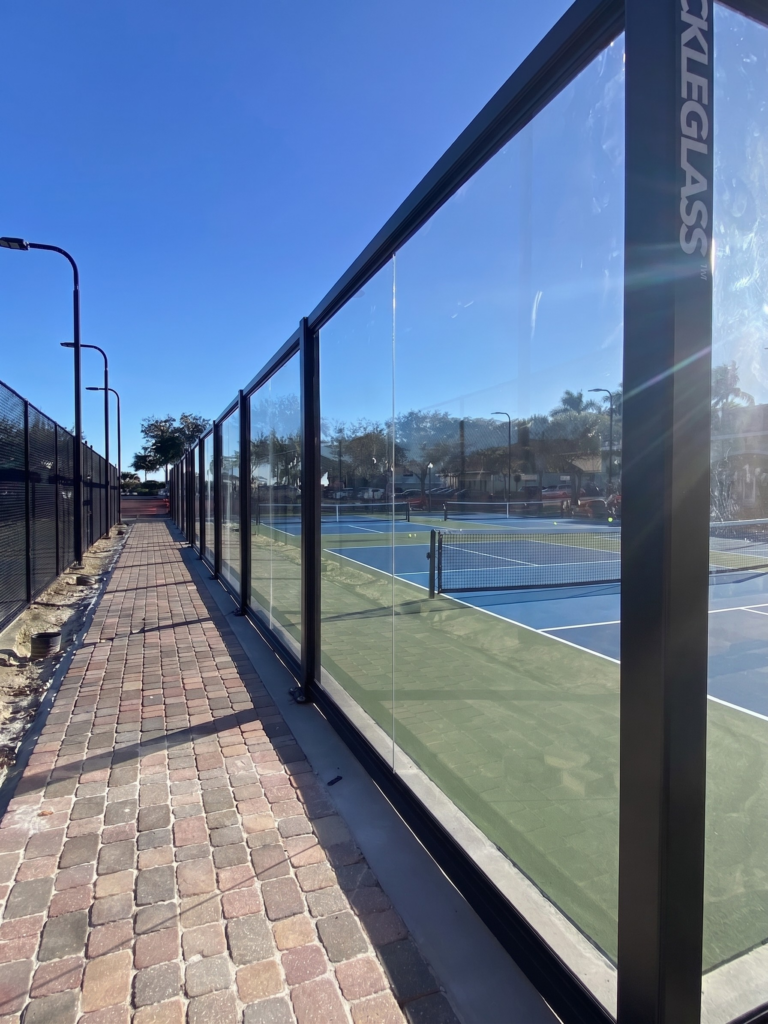
Full-height structural glass enclosure systems, like the PICKLEGLASS system PICKLETILE builds, change the physics of the court’s relationship to the rest of your property. The transparency creates visual activation. The acoustic performance reduces the noise exposure to adjacent units and common areas. The architectural finish communicates that this was a designed amenity, not a line item.
Access and programming capability. A court that residents cannot easily access is a court that does not get used. And a court that does not get used does not produce the leasing and retention benefits that justify the capital. Integrated access control tied to your property management platform allows residents to book courts, manage scheduling, and access the facility without staff involvement. This is increasingly a baseline expectation at premium price points.
Durability and maintenance profile. You are not evaluating this investment over 18 months. You are evaluating it over the hold period of the asset. A facility engineered with materials rated for 10-plus years of performance, with documented structural warranties and powder-coated finishes built to architectural standards, does not require a capital refresh in year 4 or year 6. A facility built to a budget number does.
The decision you are making before the drawings are final
The window for making the right decision on court infrastructure is the amenity design phase, before your architect finalizes the plans and your GC prices the scope. Once the amenity package is locked, changing the court specification becomes a change order problem.
The developers who consistently get this right engage an infrastructure partner early, not after the site plan is done. Getting a scoping conversation on the calendar now, while your amenity decisions are still open, takes 20 minutes and costs nothing. It is the difference between a court that contributes to your project’s competitive position for the entire hold period and one that creates headaches you did not budget for.
If you are planning a development or a renovation where court amenities are part of the scope, we would like to talk with you before the budget is locked. Request a quote and we will start with a no-commitment scoping conversation to understand your project and show you what is possible.
If you’re at the point where you’re locking in your amenity scope, now is the right time to have a 20-minute conversation. Request a quote and we’ll get something on the calendar.
About PICKLETILE™
PICKLETILE™ is the leading design-build firm for premium pickleball court construction and the Official Court Builder of USA Pickleball.
Headquartered in Austin, Texas, PICKLETILE™ simplifies the complex construction process by offering turnkey solutions for residential, commercial, and club-level projects. The company is also the creator of PICKLEGLASS™, a patented soundproof glass wall system engineered to reduce noise by 50% while offering panoramic views and wind protection. For more information, visit www.pickletile.com.
