
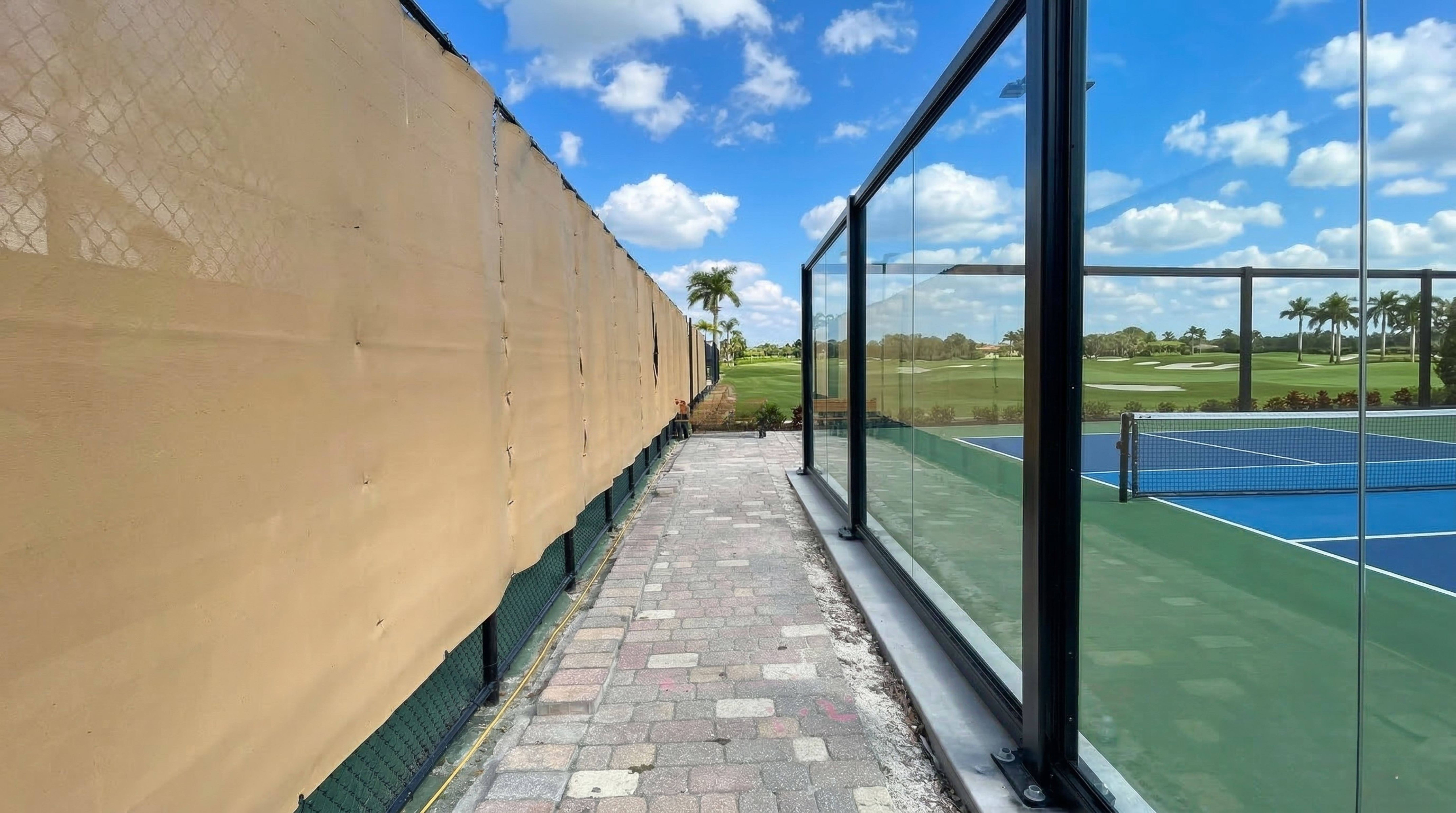
Noise is now the most common constraint on new club court development — and the cost difference between designing it in versus retrofitting it later is significant.
AUSTIN, Texas – May 14, 2026 – Over the past three years, noise has become the single largest constraint on new pickleball facility development in the United States. The issue is not limited to public parks or residential communities. Private clubs are increasingly affected, particularly clubs located in or adjacent to residential neighborhoods.
Noise sits across both offices at the club. For the Director of Racquets, it shows up as restricted playing hours, league schedules that have to be redesigned around evening cutoffs, and the daily reality of being the one who tells a member their 7pm clinic moved to 5pm because the courts now close early. For the GM, it shows up as letters from neighbors, calls from the HOA, conversations with city code enforcement, and the question of whether the racquet investment the club just made is now operating at a fraction of its capacity. Both arrive at the same place: the club did the project, and the project is producing less than it should.
Acoustic engineering during the original design is the difference between a facility that performs as planned and a facility that has to be defended.
Why pickleball noise is different
Pickleball generates a distinctive sound. The ball-on-paddle impact creates a sharp, high-frequency percussive noise that behaves differently from the lower-frequency sounds of tennis or most other outdoor recreation. High-frequency sounds carry further, penetrate building envelopes more effectively, and are perceived as more irritating at the same decibel level.
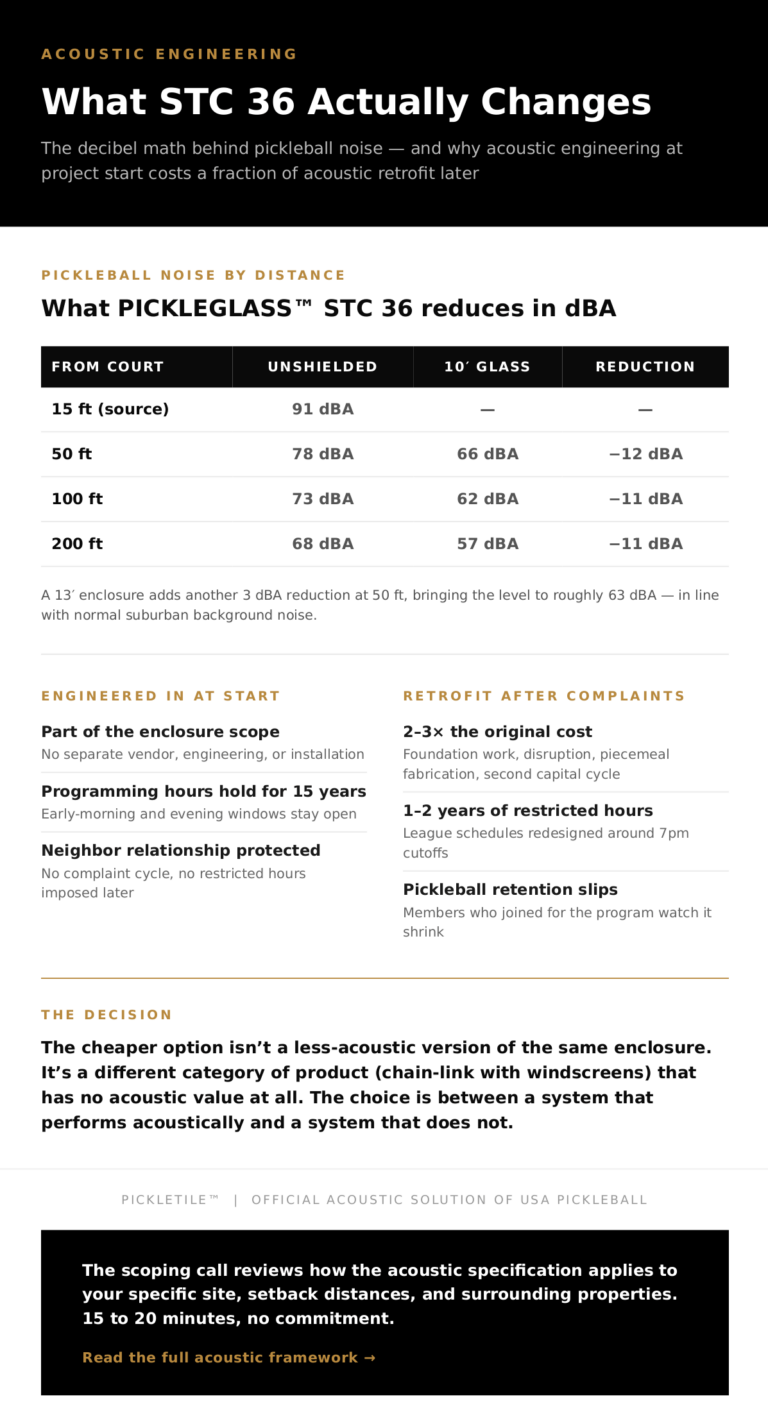
Measured at the source, pickleball activity produces approximately 91 dBA at 15 feet from the court. At 50 feet (a common distance to the property line at many clubs), an unshielded court registers approximately 78 dBA. At 100 feet, approximately 73 dBA. At 200 feet, approximately 68 dBA.
For context: 78 dBA is comparable to a running vacuum cleaner. It is not dangerously loud. It is the kind of persistent, percussive noise that people notice, and once they notice it, they cannot stop noticing it.
The complaint cycle
The pattern plays out the same way at clubs as it does in public settings, just with different stakeholders. Courts are built or converted to pickleball without acoustic planning. Play begins. Neighbors in adjacent residential properties start hearing the distinctive pickleball sound, particularly in the early morning and evening when ambient noise is lowest and play activity is highest.
The first calls go to the club directly. Sometimes they escalate to the HOA, city code enforcement, or local government. The GM is the one who takes the calls. The board is the one who hears about them at the next meeting.
The club responds the way most clubs do: by restricting playing hours. Early morning and evening play, the windows when most working members are available, get eliminated or curtailed. The courts are now operating at a fraction of their potential capacity. Members who joined or renewed specifically for the pickleball programming are frustrated. The Director of Racquets is managing scheduling conflicts with fewer available hours and answering questions about why their evening clinic is no longer offered. The investment in the court project is generating less member value than planned.
The cycle is playing out at clubs across the country right now. The clubs that planned for noise are unaffected. The clubs that did not are managing the consequences in both offices.
What acoustic mitigation actually achieves
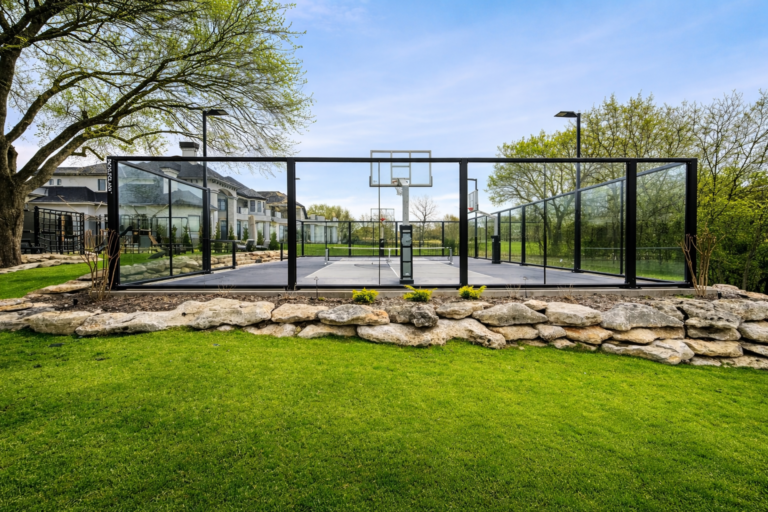
A structural glass enclosure with an STC rating of 36 (the engineering standard of PICKLEGLASS™ and the Official Acoustic Solution of USA Pickleball) provides verified sound attenuation that changes the noise picture significantly.
At 50 feet from a 10-foot glass enclosure, the sound level drops from 78 dBA to approximately 66 dBA. That is a reduction of 12 dBA, which is perceived as more than half as loud because of how the decibel scale works logarithmically.
At 100 feet from the same enclosure, the level drops from 73 dBA to approximately 62 dBA.
A 13-foot enclosure provides even greater attenuation: 15 dBA at 50 feet, bringing the level to approximately 63 dBA, which approaches background ambient noise in most suburban settings.
The practical difference: 78 dBA from an unshielded court is clearly audible and intrusive. 63 to 66 dBA from an enclosed court blends into the normal sound environment of a residential neighborhood. That is the difference between a noise problem and a non-issue. It is also the difference between a Director running full programming hours and a Director redesigning the league schedule around 7pm court closures.
The capital math: acoustic engineering at project start vs. acoustic retrofit later
The cost of acoustic engineering during initial construction is part of the enclosure scope. It is designed in from the start. There are no separate vendors, no separate engineering, no separate installation. The acoustic performance is built into the same PICKLEGLASS system that provides the wind protection, ball containment, and visual presence.
The cost of retrofitting acoustic solutions after complaints arise is a completely different number. The original foundation was not designed to support a structural enclosure, so the retrofit requires new foundation work. The court itself is now finished, so the installation creates disruption to existing play. The work is scheduled around play rather than ahead of it. Materials are ordered piecemeal rather than as part of an integrated fabrication. The total investment is typically two to three times what the same scope would have cost during initial construction, and the club lives through a second capital approval cycle to get there.
For the GM evaluating a court project today, the question is not whether acoustic performance matters. The question is whether it is addressed during initial design (when it is part of the project) or after complaints force the issue (when it is a crisis being managed under pressure).
The programming view of the same decision
For the Director, the same decision shows up differently. Acoustic engineering at project start means the league schedule the Director designs in year one is the league schedule that runs in years two through fifteen. Early-morning leagues run. Evening play runs. Tournament scheduling is not limited by hour restrictions imposed after the project opened. Member retention in the pickleball program holds because the program runs at the hours members actually want to play.
Acoustic retrofit after complaints means a year or two of reduced hours while the retrofit is engineered, scoped, approved through a second capital cycle, and built. During that window, the Director is managing programming that has to fit inside the restricted hours, fielding member complaints about the restriction, watching pickleball renewals slip, and answering the question of when the courts will be available again.
The Director cannot fix this through better scheduling. It is a facility decision, made once, with consequences that compound for fifteen years.
The board conversation about noise
When the project comes to the board, the acoustic specification is one of the strongest elements of the proposal. It protects the club’s relationship with neighboring properties, prevents the restricted-hours scenario that undermines the investment, and demonstrates that the club is approaching the project as a thoughtful infrastructure decision rather than a reactive recreational installation. Boards that understand the noise risk are more likely to approve a project that addresses it proactively. Boards that do not are sometimes drawn to a cheaper project that creates the problem, only to face a more expensive solution later.
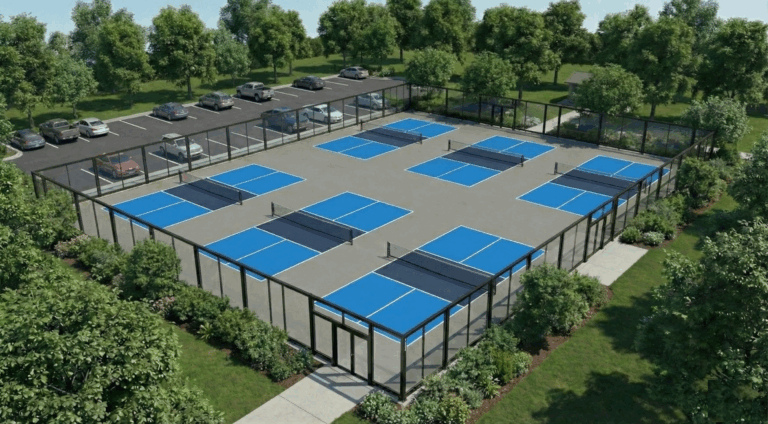
The simplest framing for the board: the acoustic engineering is not an upgrade to the enclosure. It is what the enclosure is. The cheaper option is not a less-acoustic version of the same product. It is a different category of product (chain-link with windscreens) that has no acoustic value at all. The decision is between a system that performs acoustically and a system that does not.
If your club is near residential areas, or if noise has come up in any member or neighbor conversation, the scoping conversation includes a review of how the acoustic specification applies to your specific site and surrounding properties. Happy to walk through it whenever works.
About PICKLETILE™
PICKLETILE™ is the leading design-build firm for premium pickleball court construction and the Official Court Builder of USA Pickleball.
Headquartered in Austin, Texas, PICKLETILE™ simplifies the complex construction process by offering turnkey solutions for residential, commercial, and club-level projects. The company is also the creator of PICKLEGLASS™, a patented soundproof glass wall system engineered to reduce noise by 50% while offering panoramic views and wind protection. For more information, visit www.pickletile.com.
