
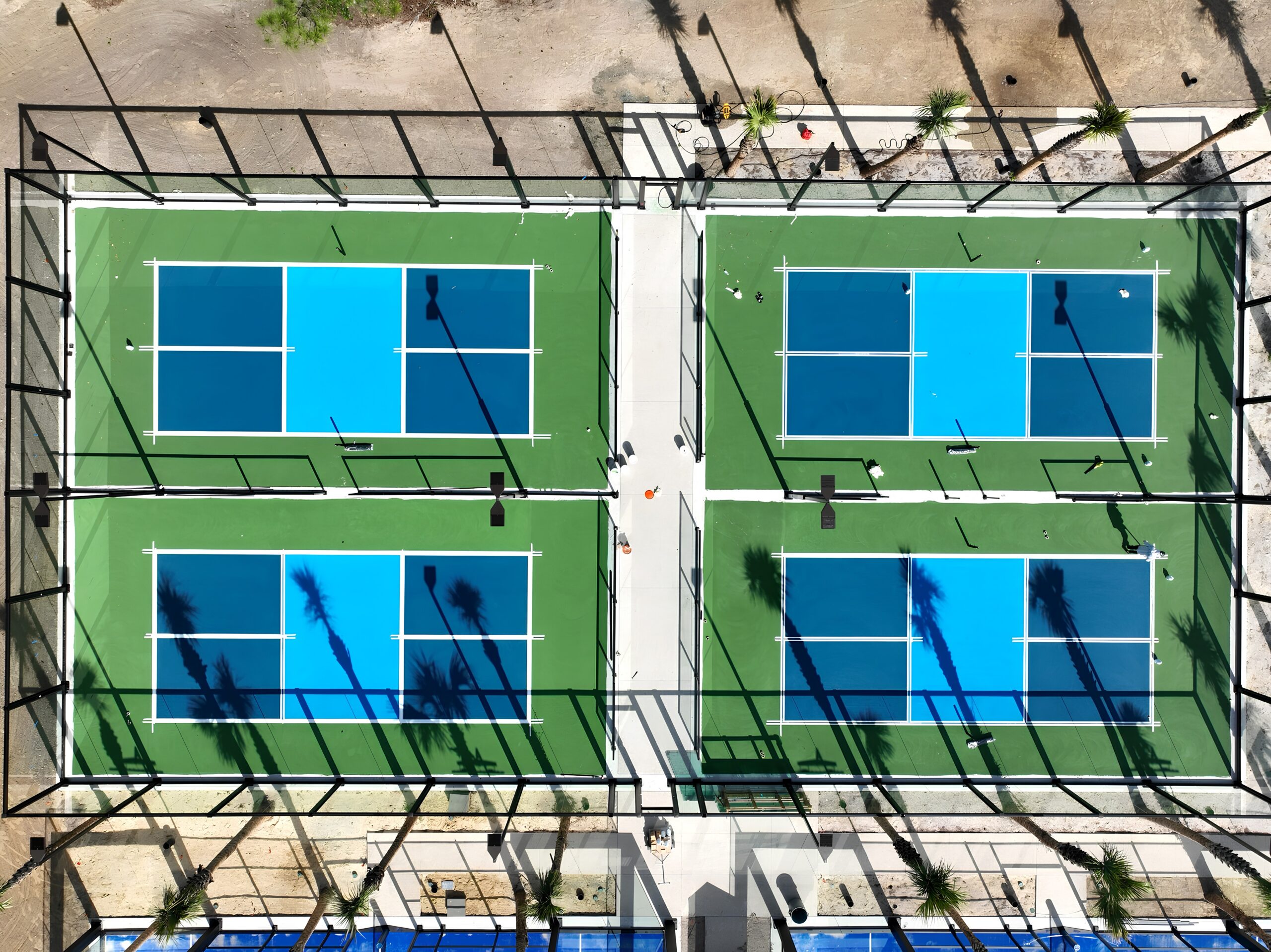
The design decision that resolves the tennis-pickleball membership tension — and four programming outcomes it opens up the day the facility opens.
AUSTIN, Texas – May 13, 2026 – If you are running a private club’s racquet program in 2026, you are almost certainly working through some version of this dynamic: a growing group of members passionate about pickleball, a loyal tennis membership that feels protective of their courts and programs, and a limited number of courts that both groups want to use during the same peak hours.
For the Director of Racquets, this is the operational problem at the center of every week. For the GM and the board, it is the political problem at the center of every capital conversation about the racquet facility. Both are real. Both are solvable. And both have the same solution.
The tension is not actually a political problem. It is a facility design problem. Facility design problems have answers.
Why dual-line striping makes the problem worse
The most common first attempt at resolving the tennis-pickleball question is to paint pickleball lines on existing tennis courts. It is cheap, it is fast, and it appears to give both groups what they want.
In practice, it satisfies neither group and creates new problems in both offices.
The playing experience is confusing. Two sets of lines on one court creates visual clutter that affects play for both sports. Tennis players are distracted by pickleball lines. Pickleball players are confused by tennis lines. Neither sport is being presented at the standard members expect from a private club.
Scheduling conflicts multiply. A dual-lined court can be used for tennis or pickleball at any given time, but not both. The scheduling problem does not go away. It just adds a layer of complexity: now the Director has to manage not only who gets the court but which sport the court is configured for during each time block. League programming, clinics, and open play all compete for the same surface.
Neither membership feels valued. Dual-line striping sends a message to both groups: your sport is not important enough for its own courts. Tennis members read the new lines as an intrusion. Pickleball members read the shared courts as a signal that their sport is still being treated as secondary. From the GM’s seat, what was sold as a compromise reads to members like a half-investment. The board conversation gets harder, not easier, the next time a racquet capital request comes up.
The design that resolves the tension
Clubs that have moved past the dual-line phase and invested in dedicated courts for each sport report a consistent outcome: the tension dissolves.
When tennis has its own courts and pickleball has its own courts, the scheduling conflict goes away. Both sports run programming simultaneously. Neither group feels displaced. The Director plans leagues, clinics, and events for each sport independently, without one program displacing another. The GM stops fielding complaints from both sides of the racquet membership and starts hearing about the new facility from members who use it.
A handful of design elements make this work.
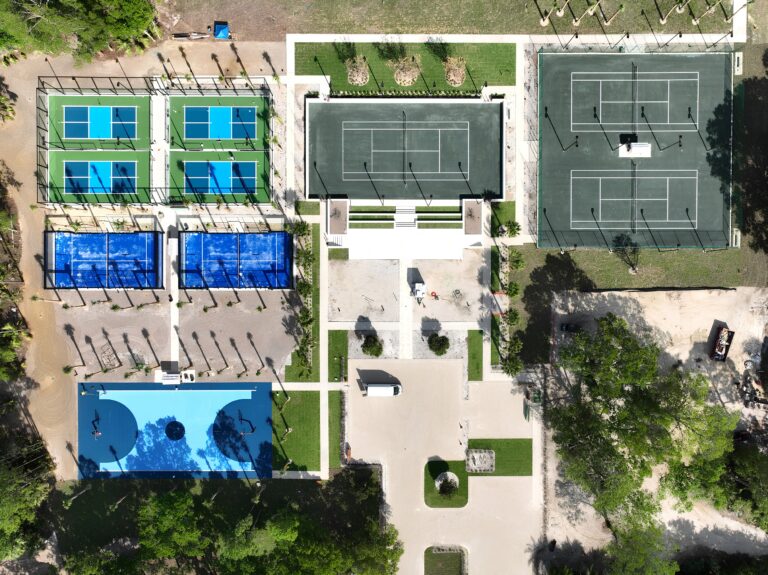
Dedicated courts for each sport. This is non-negotiable for resolving the tension. The exact ratio of tennis to pickleball courts depends on the club’s specific demand patterns, but the principle is consistent. Shared courts create conflict. Dedicated courts eliminate it.
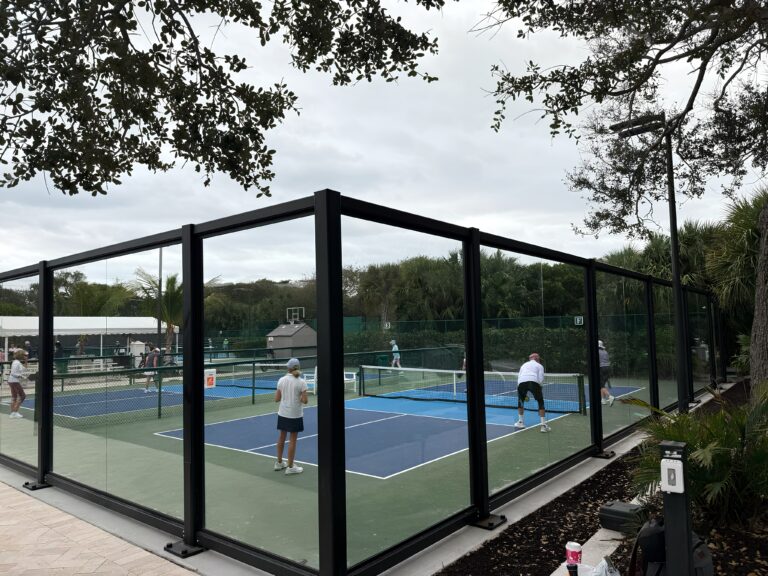
A unified enclosure system across all courts. When the same structural glass enclosure covers both tennis and pickleball courts, the facility reads as one cohesive racquet complex rather than two separate areas. Tennis members see that the investment benefits their courts too: wind protection, an aesthetic upgrade, a premium playing environment. Pickleball members see a purpose-built facility that signals the club is taking their sport seriously. The board sees one investment in the racquet program, not a pickleball project sitting next to a neglected tennis program.
Glass dividers between sport areas. PICKLEGLASS™ four-foot glass dividers between the tennis and pickleball sections provide visual separation and ball containment between the two zones without creating a physical wall. Players in each section can focus on their own game without distraction from the adjacent sport. Spectators can still see across the facility. The separation is functional without feeling divisive. (The four-foot dividers do not provide acoustic separation, which comes from the perimeter PICKLEGLASS enclosure, not from the dividers.)
Shared amenities. When practical, the facility should share common elements: a spectator area, shaded seating, water stations, and access paths. Shared amenities create a common gathering space where tennis and pickleball members interact socially rather than being segregated into separate clubs-within-a-club.
How this design clears the board conversation
The design is also the political answer. When the Director and the GM present the project as “dedicated pickleball courts,” the board hears an investment that benefits one group at the potential expense of another. The conversation turns into a contested vote.
When the project is presented as a racquet facility upgrade that serves all racquet sports members, with dedicated courts for each sport, premium enclosures across the entire area, and extended playing hours through integrated lighting, the board hears an investment in the whole club. The vote becomes a different vote.
The distinction is not wordplay. The facility has to actually serve both sports well for the framing to hold. Dedicated courts, a unified enclosure system, glass dividers that define the zones, and shared amenity areas create a facility that genuinely benefits every racquet sports member. The board approves it because it is true.
What the design opens up for programming
Once the political tension is resolved through dedicated courts, the racquet program opens up in ways that benefit the Director directly and become measurable revenue and engagement outcomes for the GM.
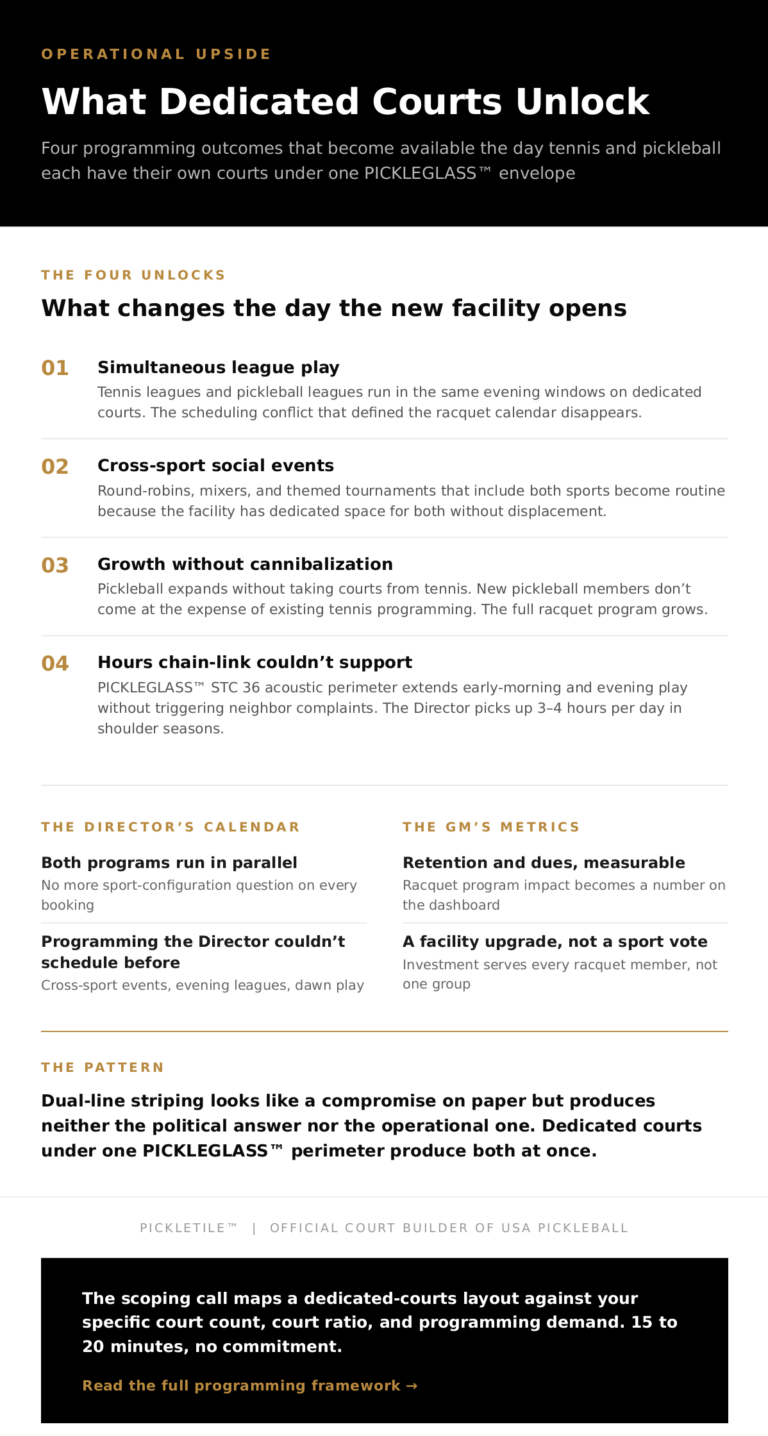
Simultaneous league play. Tennis leagues and pickleball leagues run at the same time, on different courts, without conflict. This effectively doubles the programming capacity during peak evening hours. The Director runs both programs without compromise. The GM sees member participation and dues retention move in the right direction.
Cross-sport social events. Round-robins, mixers, and themed tournaments that include both sports become possible because the facility has space for both without displacement. The events the Director has wanted to run but could not schedule become routine.
Growth without cannibalization. When pickleball programming expands, it does not take courts away from tennis. New members attracted by pickleball programming do not come at the expense of existing tennis programming. The total racquets program grows. The board notices.
Programming for hours the chain-link facility could never support. With integrated PICKLEGLASS acoustic performance from the perimeter enclosure, early-morning leagues and evening play become possible without triggering neighbor complaints. The Director picks up three to four additional programming hours per day in shoulder seasons. The GM avoids the complaint cycle that has restricted hours at clubs across the country.
The pattern
The clubs working through the tennis-pickleball question successfully are not finding clever ways to satisfy two opposed groups. They are designing the facility so the two groups are not opposed in the first place. The Director gets a facility that runs cleanly. The GM gets a project the board can approve and the membership can rally around. The political tension was never the real problem. It was a symptom of a design that asked one set of courts to serve two different sports.
When the courts stop having to do that, the tension stops being a problem.
If you and your counterpart want to walk through what a dedicated-courts design would actually look like at your club, the scoping conversation covers layout, court count, enclosure options, and programming capacity for your specific site. Takes about 20 minutes. Happy to set it up whenever works.
About PICKLETILE™
PICKLETILE™ is the leading design-build firm for premium pickleball court construction and the Official Court Builder of USA Pickleball.
Headquartered in Austin, Texas, PICKLETILE™ simplifies the complex construction process by offering turnkey solutions for residential, commercial, and club-level projects. The company is also the creator of PICKLEGLASS™, a patented soundproof glass wall system engineered to reduce noise by 50% while offering panoramic views and wind protection. For more information, visit www.pickletile.com.
