
How court projects are typically delivered, and why the traditional approach creates problems that are easy to avoid.
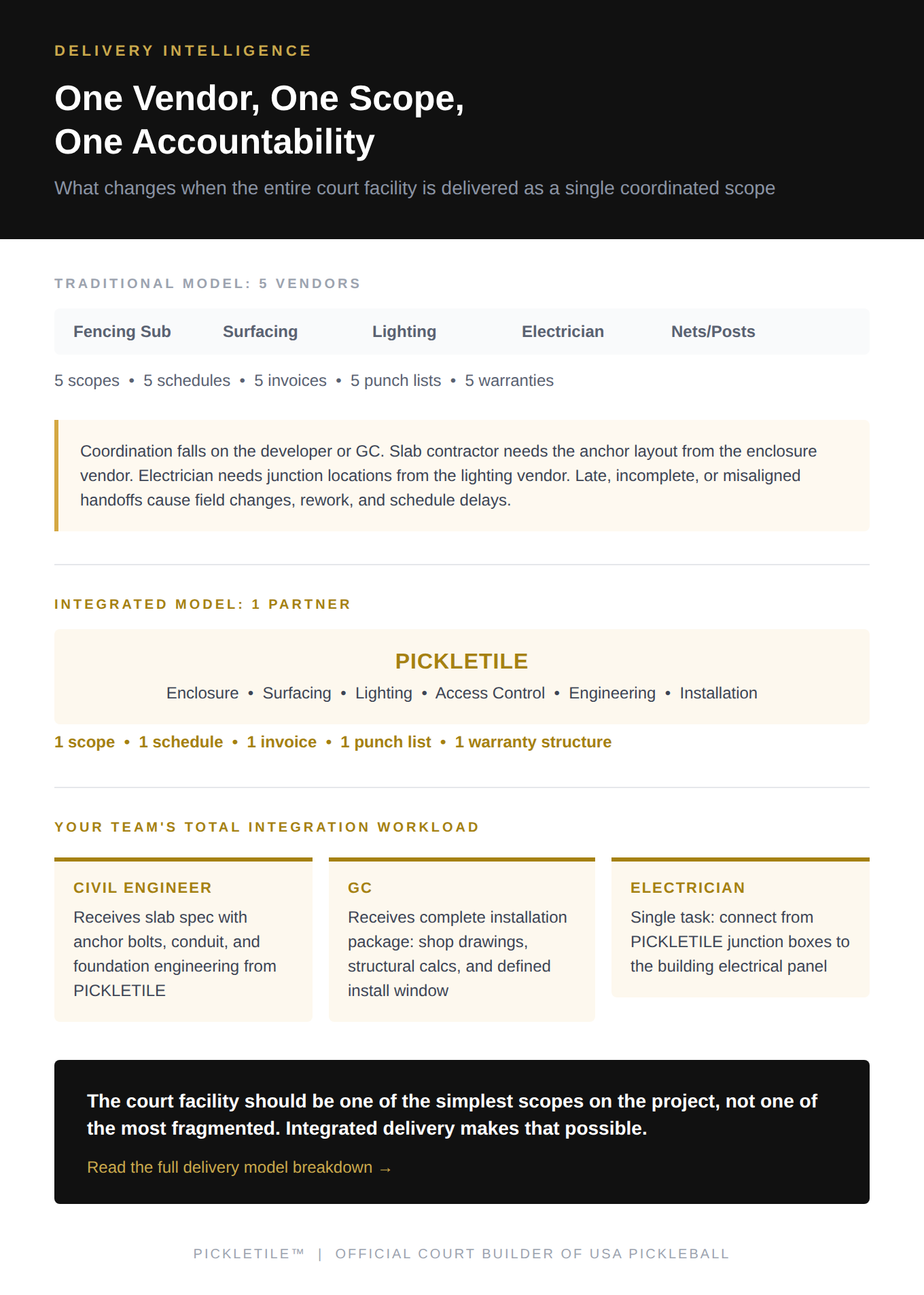
AUSTIN, Texas – Apr. 9, 2026 – Most court construction projects are assembled the same way they’ve been assembled for decades: the developer or GC hires a fencing sub for the perimeter, a surfacing contractor for the playing surface, a lighting company for the fixtures, an electrician for the wiring, and a supplier for the nets and posts. Five scopes, five vendors, five schedules, five invoices, five punch lists.
This fragmented model works well enough for commodity construction, where the perimeter is chain-link, the surface is basic acrylic, and the lighting is standalone poles on separate foundations. Each vendor does their piece and moves on.
It breaks down when the facility needs to be more than commodity construction.
Where the coordination problems start:
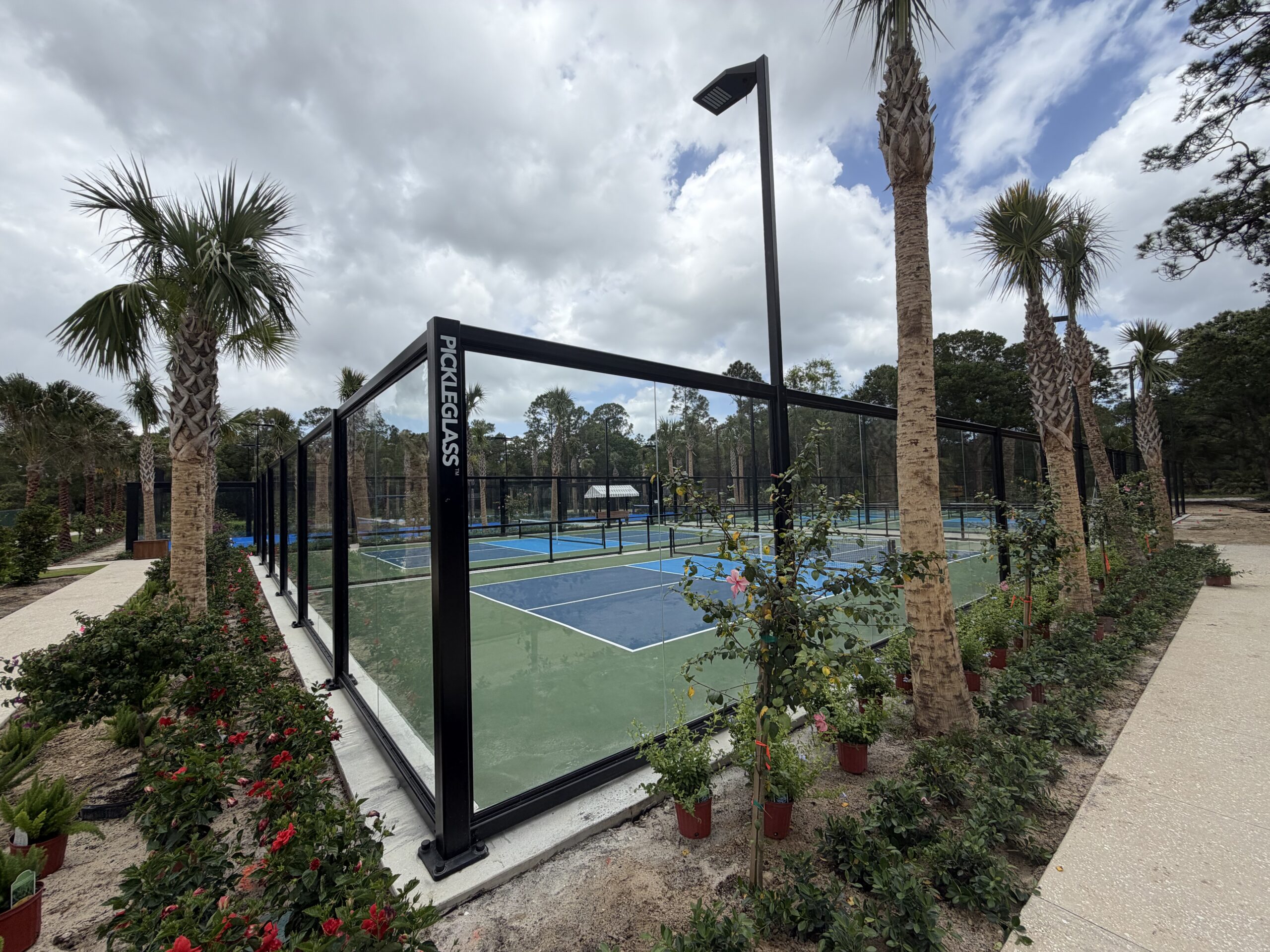
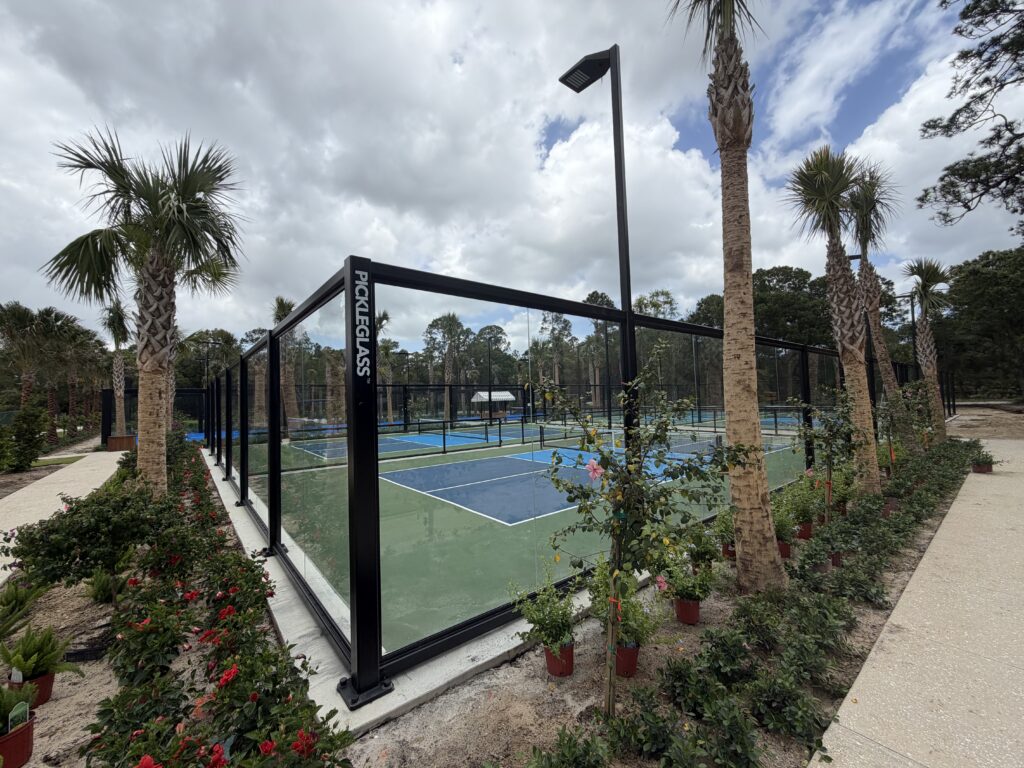
When an enclosure system involves structural engineering (steel posts anchored into a specifically designed foundation, glass panels joined for acoustic continuity, lighting integrated into the structural frame, electrical conduit routed through the slab to junction boxes at each post) the individual components need to work together as a system. That requires coordination between the structural design, the slab specification, the electrical routing, the enclosure installation, and the finish work.
In a multi-vendor model, that coordination falls on the developer or the GC. The slab contractor needs the anchor bolt layout from the enclosure vendor. The electrician needs the junction box locations from the lighting vendor. The fencing sub needs the enclosure engineer’s specifications. If any of these handoffs are late, incomplete, or misaligned, the result is field changes, rework, schedule delays, and finger-pointing between vendors about whose scope caused the problem.
For a PM managing 20+ subcontractor relationships on a development, adding 5 more coordination dependencies for the court scope is the last thing they need.
What integrated delivery changes:
When one partner handles the entire court facility (enclosure, surfacing, lighting, access control, engineering, and installation) the coordination dependencies disappear. The slab spec, anchor bolt layout, conduit routing, enclosure engineering, and lighting design are all produced by the same team, from the same set of drawings, built to work together. There’s no handoff between vendors because there’s only one vendor.
For the developer, this means one scope to approve, one schedule to track, one invoice structure, and one point of accountability if anything needs to be addressed. For the GC, it means one sub-scope that arrives on-site as a coordinated package with clear documentation, not five separate trades that need to be sequenced and managed.
What this means in practice:
The slab specification, including anchor bolt locations, conduit routing, and foundation engineering, is produced by PICKLETILE’s engineering team and delivered directly to the developer’s civil engineer. The GC receives a complete installation package: shop drawings, structural calculations, site access requirements, and a defined installation window. The electrician’s scope is reduced to a single task: connecting from PICKLETILE’s junction boxes to the building’s electrical panel.
One coordination handoff to the civil engineer. One coordination handoff to the GC. One junction box connection for the electrician. That’s the entire integration workload for the developer’s team.
The comparison:
Five vendors means five schedules to align, five scopes to manage, five potential sources of delay, and five separate warranties with five different coverage terms and five different claims processes.
One partner means one schedule, one scope, one warranty structure, and one phone number to call if anything needs attention.
For developers managing complex projects with dozens of competing priorities, the court facility should be one of the simplest scopes on the project, not one of the most fragmented.
This is the delivery model we’d walk through on a scoping call: how the entire court facility is designed, engineered, and installed as a single coordinated scope. If you’d like to see how it applies to your project, contact us today.
About PICKLETILE™
PICKLETILE™ is the leading design-build firm for premium pickleball court construction and the Official Court Builder of USA Pickleball.
Headquartered in Austin, Texas, PICKLETILE™ simplifies the complex construction process by offering turnkey solutions for residential, commercial, and club-level projects. The company is also the creator of PICKLEGLASS™, a patented soundproof glass wall system engineered to reduce noise by 50% while offering panoramic views and wind protection. For more information, visit www.pickletile.com.
