
It’s the issue that causes more post-occupancy amenity problems than any other, and it’s entirely preventable with the right planning.
AUSTIN, Texas – Apr. 8, 2026 – Pickleball generates a distinctive sound. Unlike most recreational activities, the ball-on-paddle impact creates a sharp, high-frequency percussive noise that carries farther and is perceived as more irritating than its decibel level would suggest. It’s not dangerously loud, but it’s the kind of sound that residents notice through closed windows, on balconies, and in outdoor common areas adjacent to the courts.
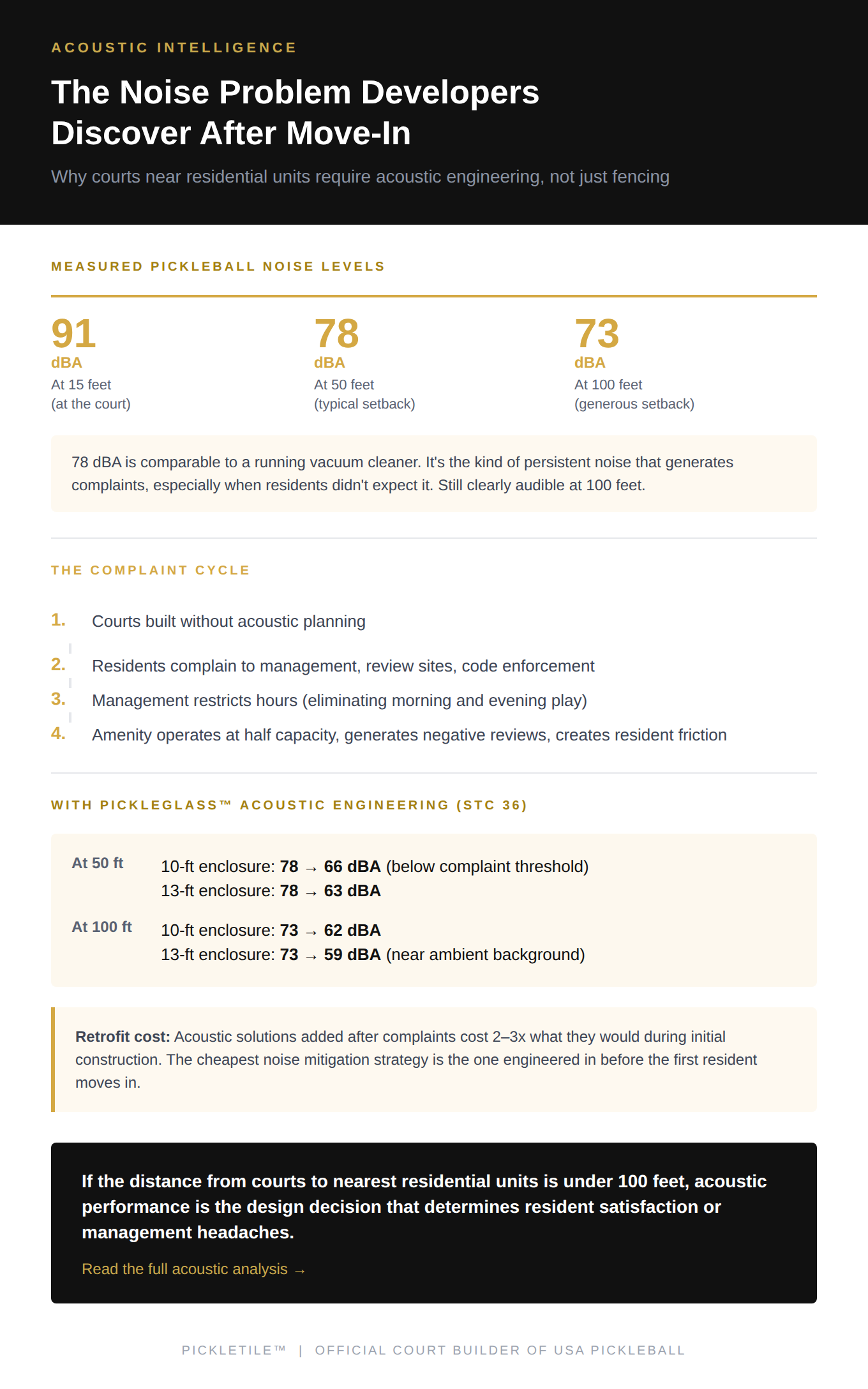
The numbers:
Measured pickleball activity generates approximately 91 dBA at 15 feet from the court. At 50 feet (a typical distance from a court to the nearest residential unit in a multifamily development) an unshielded court produces approximately 78 dBA. For context, 78 dBA is louder than normal conversation (60 dBA) and comparable to a running vacuum cleaner. It’s the kind of persistent noise that generates complaints, especially when residents didn’t expect it.
At 100 feet (a more generous setback) the noise drops to approximately 73 dBA without any barrier. Still clearly audible. Still the kind of sound that prompts residents to contact property management.
What happens next: the complaint cycle.
The pattern is well-documented across multifamily and community developments:
Courts are built without acoustic planning. Residents move in. Within the first few months, residents whose units face the courts begin complaining to property management, on review sites, and sometimes to local code enforcement. Property management responds by restricting court hours, typically eliminating early morning and evening play, which are exactly the hours working adults are available. The amenity that was supposed to attract and retain residents is now operating at half capacity, generating negative reviews, and creating friction between residents who play and residents who don’t.
The restricted-hours scenario is the best case. The worst case: the noise issue generates enough complaints to trigger a formal code review, and the courts face operational limits that effectively make them unusable during the hours residents actually want to play.
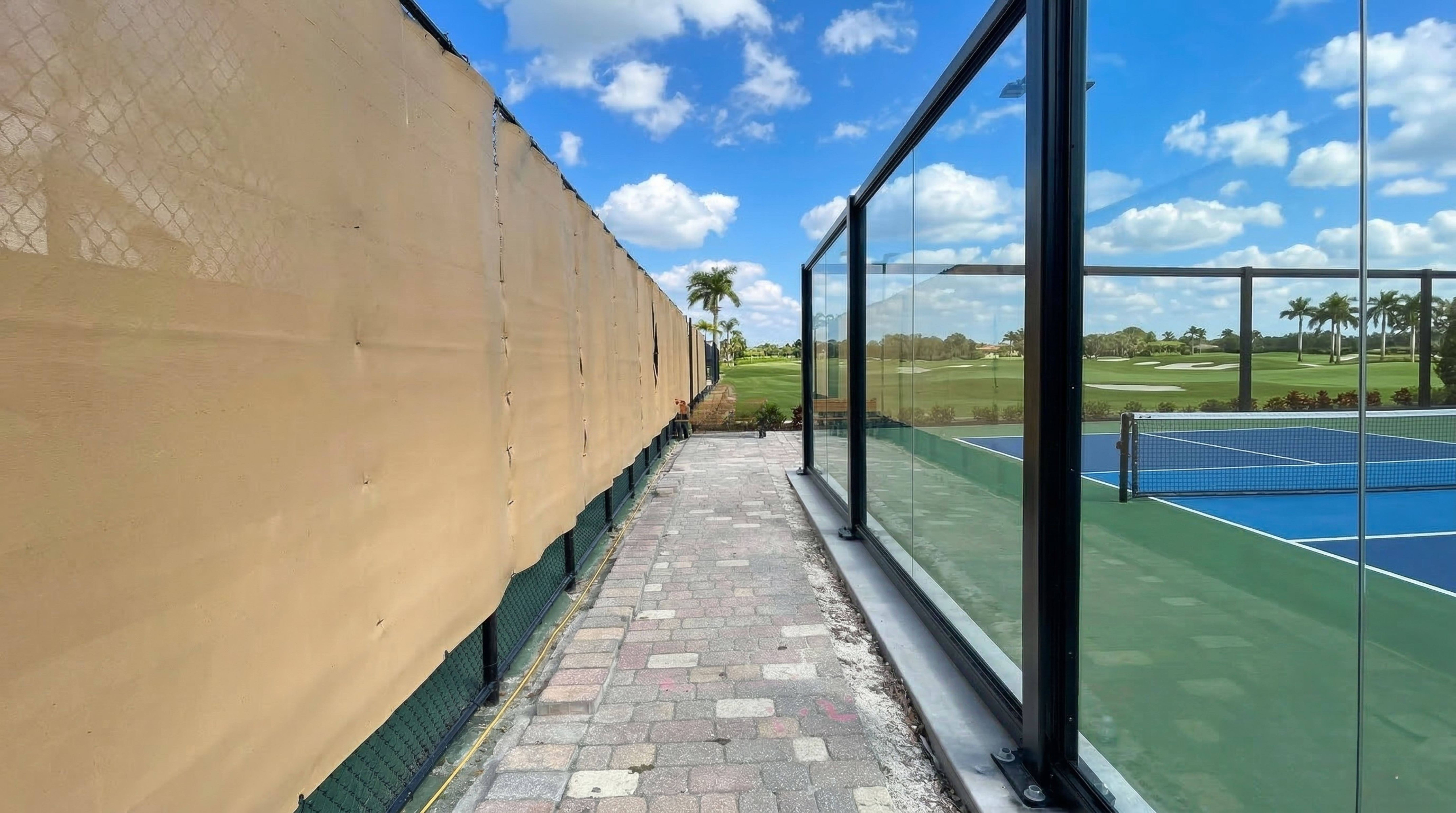
How acoustic engineering prevents this:
A structural glass enclosure with an STC (Sound Transmission Class) rating of 36 reduces perceived noise by up to 50%. In practical terms:
At 50 feet, a 10-foot glass enclosure reduces the sound level from 78 dBA to approximately 66 dBA, below the threshold that triggers complaints in most residential settings. A 13-foot enclosure reduces it further to approximately 63 dBA.
At 100 feet, a 10-foot enclosure brings the level down to approximately 62 dBA. A 13-foot enclosure brings it to 59 dBA, approaching background ambient noise in most suburban environments.
The difference between 78 dBA and 66 dBA doesn’t sound like much on paper. But because decibels are logarithmic, a 10+ dBA reduction is perceived as more than half as loud. It’s the difference between a clearly audible nuisance and a barely noticeable background sound.
The cost comparison that matters:
Acoustic engineering during initial construction is part of the design and enclosure scope. It’s built into the project from the start. Retrofitting acoustic solutions after complaints arise is a different story: it requires new foundation work, structural installation on a completed site, construction disruption to occupied residents, and a cost that’s typically 2 to 3x what it would have been during initial construction.
The cheapest noise mitigation strategy is the one that’s engineered into the facility before the first resident moves in.
The planning question for your project:
Where are the courts positioned relative to your nearest residential units? If the distance is under 100 feet (which it is on most multifamily sites) the acoustic performance of the enclosure system isn’t optional. It’s the design decision that determines whether the amenity generates resident satisfaction or management headaches.
This is something we cover in detail on the scoping call: how your specific site layout affects the acoustic requirements and what the right enclosure specification looks like for your project. If you’d like to walk through it for your facility, contact is today.
About PICKLETILE™
PICKLETILE™ is the leading design-build firm for premium pickleball court construction and the Official Court Builder of USA Pickleball.
Headquartered in Austin, Texas, PICKLETILE™ simplifies the complex construction process by offering turnkey solutions for residential, commercial, and club-level projects. The company is also the creator of PICKLEGLASS™, a patented soundproof glass wall system engineered to reduce noise by 50% while offering panoramic views and wind protection. For more information, visit www.pickletile.com.
