
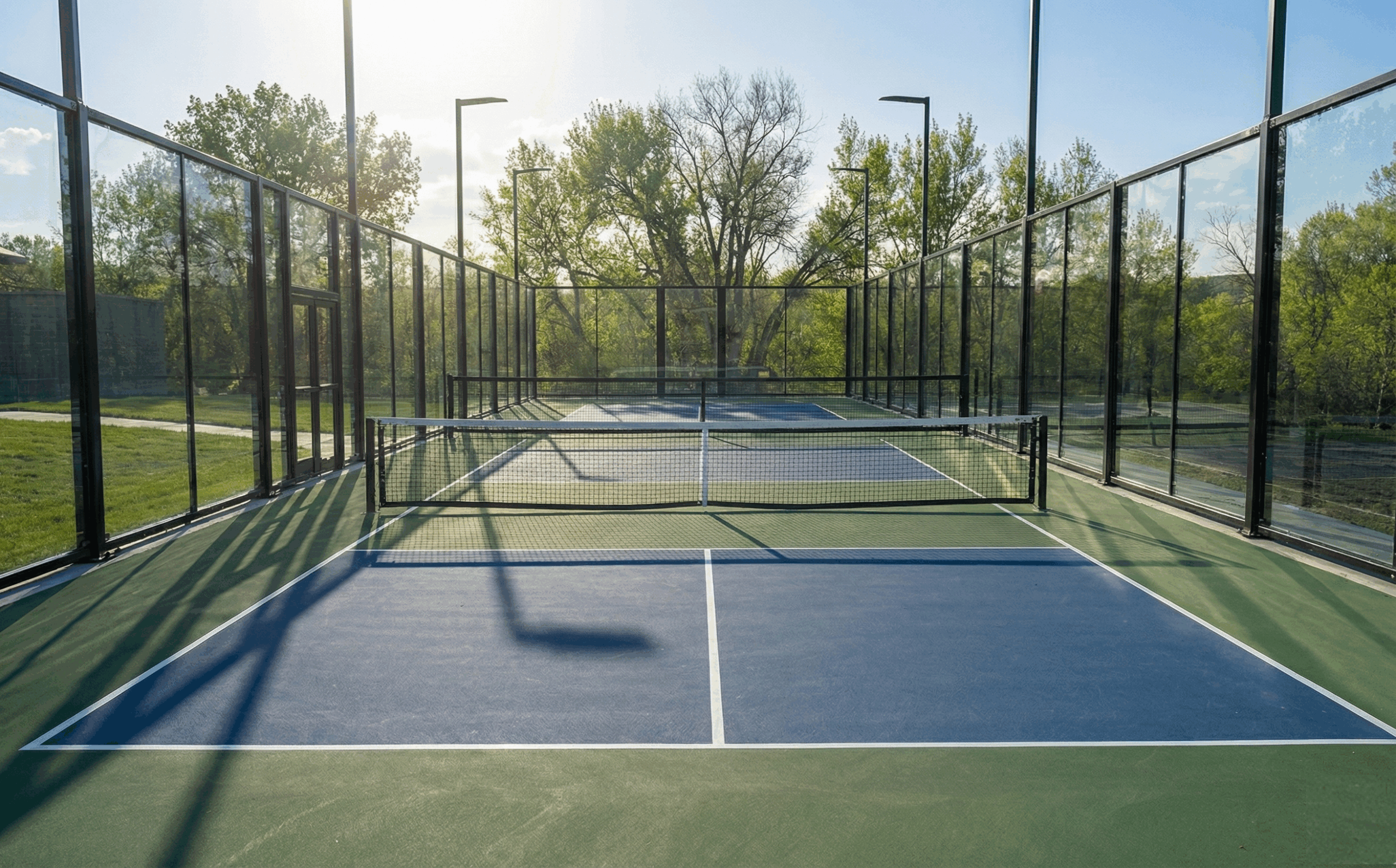
A 10-point framework for comparing court bids honestly — what each “no” on the checklist actually costs the club.
AUSTIN, Texas – May 4, 2026 – If your club is evaluating a court project, you’re probably holding more than one bid. That’s good practice. But comparing bids for court facilities is unusually difficult, because the scope of what’s included varies dramatically between vendors, and the differences aren’t always visible on the surface.
A bid from a local fencing contractor and a bid from an integrated design-build firm may both say “4-court pickleball facility,” but the scope behind those words can describe two fundamentally different projects. One might include everything from foundation construction through turnkey installation, with engineering, acoustic performance, and a multi-year warranty package. The other might include only a chain-link fence, with the rest of the work — and the rest of the cost — left to the club to source and coordinate separately.
This creates a real problem for both sides of the project team. The President or GM is comparing total bid amounts and may see a significant price gap that looks like one vendor is dramatically more expensive. The Director of Racquets is comparing what each facility will actually be like to operate, and may see that the “cheaper” bid produces a facility that’s harder to maintain, harder to schedule around, and harder to live with.
Here’s a framework for making the comparison honest, with both perspectives in mind.
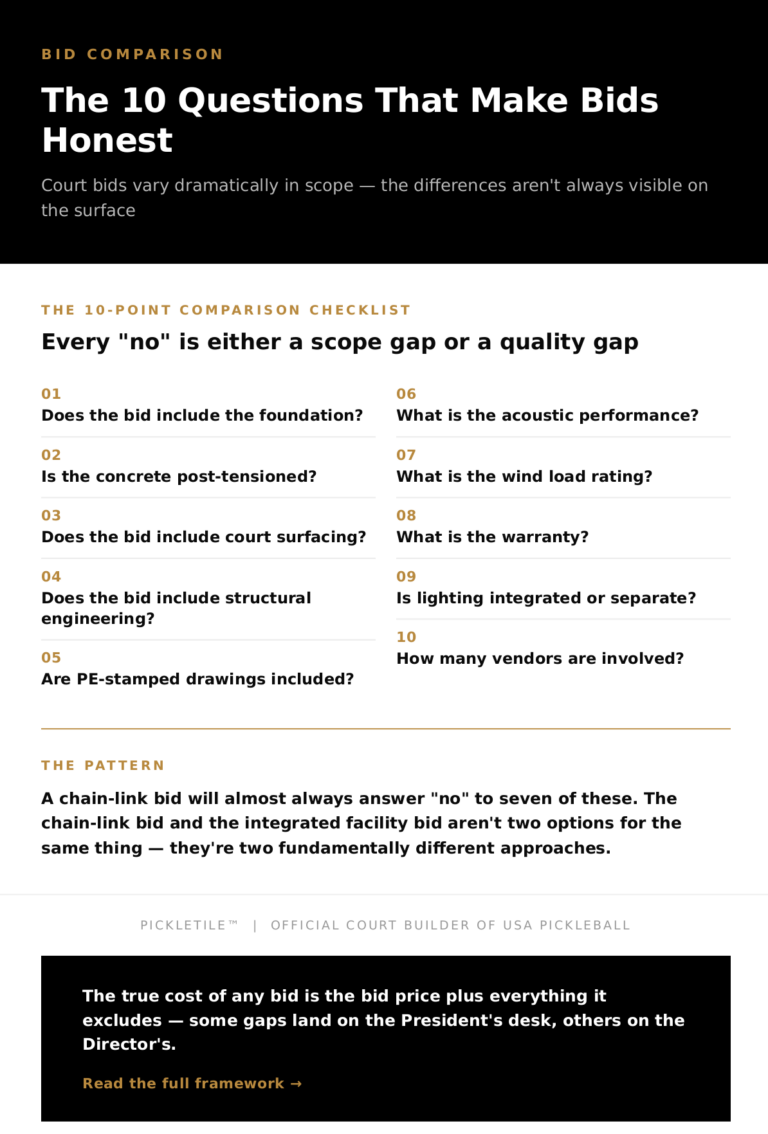
The 10-point comparison checklist
When evaluating any court bid against any other, these are the ten questions to ask. Every “no” represents either a scope gap (something the club has to source separately, at additional cost) or a quality gap (something that affects the facility’s performance and longevity). Both create real consequences — they just show up in different places on the club’s books.
1. Does the bid include the foundation?
Some bids include complete slab construction: site prep, post-tensioned concrete, embedded anchor bolts and conduit, and curing. Others assume the club provides a finished slab, which means hiring a separate concrete contractor and managing that coordination.
For the President or GM, the question is what the foundation actually costs once it’s added back into the comparison. A bid without the foundation is incomplete, not cheaper. The separate concrete bid often comes in lower than expected because the contractor doesn’t understand the specialty specification (post-tensioned slab with embedded anchor bolts and conduit isn’t standard flatwork), and the gap shows up as change orders later. For the Director, a slab built by a contractor unfamiliar with court specifications is the foundation of every operational headache the facility will produce — surface issues that affect play, drainage problems, and slab cracks that propagate into the playing surface.
2. Is the concrete post-tensioned?
Standard reinforced concrete slabs crack over time. Post-tensioned slabs use steel cables tensioned after curing to compress the concrete, preventing the cracking pattern that develops in standard slabs within 3 to 5 years in most climates.
The financial impact lives in the resurfacing cycle. A cracking slab requires more frequent resurfacing, and the cracks eventually migrate through the surface even after a fresh coat. Over a 10-year hold, the difference between a post-tensioned slab and a standard one is multiple resurfacing events the club doesn’t have to pay for. The operational impact lives with the Director: cracking surfaces affect ball bounce, create uneven footing, and generate the kind of “the courts aren’t right” feedback from members that doesn’t go away until the slab is replaced. Both perspectives point at the same answer.
3. Does the bid include court surfacing?
Some enclosure bids don’t include the playing surface at all. That’s a separate scope from a separate contractor. If surfacing is included, is it a professional-grade multi-layer acrylic system or a single-coat application?
For the President, surfacing that isn’t included is another line item that needs to be added back into the bid total before any honest comparison can happen. The cost difference between a multi-layer professional system and a budget single-coat is modest at the project level. For the Director, the difference is large at the daily level. A multi-layer system holds up under heavy programming use, maintains consistent ball bounce and footing across the surface, and resurfaces cleanly when the time comes. A single-coat application looks acceptable for the first season, then deteriorates faster than members at a private club will tolerate. The Director is the one who hears about it.
4. Does the bid include structural engineering?
For chain-link, structural engineering typically isn’t required. For any structural glass or heavy enclosure system, it is — wind load calculations, steel sizing, connection design, foundation load analysis. If the bid doesn’t include engineering, the club has to hire a structural engineer separately, which adds cost ($5,000 to $15,000 depending on complexity) and creates a coordination dependency between the engineer and the enclosure vendor.
This is primarily a President or GM question. Structural engineering is what produces the documents the club needs for permits and what creates a defensible position if any structural question ever arises during the life of the asset. A chain-link installation without engineering doesn’t create the same documentation trail. From the board’s perspective, the engineering package is part of what the club is buying when it builds a structural facility, and a bid that excludes it is selling something less than a complete facility.
5. Are PE-stamped drawings included or available?
Most jurisdictions require PE-stamped structural drawings for glass enclosures. If the bid doesn’t include them, the club needs to source them separately at additional cost (typically $3,500+). If the vendor can’t provide them at all, that’s a question about the vendor’s engineering capability and whether their system can meet code.
This is the President’s question, and it’s mostly a permit and risk consideration rather than an operational one. The cost should be added to any bid that doesn’t include the stamps. A vendor that can’t produce them is a vendor whose system may not pass plan review.
6. What is the acoustic performance?
Chain-link has an STC rating of 0. It provides no sound reduction. For most private clubs — especially those with residential properties nearby, member residences on the property, or houses adjacent to the club — that’s the wrong starting point.
The President’s view is risk-based: noise complaints from members or neighbors are documented across the industry, they tend to escalate to the board, and they’re expensive to retrofit. A bid that includes verified acoustic performance backed by third-party testing data prices in that protection. A bid with no acoustic specification (or with marketing claims like “reduces noise” that aren’t backed by an STC number) leaves the club exposed to a problem the board will hear about. The Director’s view is operational: noise complaints lead directly to restricted playing hours, which means the prime member-availability windows — early morning and evening — get cut from the programming calendar. A facility with restricted hours is a facility that delivers a fraction of the member engagement it was designed for.
7. What is the wind load rating?
Any structural enclosure should be engineered for the wind environment at the specific project site. The bid should reference ASCE 7-16 and specify a wind load rating appropriate for the location. A bid that doesn’t reference wind load engineering may not be structurally adequate for the environment.
This is mostly a President or GM concern. The wind load specification is a safety, liability, and permitting consideration. An enclosure rated for the site’s specific wind environment has a documented engineering basis. An enclosure with no wind rating is an unknown — and if the system fails during a major wind event, the liability and replacement costs land on the club.
8. What is the warranty?
Chain-link typically carries a 1-year workmanship warranty with no material performance warranty. Vinyl coating degradation, rust, and fabric wear are considered normal. Structural glass systems should carry multi-year warranties: 10 years on steel corrosion, 5 years on lighting, 3 years on material defects.
The financial implication for the President is direct. A 10-year corrosion warranty means no structural maintenance or replacement costs during the first decade of ownership. A 1-year warranty means the club absorbs all maintenance costs from year 2 onward. Over a 10-year hold, that difference is a substantial operating expense line. The operational implication for the Director is just as direct. The Director is the one who deals with rusting fence sections, deteriorating windscreens, and equipment that fails outside warranty. A facility with comprehensive multi-year coverage is a facility the racquets staff can run without absorbing recurring maintenance into their routine. A facility with a 1-year warranty is the opposite.
9. Is lighting integrated or separate?
If lighting is included, the question is whether it’s integrated into the enclosure frame (conduit through the slab, fixtures on the steel structure) or a separate scope with standalone poles requiring their own foundations and electrical runs.
The cost case for integrated lighting is clear: it’s less expensive overall because the conduit, mounting, and fixtures are designed as part of a single system. Standalone light poles require separate foundations, separate electrical work, and a separate vendor. The total cost of separate lighting (including the additional foundations and coordination) should be added to any bid that doesn’t include integrated lighting before any honest comparison.
The Director’s view points at the same answer for different reasons. Standalone light poles look like utility infrastructure, generate visual clutter on aerial photos and member tours, and create scheduling fragmentation when fixtures or controls fail. Integrated lighting on the enclosure frame produces a cleaner facility, supports evening programming reliably, and consolidates accountability with the enclosure vendor. The aesthetic and operational differences both matter at a private club.
10. How many vendors are involved?
Is the bid from one partner handling the complete scope (foundation, surfacing, enclosure, lighting, installation)? Or does the bid cover only one piece, with the rest requiring separate contractors?
Every additional vendor represents a separate contract, a separate invoice, a separate warranty, and a separate boundary of accountability. The President sees this in the procurement and contracting overhead — five contracts instead of one, five payment schedules, and a vendor-management burden that doesn’t appear on any single bid but is real. If something goes wrong at the interface between two scopes (where most problems occur), the club is the one determining which vendor is responsible.
The Director sees the same fragmentation in operations. A facility built by five vendors has five warranty contacts, five service relationships, and five sets of installation conventions to remember when something breaks. A facility built by one vendor has one phone call. The day-to-day difference shows up over years of operation, not just during the build.
How to use the checklist
Create a simple comparison grid with each bid as a column and the 10 questions as rows. Mark yes, no, or partial for each. When the answers are visible side by side, two things become obvious.
First, the scope differences. A bid that’s 40% lower but answers “no” to six of the questions isn’t actually comparable to a bid that answers “yes” to all ten. The price gap reflects the scope gap, not a margin gap.
Second, who absorbs the gaps. Some are financial — the club pays for separately-contracted engineering, separately-contracted concrete, separately-contracted lighting. Those costs land on the President’s desk. Others are operational — the Director inherits multi-vendor warranty disputes, ongoing maintenance from a 1-year warranty, programming restrictions from poor acoustic performance. Those costs land on the Director’s desk. The true cost of any bid is the bid price plus everything it excludes, allocated across both sides of the team.
A note on chain-link comparisons specifically
If one of the bids on your desk is from a chain-link fencing contractor, it will almost certainly be the lowest number. It will also almost certainly answer “no” to questions 2, 4, 5, 6, 7, 9, and 10 — that’s seven scope gaps the club has to address either by hiring additional vendors (adding cost) or by accepting that the facility won’t have those capabilities (accepting lower performance and higher long-term maintenance).
For the President, the chain-link bid means the project still needs separate contractors for engineering, the foundation may not be specified correctly for what eventually replaces the chain-link, the warranty is one year on workmanship only, and the facility’s documentation trail is essentially nonexistent. For the Director, the chain-link facility means ongoing maintenance from year one, no acoustic protection (with the restricted hours that follow when residential complaints start), no integrated lighting, and a facility that photographs as utility infrastructure in every member-facing image the club produces.
The chain-link bid and the integrated facility bid aren’t two options for the same thing. They’re two fundamentally different approaches to the court project, with different cost profiles for the President and different operational profiles for the Director. The comparison should reflect that.
If your team is working through a bid comparison and wants help evaluating what’s included and what’s missing across the proposals on the table, happy to walk through it on a call with both your President or GM and your Director of Racquets. Not to advocate for our bid over someone else’s, but to make sure the comparison is based on equivalent scope so the board is making an informed decision and both sides of your team know what they’d be inheriting.
About PICKLETILE™
PICKLETILE™ is the leading design-build firm for premium pickleball court construction and the Official Court Builder of USA Pickleball.
Headquartered in Austin, Texas, PICKLETILE™ simplifies the complex construction process by offering turnkey solutions for residential, commercial, and club-level projects. The company is also the creator of PICKLEGLASS™, a patented soundproof glass wall system engineered to reduce noise by 50% while offering panoramic views and wind protection. For more information, visit www.pickletile.com.
