
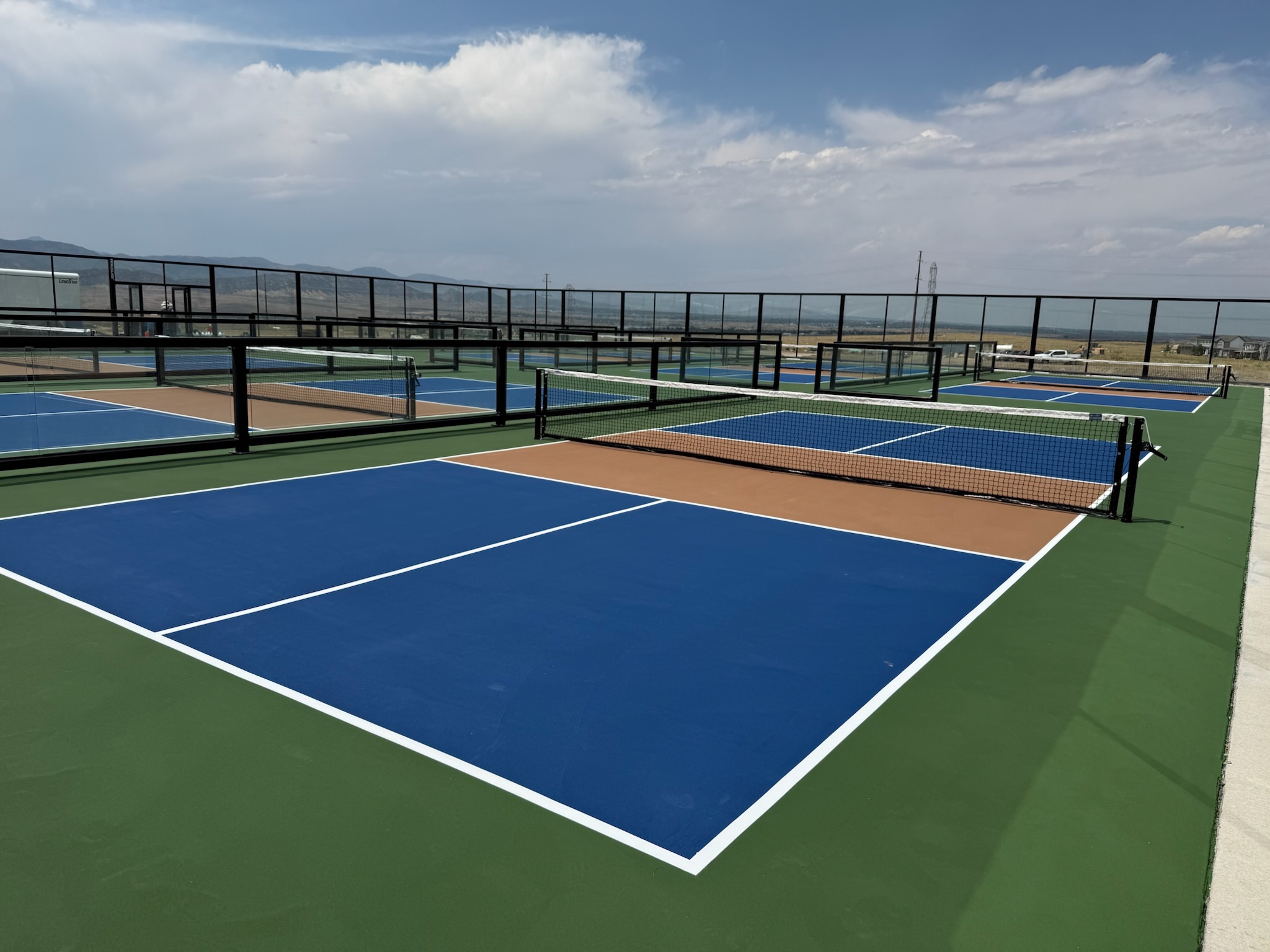
The clubs that successfully advance a court project to board approval share three things: unified framing, a specific programming commitment, and a concrete scope.
AUSTIN, Texas – May 18, 2026 – At every club that successfully upgrades its racquet facility, someone is carrying the project internally. At some clubs, that person is the Director of Racquets, advocating up to the GM and the board because they see the member demand and the facility’s limitations every day. At other clubs, that person is the GM, who has decided the racquet facility is the next strategic priority and is making the case to the board. At many clubs, the Director and the GM are carrying the project together.
Whoever is championing the project, the playbook is the same. The challenge is not awareness of the need. It is moving the project from “we should do something” to a specific decision the board can approve.
Directors and GMs who successfully get court projects approved at their clubs share a common approach. It is different from what most people try first.
What does not work: leading with the problem
The natural instinct is to bring the problem forward. The courts are aging. Members are complaining. Pickleball demand is unmet. The chain-link is rusting. All true. But framing the conversation around problems puts the decision-maker (the GM, the board) in a reactive position. They are being asked to fix something, not invest in something.
Fixing problems competes for the same budget as every other maintenance and repair item at the club. The new chairs for the dining room are also fixing a problem. So is the parking lot resurfacing. So is the pool pump. When the racquet facility is framed as a problem to be fixed, it sits in the same budget queue as everything else that is wearing out, and it loses on size and visibility.
What works: leading with the opportunity
The champions who get projects approved frame the conversation differently. They present the court project as a strategic investment in the club’s racquet program and member experience, comparable in scope and impact to other major amenity investments the club has made.
The framing shift: “Our courts need work” becomes “Here is what an upgraded racquet facility does for our members, our programming, and our competitive position.” That is no longer a maintenance line item. It is a strategic decision the board can rally around.
The four pillars of the case
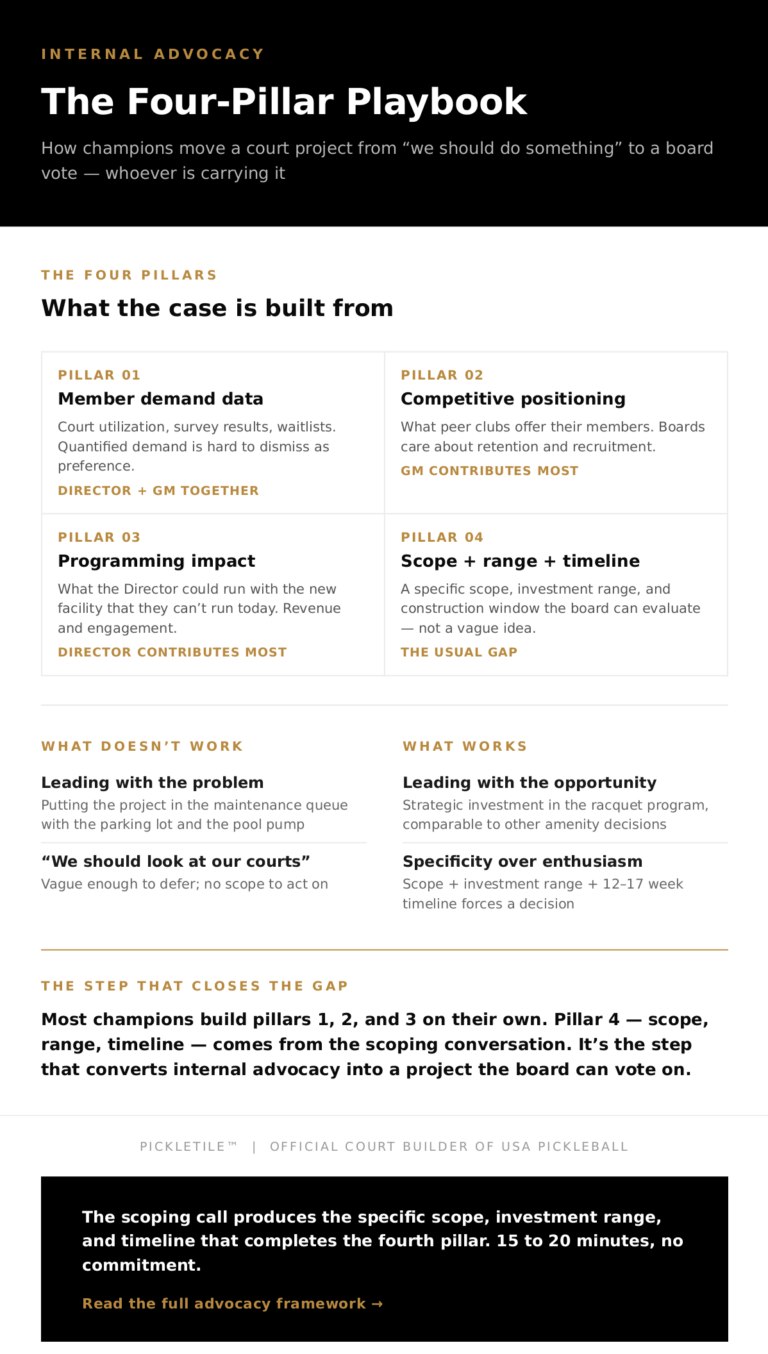
Champions who have been through this successfully build their case around four elements. The pillars work whether the champion is the Director making the case to the GM, the GM making the case to the board, or both making the case together.
Member demand data. Concrete evidence that members want this. Court utilization data showing consistently full schedules. Member survey results (even informal ones) showing demand for pickleball, evening play, or better facilities. Waitlist data for programs, leagues, and events. The more quantified the demand, the harder it is to dismiss as a Director’s preference or a GM’s preference. This pillar is usually strongest when the Director and GM build it together: the Director has the operational data, the GM has the membership and survey data, and the case lands harder when both perspectives reinforce each other.
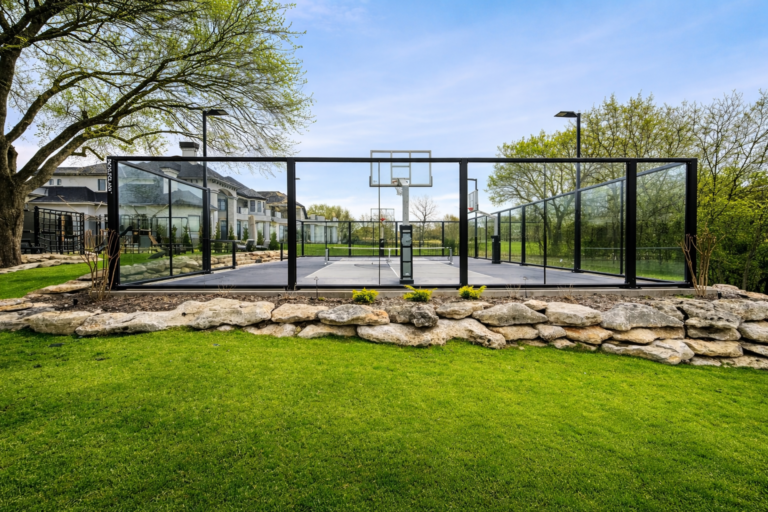
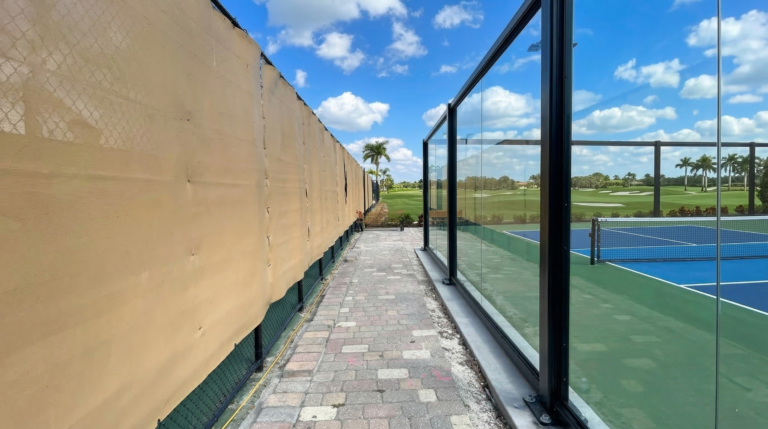
Competitive positioning. What peer clubs and competitor clubs are offering their members. If clubs in the same market have upgraded their racquet facilities to glass enclosures and integrated lighting, and the club in question still has chain-link from fifteen years ago, that is a competitive gap members notice and talk about. Boards care about competitive positioning because it directly affects membership retention and recruitment. This pillar is often where the GM contributes the most: market intelligence, peer benchmarking, member retention data, and recruitment conversations with prospective members.
Programming impact. What the Director could do with the new facility that they cannot do with the current one. More simultaneous programs. Evening programming. Tournament hosting. Revenue-generating court reservations. Social events that combine tennis and pickleball memberships. When the board sees a specific programming plan attached to the facility investment, the project stops feeling like a construction expense and starts feeling like a revenue and engagement opportunity. This pillar is the Director’s contribution: only the person running the programs can articulate what becomes possible.
A clear scope and investment range. The GM and board need something specific to evaluate. “We should look at our courts” gets deferred. “Here is a scope for X dedicated pickleball courts with a glass enclosure, integrated lighting, and professional surfacing, with an investment range of [X] and a construction timeline of 12 to 17 weeks” gets discussed. Specificity forces a decision. Vagueness allows deferral. This pillar is the most common gap in internal advocacy, and it is the easiest one to close.
Where champions usually get stuck
Most champions, Director or GM, can articulate three of the four pillars on their own. Member demand. Competitive positioning. Programming impact. They have the operational and strategic context to make those cases.
Where they get stuck is on the fourth pillar. Scope. Investment range. Construction timeline. They know what the club needs. They do not yet have the specifics of what it includes, what it costs, and how long it takes.
Those specifics come from the scoping conversation. That is the step that transforms internal advocacy from “I think we should do something” into “I have talked to the Official Court Builder of USA Pickleball, and here is the specific scope, investment range, and timeline for our club.”
The champion who walks into the next conversation (GM with the board, Director with the GM, both with the board together) with that level of specificity gets a very different reaction than the champion who walks in with a general request.
The timing question
The right time to have the scoping conversation is not when the project is ready to build. It is when the internal case is being built. The scope, investment range, and timeline from the scoping conversation become the assets the champion uses to move the project forward inside the club. Without them, the advocacy is enthusiasm. With them, it is a plan.
For the Director, the scoping conversation is the moment of converting their operational knowledge of what the club needs into a specific proposal the GM can take seriously. For the GM, it is the moment of converting their strategic instinct that the racquet program is the next priority into a specific case the board can approve. The same conversation serves both paths.
If the internal case is being built at your club and you would like the specific scope, investment range, and timeline to take to the next conversation, the scoping conversation is the next step. Takes about 20 minutes and gives you a complete picture you can present with confidence. Happy to set it up whenever you are ready.
About PICKLETILE™
PICKLETILE™ is the leading design-build firm for premium pickleball court construction and the Official Court Builder of USA Pickleball.
Headquartered in Austin, Texas, PICKLETILE™ simplifies the complex construction process by offering turnkey solutions for residential, commercial, and club-level projects. The company is also the creator of PICKLEGLASS™, a patented soundproof glass wall system engineered to reduce noise by 50% while offering panoramic views and wind protection. For more information, visit www.pickletile.com.
